
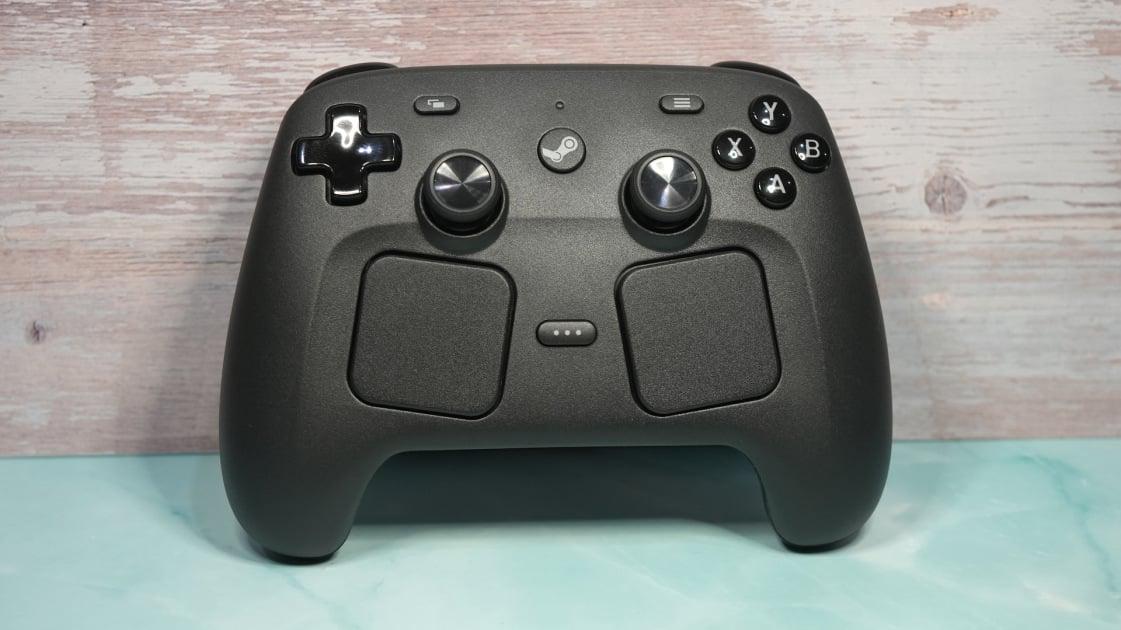
As you probably know this gamepad don't have a normal drivers for Windows/Linux/Mac but instead you need to use Steam app. PC Mag tried to use this controller with Game Pass games and it just didn't work
During testing, the biggest problem I encountered was the Xbox app, the home of Xbox Game Pass on PC. I couldn't add game binaries installed through Xbox on my Windows 11 test PC; the Xbox app said I didn't have permission, even as an administrator. Windows 11 locks down the Xbox app and any games installed through it on a system level, so Steam can't register them. That means no Xbox Game Pass games will work with the Steam Controller, so if you want to play, say, the upcoming Forza Horizon 6, you must buy it through Steam
Of course, this problem could be solved by the community in the future. The previous Steam Controller had the same issues and people found workarounds. For example, there was an app GlosSI that created a special invisible fullscreen layer above the game to capture controller input and translate it into standard Xbox 360 XInput. On linux developers used reverse engineering to hack Steam and create community drivers. So we can assume it’s only a matter of time until someone finds a way to jailbreak the Steam Controller and make it usable without Steam. It’s inevitable.
In fact, now it might be even easier than in 2015, because in 2025 Microsoft released the new GameInput API to replace older XInput. This new API natively supports gamepads with touchpads and gyro, so the community could map all Steam Controller features directly to the native Windows API.
GameInput exposes input from keyboards, mice, gamepads and other game controllers through a single unified input model, synchronized to a common time base
…
GameInput is a functional superset of all legacy input APIs: XInput, DirectInput, Raw Input, Human Interface Device (HID) and WinRT APIs. In addition to adding new features of its own. GameInput's functionality ranges from simple fixed-format gamepad state to detailed low-level raw device access. You can obtain input via polling or callbacks in an event-driven way. Haptics, sensors, and force feedback are fully supported. Developers can easily write third-party device SDKs on top of GameInput to provide access to custom device features.
Of course, this could take a few weeks or months and it will depend on the goodwill of some random developer who decides to create such an app. It would be much easier if Valve just released normal drivers themselves, but I understand that their marketing strategy. I work as a software engineer myself and I’ve also created solutions that were not perfect for users but strongly requested by project owners
So what future could look like?
I expect that as soon as this device becomes public, someone will update the GlosSI app to support new controller. This project hasn’t been updated for years, but it’s still available on GitHub.
https://github.com/Alia5/GlosSI
GlosSI provides a target application that can be added as a "Non-Steam Game" to Steam.
When launched, it redirects all configured controller inputs to a virtual system-level XBox360 controller.Additionally, it provides the Steam Overlay in an (always on top) transparent window. As a result, this brings full Steam-Input functionality to the desktop and any other application Steam-Input might not have worked before. Games do not need to be launched using GlosSI.
But of course this tool was created many years ago, so it only supports XInput with the feature set of Xbox 360 controller. Because of that, it can’t handle the new Steam Controller features like the touchpad and gyro. To support those, someone would need to update the project to the new GameInput API from the GDK 2025
———————————————
UPDATE
———————————————
There is also another solution SISR created by the same author https://alia5.github.io/SISR/stable/
Steam Input System Redirector. SISR (pronounced "scissor") redirects Steam Input configurations to the system level (localhost or network). SISR takes controllers it receives from Steam (via Steam Input) and forwards them as emulated but more compatible controllers (indistinguishable from real hardware) to the OS.