
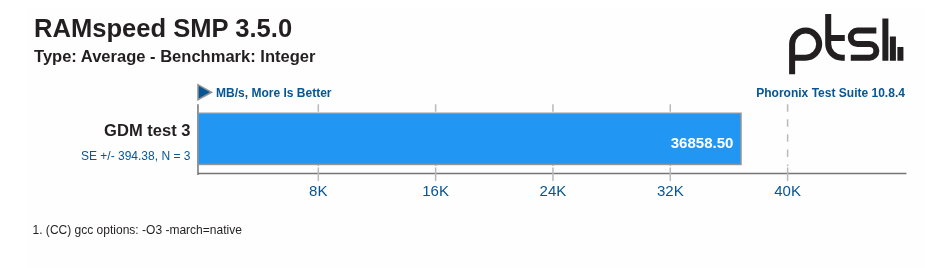
It's been couple of months since I first shared a successful OC on my 4-Dimms setup, but I've made significant progress since then, hitting 3600 stable on 4 Dimms/8 ranks. This is the result: a profile for tuning 4 x 16 GB slots, 8 ranks, of CXMT DDR4 on AM4. Still rocking the Ryzen 9 5900X, MSI MEG X570 ACE (daisy chain topology), Sapphire Pulse RX 9060 XT 16 GB. There are some important things I've discovered about overclocking CXMT dies: they degrade with higher voltages, they lose stability over 50 degrees Celsius, and they have different possibilities from Samsung and SK Hynix, and they behave in a manner between those two types. They -can- boost under higher voltage, but they can't handle the heat from that boost. Conceivably, they might be protected from degradation with a direct cooling solution at higher voltages, IE, fans mounted to the DIMMs. I have an exhaust fan on top my case zip tied right over the RAM to pull air through the gaps beetween them. My GPU fan pushes air up from beneath.
What I've found is that the voltage boost to achieve reasonably higher clocks isn't actually necessary. It was far better to tune the CPU and VRM to assist the internal memory controller, reducing voltage droop slightly and taking strain and heat off of it. To actually push to 3600 at four DIMMs with tight timings, it's essential to get the relationship between voltages, impedances, and drive strengths correct. Getting these wrong is a failed boot or unstable system that fails to pass tests, though this might have been less of an issue with only 2 DIMMs. Also, finding JUST THE RIGHT voltage settings is the difference between success and failure for me.
1T is VERY difficult at this frequency, but Gear Down Mode offers most of the performance with a lot more stability, with most latency and bandwidth recovered since it allows tighter timings and fewer workarounds.
CPU Tuning: -15 undervolt on most cores. Lower temps near the IMC. The four following specs stabilize things underneath the DRAM profile as a strong foundation.
CPU LLC: Mode 3
CPU NB LLC: Mode 3 (higher is bad on this platform for longterm)
CPU Switching Frequency: 400 Khz
CPU NB Switching Frequency: 400 Khz
Voltages: Kept low, hardly different from my 3333 Mhz profile:
SoC: 1.125 V (low as possible, shouldn't ever use more than 1.2 for daily use)
VDDP: 0.900 V (this one is less often talked about, but don't set it too high)
VDDG IOD: 0.95 V
VDDG CCD: 1.05 V (spread between IOD and CCD helps, and values are always lower than SoC, higher than VDDP)
VDIMM: 1.36 V (can go higher for tighter timings, but lower = longer life)
Primaries:
tCL: 16
tRCDRD: 18
tRCDWR: 18
tRP: 18
tRAS: 32
Secondaries:
tRC: 54
tRFC: 452 (the lower you go, the more heat, which is why this is higher on a stable CXMT config)
tWR: 20
tRTP: 10 (2:1 tWR: tRTP)
tWTR_S/L: 4/10
tRRD_S/L: 4/8
tFAW: 18 (4 x tRRD_S plus some breathing room)
tCWL: 16 = tCL
tCKE: auto
Turn arounds:
tRDRDSC_L: 4 (would have been nice to go lower, but it failed boot)
tWRWRSC_L: 4
BankGroupSwap: disabled
ODTs:
ProcODT: 36.9 Ohms
RttWr: 80 Ohms
RttNom: 34 Ohms
RttPark: 240 (haven't managed to go lower)
CAD Bus Drive Strengths: Auto though 24-20-24-24 allowed 1T to boot and pass Y-cruncher, but not MemTest. Had to be paired with AddCmdSetup: 54 and looser timings.