
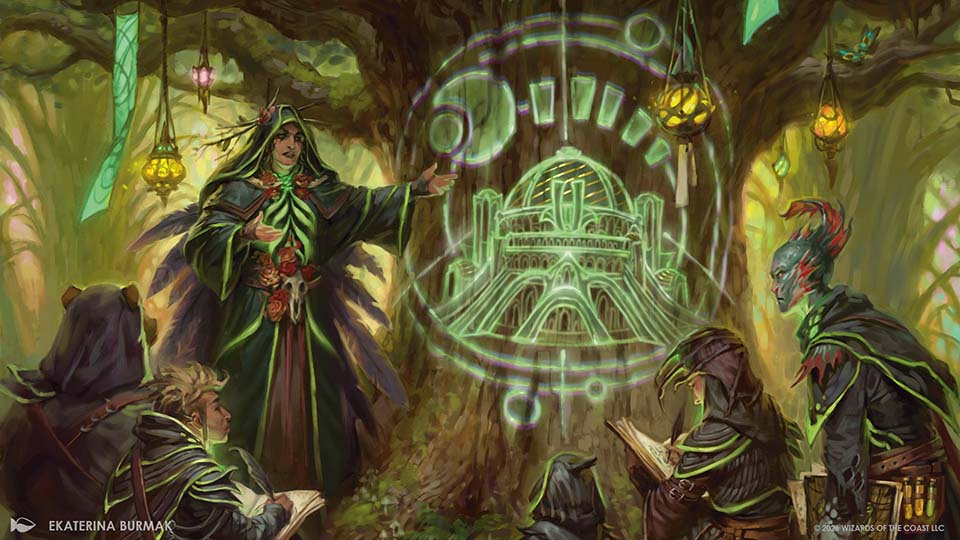
As was previewed, one of the Special Guests cards for Secrets of Strixhaven is one of the most iconic cards from Magic’s history:
0155_MTGSOS_SpecGues: Sylvan Library
And it’s coming to MTG Arena.
This has caused quite a bit of amusement and/or consternation here on the MTG Arena Development team. You see, Sylvan Library is on the list of cards that we were most certain we never ever wanted to implement on MTG Arena.
Why?
Well, that goes back to the basic mission statement of MTG Arena, which is to provide fast, fun Magic for everyone, anywhere. And the sticking point here is that first word: fast.
Let’s turn the Magic history dial all the way back to 1994, when Sylvan Library was pretty much an auto-include in any deck that could cast it. The original wording from Legends is:
You may draw two extra cards during your draw phase, then either put two of the cards drawn this turn back on top of your library (in any order), or lose 4 lives per card not replaced. Effects that prevent or redirect damage may not be used to counter this loss of life.
Putting aside how antiquated the Legends rules text is from a modern perspective, imagine how naturally that action would actually play out. You are drawing “extra” cards, meaning that intuitively you draw them at the same time as your first card. So, it turns your “draw for turn” into a “draw three, then put two back,” except you can also pay 4 life or 8 life to put fewer back. Once you get how it works, it’s a very quick and natural action.
If you were narrating your turn very carefully, you might say something like this:
“Untap. Upkeep. Use Sylvan. Hmm … Okay, put this one back and lose 4 life.”
Now, let’s compare that wording to the current Oracle text:
At the beginning of your draw step, you may draw two additional cards. If you do, choose two cards in your hand drawn this turn. For each of those cards, pay 4 life or put the card on top of your library.
What would carefully narrating that sound like?
“Untap. Upkeep. Draw. Trigger Sylvan. Sylvan resolves, I choose to draw two cards. Hmm. Okay, I choose these two cards. I pick this one as the first. I put it back on top of my library. Now, for the second, I pay 4 life.”
I kind of doubt that even very careful tabletop players really narrate it like that; particularly the “I choose these two cards” part. But that is the rub. Our job on MTG Arena is to fully and correctly implement the rules, which means we can’t generally skip steps of cards resolving or shortcut things. So, how many clicks would it take to resolve Sylvan Library with the current printing if we interpreted it completely literally? (Note: This is all in the “normal” case where you have 8 or more life, at least three cards in your library, and haven’t drawn any cards earlier in your turn.)
The trigger would go on the stack, which you would normally not get to respond to unless you were in full control.
Then, you would have to click yes or no for “Draw two cards?” This is completely unavoidable because you clearly need the choice to not deck yourself, give your opponent Treasures from Hullbreacher, or what have you.
Then, you would have to choose two of the cards in your hand. That’s two more clicks to choose them, then one more to submit.
Then, you would have to click which one of them goes first.
Then, you would have to click to decide whether to pay 4 life or put it on top.
Then, for the other one of the two chosen cards, you have to click to decide whether to pay 4 life or put it on top.
That’s seven clicks! And in addition to those seven clicks, there’s a potentially major pain point where you can’t get to the last step and decide to change the order of the cards you selected.
Now, would we never print a card which required seven clicks to resolve? There are no fixed limits on the number of clicks or decisions a player can make. But an active Sylvan Library is supposed to be a quick thing you do repeatedly as part of each of your turns. If there’s a big, splashy, eight-mana sorcery that has some massive effect on the game that takes seven clicks to resolve, that’s very different than an enchantment that comes down on turn two, sits there all game, and is supposed to make your life easier.
In fact, the MTG Arena UI flow for Sylvan Library is so tricky that, for years, we’ve asked people applying to work as designers on MTG Arena to come up with their best plan for how it should work. This was not a question that had a correct answer. In fact, that was part of why we asked. Obviously, they will fail the impossible challenge, but we’ll learn something from how they fail.
The purpose of the question was not to see how many of the problems inherent to Sylvan Library on MTG Arena they could solve. It was to see how many of the problems inherent to Sylvan Library on MTG Arena they could identify.
So, here we are. Sylvan Library is a card that cannot possibly work well on MTG Arena, but it has to. What should we do?
I’ll note that the “we” in this article primarily refers to the MTG Arena designers, with some help from RULE engineers like me. Typically, this type of decision would be entirely owned by the designers, but this card was complicated enough and had enough finnicky implications that it ended up being an all-hands-on-deck situation.
The first step was to try to imagine the cleanest interface we possibly could, our ultimate Sylvan Library-resolving wish list, then figure out what obstacles prevented us from doing it that way. Our key insight was that Sylvan is a fair bit like Brainstorm.
0155_MTGTLA_JmpRep: Brainstorm
People resolve Brainstorms all the time on MTG Arena without it being a torturous mess. Brainstorm draws extra cards, then you select some of them, then the ones you selected end up on top of your library in an order that you choose later.
Could we just do that for Sylvan Library?
Well, how are Sylvan Library and Brainstorm different?
Brainstorm lets you choose any card in your hand, while Sylvan only lets you choose cards drawn this turn.
Brainstorm always makes you put back two cards. Sylvan Library lets you put back zero, one, or two cards and forces you to pay life if you put back fewer than two.
For a quick aside on that first point: There’s a deep irony about this entire issue, which is that because of the text “two cards in your hand drawn this turn,” Sylvan Library is one of the most troublesome cards that has ever been printed from a rules perspective. How do I know which cards in my hand were drawn this turn? How does my opponent know? What if I’ve already Brainstormed? What if I control a Phyrexian Arena?
While this is a massive issue in paper Magic, it’s a complete non-issue for digital Magic because MTG Arena always knows what cards in your hand were drawn this turn. The game can enforce that restriction trivially, incorruptibly, and invisibly. In fact, we’d already set up all the syntax and semantics necessary to make that text work due to the digital-only card Captain Eberhart.
Captain Eberhart (Y22)
How is this problem actually solved in paper Magic? To really do it right, you need to keep the cards you’ve drawn this turn separate from the other cards in your hand. And for someone to make it through an entire game without ever messing that up would be something of a miracle.
But other than those differences, they’re very similar. So, let’s assume we implemented Sylvan Library to work like Brainstorm. Would that actually be correct?
After some thought, we decided that it would result in gameplay with no differences from following the steps precisely … unless it wouldn’t. That is, if Sylvan is resolving in isolation, with no other effects interfering, then our Brainstorm shortcut is effectively rules-correct. But that wouldn’t always be the case.
For instance, what if you control Ashiok, Wicked Manipulator?
0078_MTGWOE_Main: Ashiok, Wicked Manipulator
Now paying life involves exiling cards from the top of your library. So, you should be able to exile the top four cards of your library, look at them, then decide what to do with the other card in your hand. Or you could choose to put one card back, then exile the top four cards of your library to keep the other card, which would cause you to exile the other card.
So, we found ourselves with a difficult choice to make. We had chosen a card, and we had to decide what to do with it. Pay 4 life, or put it into our hand? Wait, I mean, make it as fast as possible, or make it as rules-correct as possible?
And what we decided to do was … both.
So, when you resolve Sylvan Library’s ability, you will see the fastest, cleanest, most intuitive interface we could come up with. Unless one of a teeny handful of other cards are in play, in which case you will see the most rules-accurate interface we could come up with.
What does our fast, clean, interface look like?
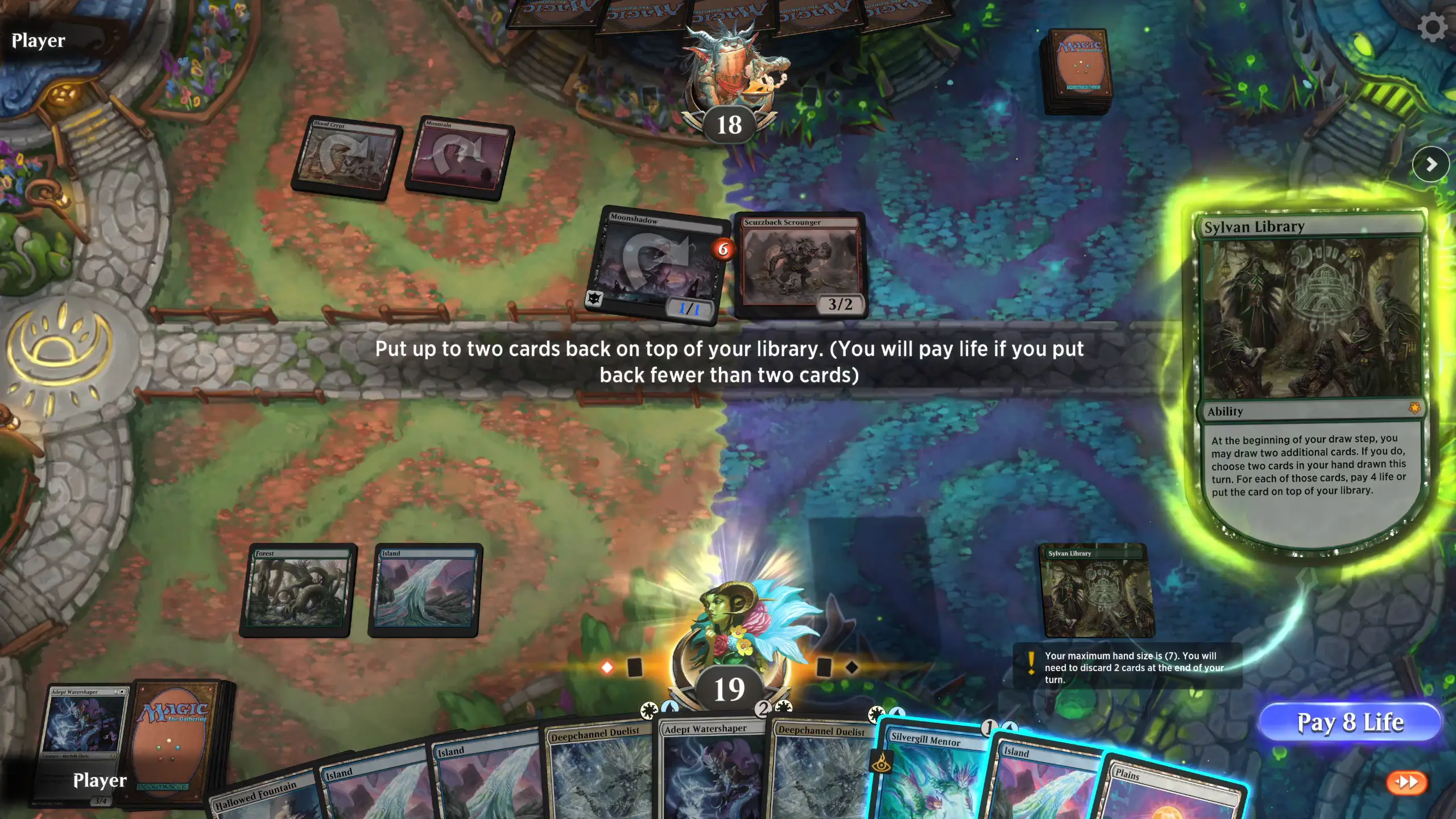
So, you select zero, one, or two cards from your hand. When you are done selecting, you click this button, which will automatically update to indicate how much life you will be paying:
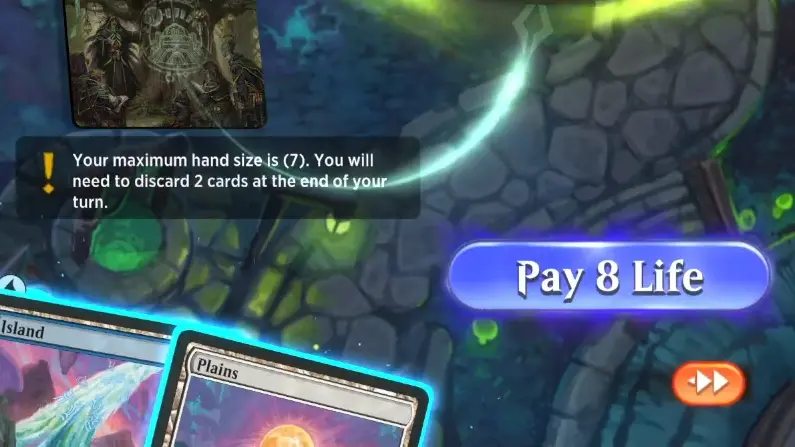
If you put back one card, then you are done. If you put back two, you see this:
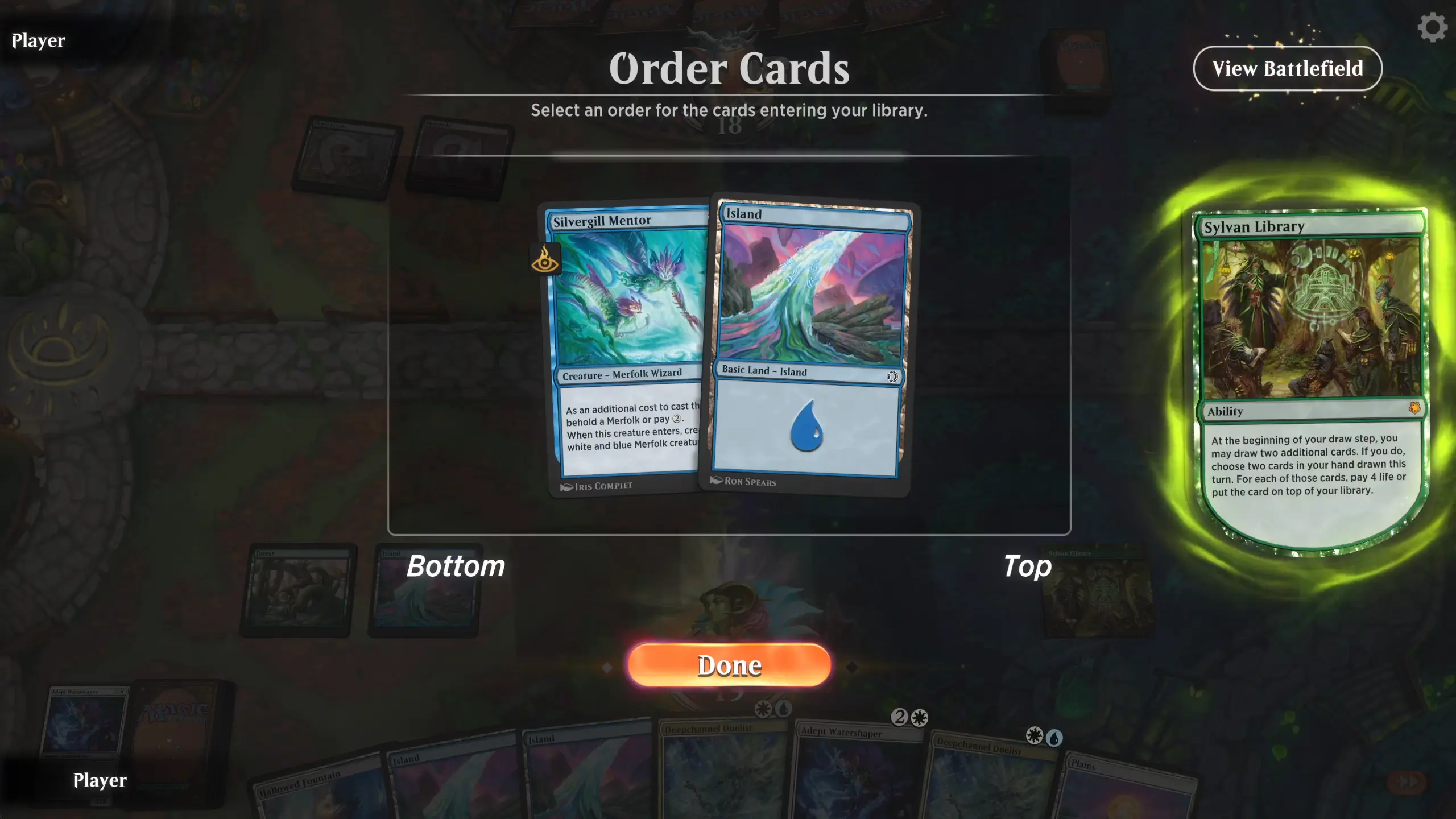
If you put back zero cards and pay 8 life (which people do a lot), then there’s only one button press involved.
That’s what you’ll see the vast majority of the time if you play with Sylvan Library. Now, it’s a bit more complicated than that:
The number of cards you choose won’t always be “up to two.” If you can’t pay any life, then you will have to choose two cards, not “up to.”
On very rare occasions that involve Platinum Angel or Narset, Parter of Veils, you may draw less than two cards when Sylvan resolves, in which case you won’t be able to pick two cards. But you’ll still have to pay 4 life for each card you keep.
And, of course, if you have fond memories of breaking everyone’s brains back in the late ’90s and have drawn more than three cards when Sylvan Library resolves, you’ll pick your two cards from a larger selection than just three.
Finally, there were a few less-obvious details we had to get right:
Wan Shi Tong, All-Knowing (TLE)
Font of Agonies (RNA)
When you resolve Brainstorm and put two cards back on top of your library, that triggers Wan Shi Tong, All-Knowing only once, as “one or more” cards were put into your library only once. If you put back two cards with Sylvan Library, it will trigger twice
Similarly, paying 8 life for Sylvan Library is really paying 4 life twice, so Font of Agonies will trigger twice.
As for the rules-accurate interface, well, it’s rules-accurate. It’s a lot of clicking. It works fine, and I bet most of you will never see it.
But I do have one little challenge for you all. As I said, there are some cards which necessitate the rules-accurate interface. One of them is Ashiok, Wicked Manipulator. And there is in fact only one other. Can you figure out what it is?
Of course, every story about implementing a card on MTG Arena ends with ” … and then QA got their hands on it and found a bug.” This story is no different. Our testers discovered that Sylvan Library was interacting incorrectly with Karn’s Sylex, which was preventing the life payment. So, we fixed that and proceeded to our precombat main phase.
Thanks for reading, and enjoy your time at the library!