
Loading
The financial sustainability of esports organizations remains a key industry challenge. As Western teams continue to reduce costs, South Korean organization T1 Entertainment & Sports has reported a shift in its financial position. According to recent audit reports cited in Korean media, the company became profitable in 2025 for the first time since its relaunch.
To understand the weight of this milestone, it is necessary to look at the organization’s structural reset. Although the team’s legacy traces back to 2002 under the SK Telecom T1 banner, the financial reports treat 2019 as the “Year Zero”. This was the moment the organization became just ‘T1’ and transitioned into a standalone global joint venture between SK Telecom and Comcast Spectacor. This 2019 reform was designed to turn a legendary team into a viable commercial enterprise. Six years after that high-stakes gamble, the company has officially moved out of the red and into the black.
How did T1 achieve $60M revenue growth in 2025?
The numbers revealed in the latest regulatory filings are nothing short of a massive leap. The organization reported a revenue of over $60 million (approximately 83.4 billion KRW), marking an 80% increase compared to the previous year. To put that in perspective, T1 was staring at a $12 million loss just two years ago.
What makes this turnaround particularly impressive is that T1 didn’t achieve it by penny-pinching. They famously retained their “ZOFGK” roster (Zeus, Oner, Faker, Gumayusi and Keria), which is arguably the most expensive lineup in the history of the League of Legends Champions Korea (LCK). Usually, high salaries are the primary reason esports teams lose money, but T1 managed to turn its star power into a revenue engine six years after launch.
The “Faker effect” remains the cornerstone of this success, but the 2025 report shows that the business has become much more sophisticated. The surge in profit was fueled by a perfect storm of commercial wins: record-breaking sales of digital in-game items and championship skins, a massive uptick in premium global sponsorships, and a merchandise business that has moved far beyond simple jerseys.
By leveraging their consistent dominance on the world stage, T1 has effectively decoupled itself from the “esports winter” affecting the rest of the globe. The audit clarifies that the organization is no longer just a marketing project for its parent companies but a self-sustaining commercial entity.
What makes T1 a global esports viewership powerhouse?
T1’s financial breakthrough is built on a foundation of unmatched popularity. The tag is not only the most iconic in South Korean history but arguably the most recognizable brand in global esports. This status is backed by consistent data: according to Esports Charts, which began tracking comprehensive team statistics in 2017, T1 has appeared in the top 10 most-watched organizations eight times.
Even more remarkably, the club has secured the number one spot in global live viewership for the last four consecutive years. With a massive fanbase that spans far beyond the borders of South Korea, T1 has proven that its Hours Watched metric is one of the primary engine behind its transition to a profitable business.
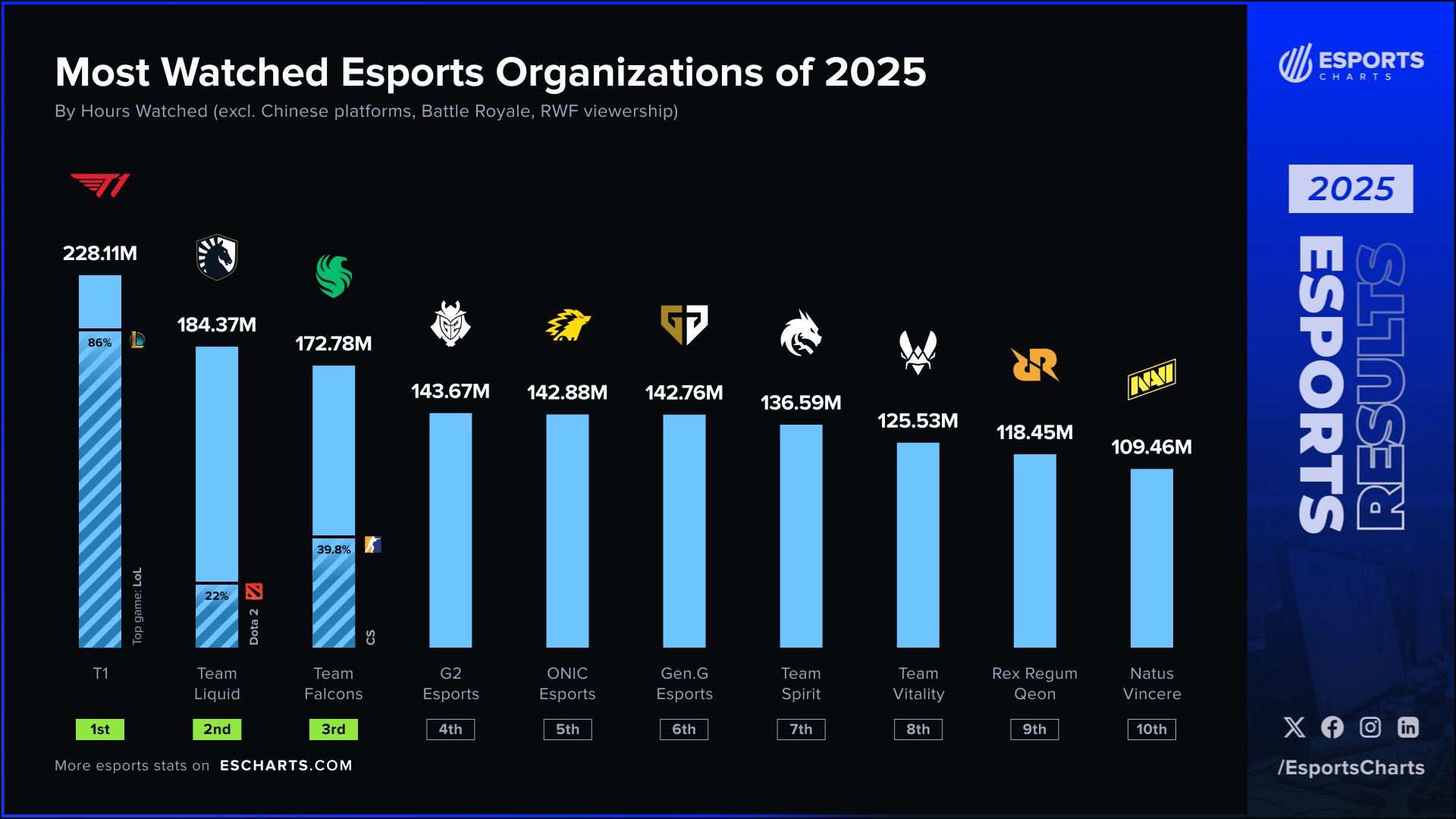 T1 led all esports organizations in live viewership in 2025
In an era where many organizations are fighting for their lives, T1’s 2025 performance suggests that the path to profitability isn’t found in cutting costs, but in building a brand so dominant that the market simply cannot ignore it. For the first time in its history, T1 isn’t just winning trophies but winning at the business of esports itself.
Read more: Top Esports Organizations of 2025