
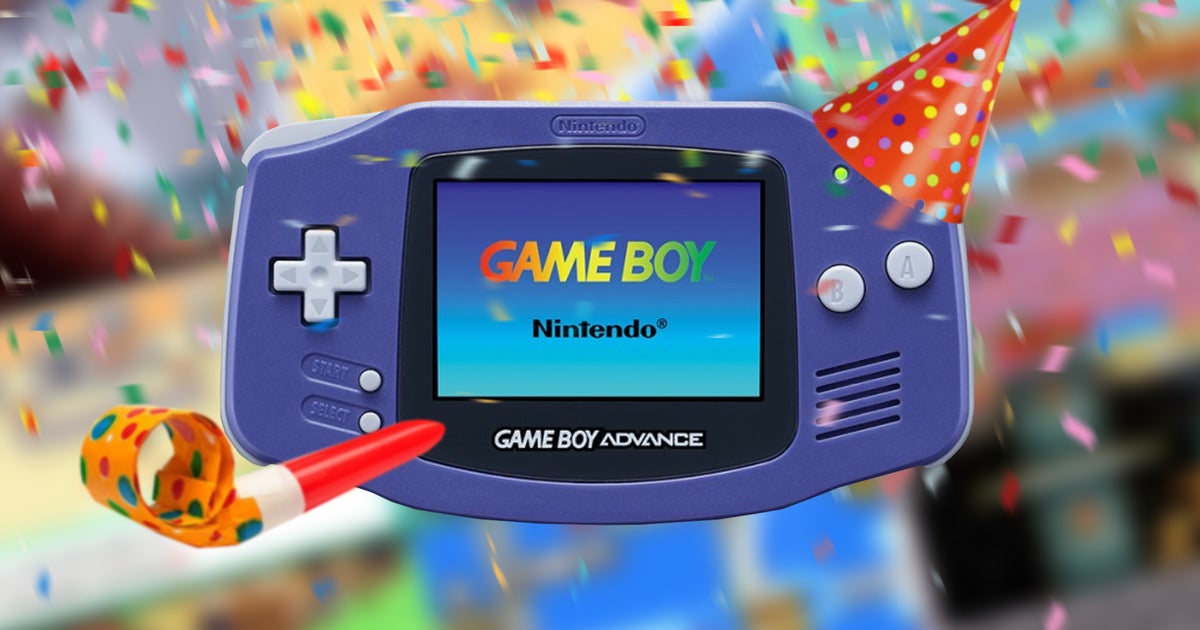
Happy birthday Game Boy Advance! It’s been 25 years since Nintendo’s handheld line-up bound into the world of proper 16-bit technicolour. Two and a half decades later, with a whopping 81.5m units sold, the diminutive machine is the stuff of legend. Its library is vast, home to many of video gaming’s most iconic characters, and it also managed to birth a whole bunch of series that would go on to become just as beloved themselves.
So to celebrate GBA’s 25th anniversary, we’ve roamed through the pink-hued mists of nostalgia to pick some of our personal favourites still easily playable via Switch’s eShop or Switch Online + Expansion Pack today (consider this more a list guided by our most treasured GBA memories than an attempt at creating a definitive best-of). And we’ve also included some far more elusive favourites we’d love to see resurrected and given their Switch debut. Of course, with a back catalogue as rich as this one, omissions are inevitable (sorry Metroid fans!), so why not don your own party hat and get your GBA reminisces going in the comments below?
Let’s start with the ones on Switch…
The Legend of Zelda: Four Swords (Switch Online)
Image credit: Nintendo
Four Swords on the GBA came packaged with A Link to the Past, so it was already money in the bank. Link to the Past is perhaps the neatest and most satisfying of Zeldas, a true puzzle box of a thing in which two overlapping maps harmonise in delightful, maddening, and unexpected ways. It’s ingenious.
Four Swords is a lovely counter to all that. It turns Zelda into a collaborative adventure for up to four players, and the focus is kind of on puzzle solving but mainly on knockabout action. There are procedural dungeons and all kinds of challenges, but the fun comes, if I remember correctly, from snagging more rupees than anyone else.
An admission here: I played Four Swords on GBA precisely once, on a train from London to Brighton where a few of my friends happened to have GBAs and enough cables to make it all work. But that session, fitting into a brisk 54 minute commute, remains one of my favourite gaming memories of all time. It’s lovely to share the most insular of games with other people, and to revel in the chaos that is always present to some extent in Link’s adventures. Now it’s on Switch, I should really play it again. But I know it won’t be quite as good as my memory of it – CD
Castlevania: Circle of the Moon (Switch eShop)
Image credit: Konami
For all the excitement surrounding GBA’s launch, one of the most persistent complaints aimed at the handheld was its lack of a backlit screen. And to my mind, no game exemplified the woes of its absence more than the brilliant GBA launch title Castlevania: Circle of the Moon. To my youthful eyes, this thing was gorgeous; full of impressively animated sprites and lush pixel art background detail that really sold the idea of a next-gen handheld after the Game Boy Color. The trouble was, in anything approaching normal light levels, it’s action was almost completely unreadable (I half suspect nobody at Konami ever saw the thing running in situ before shipping it – and, notably, later GBA entries put a bloody big halo around everything that moved).
I’d wager Circle of the Moon probably single-handedly managed to shift more of those silly clip-on front lights than any other GBA launch game. But as awkward as I remember it being to play in anything less than ideal lighting conditions, this quirk also led to one of my most vivid gaming memories: hours spent plopped on an uncomfortable garden chair desperately trying to blast as much summer sun onto GBA’s tiny screen as possible (the handheld saw a June release in Europe, conveniently), just to enjoy the majesty of Circle of the Moon a little more. You could reasonably argue it isn’t the best Castlevania on GBA, that its successors were responsible for turning the Metroidvania formula into something truly great, but as the gateway to the wonderful world of GBA, Circle of the Moon is the Castlevania closest to my heart – MW
The Legend of Zelda: Minish Cap (Switch Online)
Image credit: Nintendo
Capcom had already proved it was really good at making Zelda games by the time that Minish Cap came out. I love the Oracle adventures on the original Game Boy, and it’s a delight to be able to play them both today on the Switch.
But Minish Cap is a step up. It takes the lovely cartoon art from GameCube’s Wind Waker and delivers an adventure that’s as soaring and heart-shaking as any other Zelda game out there. And it utilises the old standard world/overworld trick in a really clever way. This is because Link can shrink down in size in Minish Cap and become a tiny wibbling cluster of pixels, still somehow readable as the eternal hero in green.
The game also allows you to see the world from Link’s shrunken perspective, which means some landscapes exist in two forms, with the standard view and a kind of exploded close-up, with plenty of new details visible. It’s The Legend of Zelda combined with Hooke’s Micrographia. And it’s every bit as wonderful as that sounds.
One more thing: Minish Cap’s collectibles are amongst my favourite in any Zelda game. They come in the form of stone pieces that can be clipped together, or fused, to unlock cool stuff. I remember being deeply in love with these back in the day, and for my money they’re far more compelling than Korok seeds – CD
Wario Land 4 (Switch Online)
Image credit: Nintendo
Let’s be honest, Mario had a bit of a funny time on GBA. He wasn’t exactly absent, but he also never felt entirely present either. Instead of giving its number one mascot a proper new platformer on GBA, Nintendo instead decided to repackage four of the plumber’s (admittedly incontestably excellent) SNES adventures under the guise of the Super Mario Advance series. But even if Mario had got an all-singing, all-dancing brand-new adventure on GBA, I strongly suspect I’d have still picked Wario Land 4 here instead.
Wario, firmly in his protagonist era at the time, was already a favourite of mine thanks to his previous weirdo platform adventures on Game Boy and Game Boy Color, but Wario Land 4 felt like a massive step up. It looked stellar for one; like a cartoon brought to vibrant life on the tiny screen – and I still adore its opening moments as Wario charges across the desert in his purple Cadillac in search of ancient treasure. It’s not an especially deep platformer, from what I can recall, but it’s a wonderfully more-ish one, and I spent many happy hours in the shadow of its strange pyramid, tracking down collectibles before making my frantic escape from each level, come their dramatic midpoint turn. Oh, and its very odd soundtrack is great too – MW
Golden Sun (Switch Online)
Golden Sun is one of those games that lives on in my head not so much as a vivid memory as an indelible vibe. Its story is a haze beyond some looming alchemical calamity, but I remember being thoroughly delighted by the way its dinky characters were made so much more expressive by the little animated emoji speech bubbles that popped up over their hands while they jabbered away (I wasn’t much of an RPG fan back then, so this mightn’t have been especially unique, but it still felt like a little bit of magic to me).
I also remember its vaguely Pokemon-like Djinn system, which could augment the cheery cast’s stats in all sort of interesting ways, and the neat way your magic-adjacent Psyenergy abilities were used outside of battle as tools for puzzle solving (it’s even possible to mindread pretty much every NPC for some added silliness, if you desire). But more than anything I remember the wonderful breeziness of it all; it’s a brisk, spirited adventure delivered with a lightness of touch that seemed enormously refreshing compared to its more heavyweight RPG contemporaries – a whole world of charm and wonder squeezed miraculously onto a tiny cartridge. And now I’m writing this with it readily available on Switch, I’m wondering if it’s finally time for a return – MW
Mario & Luigi: Superstar Saga (Switch Online)
Image credit: Nintendo
This isn’t the first Mario RPG, but if you ask me it’s the best. It’s a wonderful sitcom of an adventure in which the two Mario brothers head off together to save the day, and must be controlled as a pair. This makes the simplest action in a Mario game – jumping – a thing that must be relearned. And it also allows for ingenious challenges like skipping rope sections, and for broad slapstick comedy, because the two brothers are constantly getting tangled together.
This is an adventure with range and real humour, and it builds on that idea, developed in Super Mario 3 and Super Mario World, that the brothers are exploring a complex land with its own areas and traditions. Everywhere Mario goes he’s asked to pull off his signature move for the crowd, and the landscapes the brothers travel through are gloriously colourful, making particularly great use of pinks and purples.
Sequels have followed and they’re all great, but none of them, for me at least, are quite as good as this one. And this might not be entirely fair. The truth is Superstar Saga is a game I first played over a Christmas break, so it lives in my memory alongside fairy lights and wrapping paper – CD
Pokémon FireRed and LeafGreen (Switch eShop)
Image credit: Game Freak/The Pokémon Company/Nintendo
What a treat that we get these again now, at last, on the Switch and Switch 2. There are caveats as there seemingly always are: you can’t call your rival Mr. Arse anymore, and they cost an awful lot – sold separately – compared to most of the above games coming bundled with your Nintendo subscription. But: these are two of the greatest and most significant video games of all time, remade into arguably the platonic ideal of Pokémon in full-colour, 16-bit form. (And also, much as I fully believe in physical media, you try getting a physical version of either and then tell me 17 quid’s expensive).
What’s nice – and I do think it’s nice – is that because they were remade so early on in Pokémon’s lifetime, during the mere third generation, these games maintain a lot of their weird, first-gen foibles. The physical/special split, as it was known, was reverted, meaning you have to re-tune all that moveset muscle memory to match your Pokémon’s stats with attack types, instead of attack categories. And the version exclusives are brutal – play Green and fail to pick Charmander as a starter and you’ll have almost no useful Fire-types for a while. As much as the later Let’s Go games were designed to get younger generations into Pokémon, I don’t think any could truly capture it as well as these: this is the essence of Pokémon in its purest, most awkward, most brilliant and challenging way – CT
And now for the ones we’d love to come back…
WarioWare Twisted!
Image credit: Nintendo
Twisted is probably not the best WarioWare – I kind of want to say that’s Touched!, purely on the strength of the Ashley song – but it’s my absolute favourite. It does everything WarioWare should do, in that it breaks games down into five second bursts of greatness, and then strings them together like you’re swiping through a kind of ludic TikTok.
Sorry about bringing TikTok into it. Anyway, on top of this, Twisted! also does that other WarioWare trick of introducing you to a new piece of hardware. And that’s some trick, given that the game came out for the GBA. But it does this by building a chunky gyro sensor into the cartridge. WarioWare therefore becomes a game about turning the GBA, and it explores this in brilliant ways, creating a kind of toilet-roll approach to Mario 1-1, and delivering rewards like they’re capsule toys coming out of a physical dispenser.
That dispenser’s crank handle is recreated using my very favourite thing about Twisted! – its uniquely corrugated rumble that was built into the gyro sensor. This is rumble with a lovely sense of up-and-down character to it. My own copy’s battery died a few years ago. I still miss it!
Twisted! was never released in Europe, and apparently the rumour that this came down to the cartridge containing mercury is not true. It’s a proper crime more people didn’t get to play this.
Spyro: Season of the Ice
Image credit: Activision
From the amount of times I’ve written about Spyro, it should come as no surprise that every Spyro game is on my favourites list, but it’s Season of Ice that holds the top spot.
Grendor has trapped fairies in ice-crystal-like prisons and it’s Spyro’s task to travel to each realm, freeing them with his flames before coming face to face with their captor. There are multiple different areas to explore, each with its own unique challenges to overcome.>p>
It was one of the first games I ever played, but also one that showed me gaming is something that could bring myself and my elder sibling closer together. It was initially their game, but as I grew more interested, they’d let me start to watch them and eventually play alongside them with their help as I got older.
This one Spyro adventure ignited a life-long bond that continues to this very day, and now that we’ve got younger members of our family, I’d love this to be on the Switch 2 so we can share it with them too. So, to my favourite little purple dragon, thank you for the memories – MP
Pokémon Emerald
Image credit: Game Freak/The Pokémon Company/Nintendo
We’ve had FireRed and LeafGreen, so surely, surely it’s time for Ruby, Sapphire, and, most importantly, Emerald to be playable again, beyond the fake carts you can get off Ebay and the real ones going for hundreds and hundreds of pounds.
Emerald was, and for some still is, the pinnacle of the old-school Pokémon format. A huge array of environmental puzzles and lengthy dungeons combined with swathes of legendaries, cross-game functionality, and special interactions. It brought the Battle Frontier, which remains the most beloved of post-game destinations for high-level play, and a load of new breeding-based functionality, and this was the generation that added now-essential elements like Abilities, too.
Above all though, Emerald’s magic is in its astonishing boss-on-boss action, in its Rayquaza-based climax that felt so much bigger than that tiny, poorly lit screen. I played these games until the GBA’s little battery light blinked red so many times I’ve lost count. The memories of getting lost, getting stuck, getting someone to try to explain braille to an 11-year old will never fade – CT
Rhythm Tengoku
Image credit: Nintendo
Rhythm Tengoku remains one of the few Japan-only video games I’ve ever imported (the others include Osu! Tatakae! Ouendan and Taiko no Tatsujin with its drum peripheral, so you can probably spot a theme here), but the second I saw its trailer, I knew it must be mine.
Rhythm Tengoku is similar in spirit to – if not exactly like – WarioWare (it was created by the same creative leads), whizzing players through a bizarre parade of musical mini-game scenarios, each with their own distinctive lo-fi art style. It’s not quite as frantic as WarioWare (at least not until you get to the later MegaMix stages), but it’s got the same relentless sense of absurd invention as it, here, builds challenges around call and response.
Essentially, as a level progresses, recurring sounds or musical motifs indicate the next button-press pattern you should play on-beat. Part of the fun is the wonderful stupidity of it all: you’ll tweezer hairs from an onion’s chin, smack baseballs at the screen as your bedroom thunders through space, guide a chorus line of dancing robots, or samurai sword yokai as they bound onto screen. But the brilliant bit is how each challenge builds as it goes on; with more complicated call-outs, for instance, or disappearing visual cues that force you to rely on your rhythmic instincts – say, as your baseball bedroom suddenly vanishes to the size of a dot.
These days, Rhythm Tengoku lives on in the west as Rhythm Heaven/Paradise (its sequel got the localisation treatment on DS, and they’ve been localised ever since). But while later entries are fun, they’re just a bit too fussy with the likes of their stylus pokes for my tastes. And I’d love to see this glorious GBA original get its chance to shine on Switch – MW
Drill Dozer
Image credit: Nintendo
Drill Dozer is a 2D action-platformer created by Game Freak. It’s also one of my very favourite objects, an odd lozenge-like cartridge in dark red that extends a little way out of the GBA cartridge slot when you whack it in.
This is because the cartridge has built-in rumble, which means it’s one of two games for the GBA that offered this, the other being WarioWare Twisted! Rumble is used beautifully here to elevate the action, as you control a mech with a drill-bit attached that can chug through walls. Chugging through walls is always fun in a game, but Drill Dozer really delivers on every shudder and shake. It’s a magical device.
The game itself is a lot of fun, but for me it was all about the cartridge – and maybe a little bit about the fact that the on-screen UI is so needlessly massive. I say “needless”, but Drill Dozer can feel less like a game and more like a machine you’re learning to use, and maybe the UI is a vital part of that. Now I want to play it again – CD