
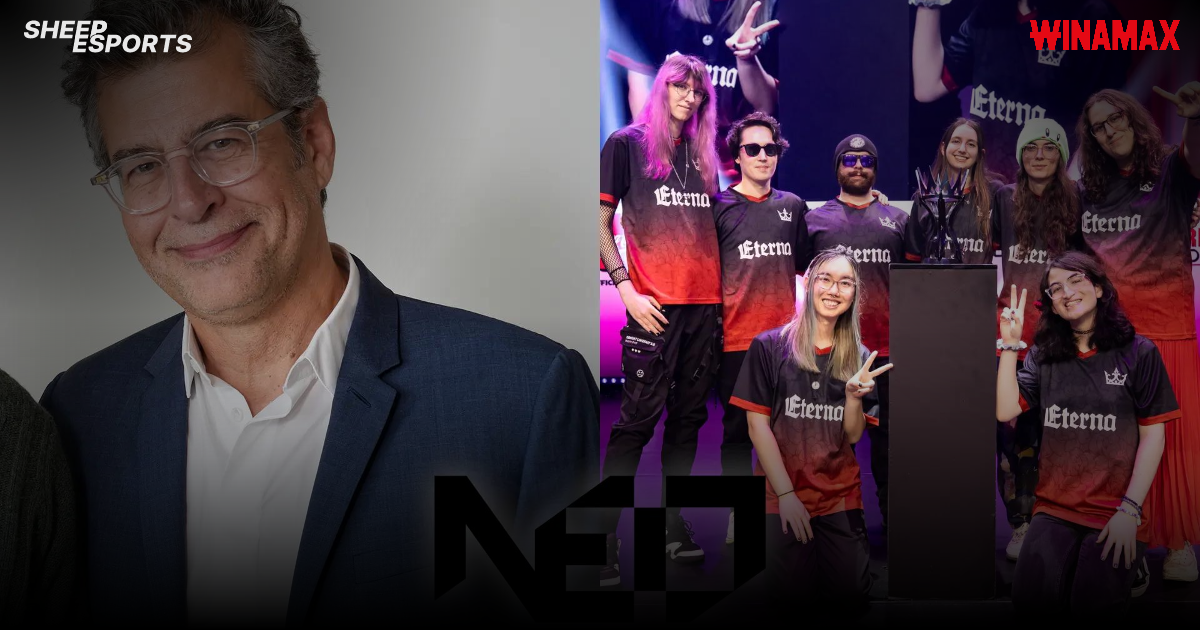
After months of silence on the project, the future of the League of Legends Game Changers (LGC) program has finally been unveiled. At its helm, former heads of Webedia now take the reins under the banner of “New Esports Org.” (N.E.O.). With improved planning and a clear vision, the company is now moving forward with plans to launch the newly reignited circuit within the coming months.In an exclusive interview, Sheep Esports sat down with the new organizer’s Chief Executive Officer, Bertrand Amar, to discuss the financials behind the project, the mentality driving it forward, and the transition from Webedia.
Bertrand Amar: “The transition happened quite naturally. My mission at Webedia was already set to end at the close of 2025. It wasn’t a resignation—it was simply the end of a third three-year contract I had signed with them, which had a known expiration date.
In mid-2025, I informed Webedia that I wouldn’t be renewing, as I wanted to move back toward a more entrepreneurial adventure and regain the agility of a smaller, more flexible structure.
At the same time, Webedia decided to reduce its esports scope to focus on French competitions that were already well-established commercially and less risky. Since they no longer wanted to continue certain competitions, I simply proposed to the rights holders that we continue these programs under a different banner. In the end, the transition was quite natural and very smooth. There was no competition with Webedia over these products.
Are you funding the LGC and EM entirely yourselves, or do you receive support from Riot?
Bertrand Amar: We are in partnership with Riot, but we provide the majority of the funding ourselves. To be clear, these aren’t competitions that we simply produce in white-label for Riot Games. We invest our own money to make them happen. It remains a partnership with Riot, but there’s a real financial commitment on our part to keep these competitions alive.
These competitions are sometimes seen as fairly risky products. Do you already have a development plan to make the LGC and EM sustainable? How do you plan to finance these projects?
Bertrand Amar: What’s important for us is not to have too many products on the market at the same time. That’s been a challenge in recent years. The idea is to maintain a more focused catalog, even if we announce several projects today, because each one has a clear and distinct theme and scope.
We’re putting a major commercial focus on these IPs. We weren’t able to sell the 2026 editions last year [due to the transition], but we remain confident and are already committed to 2027 as well. Commercialization starts now.
What’s certain is that we have big ambitions for these competitions. As I’ve always done with the projects I lead, the goal is to invest in the quality of the product, proportional to the resources we have—especially through partners and sponsors.
So, there will be a strong commercial focus. We’re already working with agencies in France, but also abroad. For example, I’ll be traveling to Germany in about ten days to meet other agencies. The idea is to put all the necessary energy into attracting partners to our products, so we can continue to grow and develop them.
Regarding the team at N.E.O., how have you organized yourselves to manage the LGC and EM, especially since some former project leads remained in Webedia? Do you already have a new staff, or do you plan to collaborate with Webedia for the organization?
Bertrand Amar: Yes, we already have a staff in place. We haven’t fully announced it yet, but it will be revealed in the coming days, probably as soon as next week.
However, our goal is not to heavily invest in in-house production capabilities. Instead, we plan to rely on expert production companies as needed. Our objective is not to build our own studios or become a full-fledged production company. We see ourselves primarily as a tournament organizer. Our role is to secure the licenses and then bring together the best experts to deliver the competitions—both on-air talent and technical teams.
That said, everything related to organization, management, commercialization, and strategic vision remains handled internally at N.E.O.
For this second edition of the LoL Game Changers in 2026, what’s your approach? Is it a continuation of last year, or is there a desire to evolve the format, especially after the challenges encountered?
Bertrand Amar: Yes, it’s extremely important for us. We initially created the Coupe des Étoiles, which later evolved into the Game Changers format.

“To be completely transparent, last year was somewhat frustrating: we weren’t able to roll out Game Changers as quickly as planned. Everyone needed to be aligned, and teams needed to be informed, which delayed the launch.”
For 2026, we want a competition that’s longer than last year, more open, and with multiple entry points. I don’t want to reveal the exact format just yet, but we hope to finalize it by the end of the month after approval from Riot Games, with clear communication and possibly a start as early as April.
We’re already talking with teams to let them know Game Changers is returning, as some needed to confirm whether they could maintain their women’s rosters.
It’s a competition we have big ambitions for. We’re also working on the faces and talent that will accompany the event. Nothing has been finalized yet regarding an offline tournament, but we have a clear vision: the format will be longer and more open than last year.
The women’s scene is currently quite fragile, with many organizations having stopped participating. How do you approach this challenge, especially since you are fully funding the Game Changers? Are there discussions with Riot to provide support?
Bertrand Amar: It’s a bit of the “chicken or the egg” problem. If there’s no competition, there are no teams. If there are no teams, there’s no competition. At some point, someone has to take the first step, and that’s what we’re doing with Game Changers.
We want to expand the competition and offer multiple entry points so that, during the tournament, new rosters can form or teams can return. Everyone in the esports ecosystem agrees on the importance of developing the women’s scene. No one is indifferent to it, but the real challenge remains economic: funding a women’s roster is becoming increasingly difficult as sponsors and partners become harder to secure.
Launching a competition allows some teams to maintain their women’s rosters. They can approach sponsors and partners and say, “We will have a women’s competition, we have a roster—are you ready to support us?”
I believe this year’s Game Changers are better organized than last year’s, and perhaps next year’s edition will be even stronger. Our goal is to develop the competition over the long term. We hope this brand becomes prestigious and that a more structured circuit will motivate teams to keep or create new women’s rosters.
Do you take inspiration from the VALORANT model, which has successfully developed a stable women’s scene over the past few years?
Bertrand Amar: Yes, but we have to stay realistic. There are far more women’s teams in VALORANT than in League of Legends. So we’re back to the “chicken or the egg” problem. You can’t be overly ambitious without facing reality: the LoL women’s scene is still less developed than VALORANT’s.
That said, we know the game will evolve, and new teams could emerge, which should renew interest in the women’s scene. We remain confident in the format and in its economic potential: it will allow clubs to find partners and brands that specifically target a female audience, which could open up new opportunities for them.
This is exactly what we want to offer to the market, to partners and sponsors. That’s why we are very active in finalizing the format—to provide a strong and attractive proposition.
Many organizations hesitate to invest in the scene due to uncertainty around competitions, particularly the Game Changers. Can you confirm that the Game Changers will continue for multiple years, and clarify the duration of your contract?
Bertrand Amar: Yes, I can confirm that we will be in charge of the League of Legends Game Changers for 2026 and 2027.
“This is a clear message to all organizations and teams that were unsure: you can go ahead and prepare your structures and rosters, because there will indeed be competitions in both 2026 and 2027. This is a commitment I can make.”
Do you think that in 2027 the Game Changers could start as early as January, alongside the other competitions?
Bertrand Amar: Absolutely—that’s the goal. But it will depend on this year: will the teams show up? Will the major organizations and sponsors be on board? A competition also lives and thrives through them.
As I’ve already shown with the EMEA Masters over the past few years, I like our products to be solid and engaging for the teams. If we have the resources and sponsor support, we will of course expand the circuit as much as possible. Starting as early as possible in the year is therefore a clear objective for us.
Bertrand Amar: These competitions are part of how we’re shaping the format. We want to position ourselves in the middle, complementing all these initiatives rather than competing with them.
I just learned yesterday that the Nova Series have been renewed with ZQSD and Riot France, which is fantastic. We’ll make sure not to compete with them, but rather to complement them. For example, maybe the Nova Series could allow teams to earn points or qualify for the Game Changers, that’s exactly the type of mechanism we want to implement.
What are the requirements to participate in N.E.O.’s Game Changers? Will the competition be exclusively for women, or open to non-binary players as in some previous tournaments?
Bertrand Amar: From our point of view, a women’s competition is open to anyone who identifies as a woman. We follow the classification defined by the publisher. So, the competition remains for all who identify as female, and that is not expected to change this year.”