
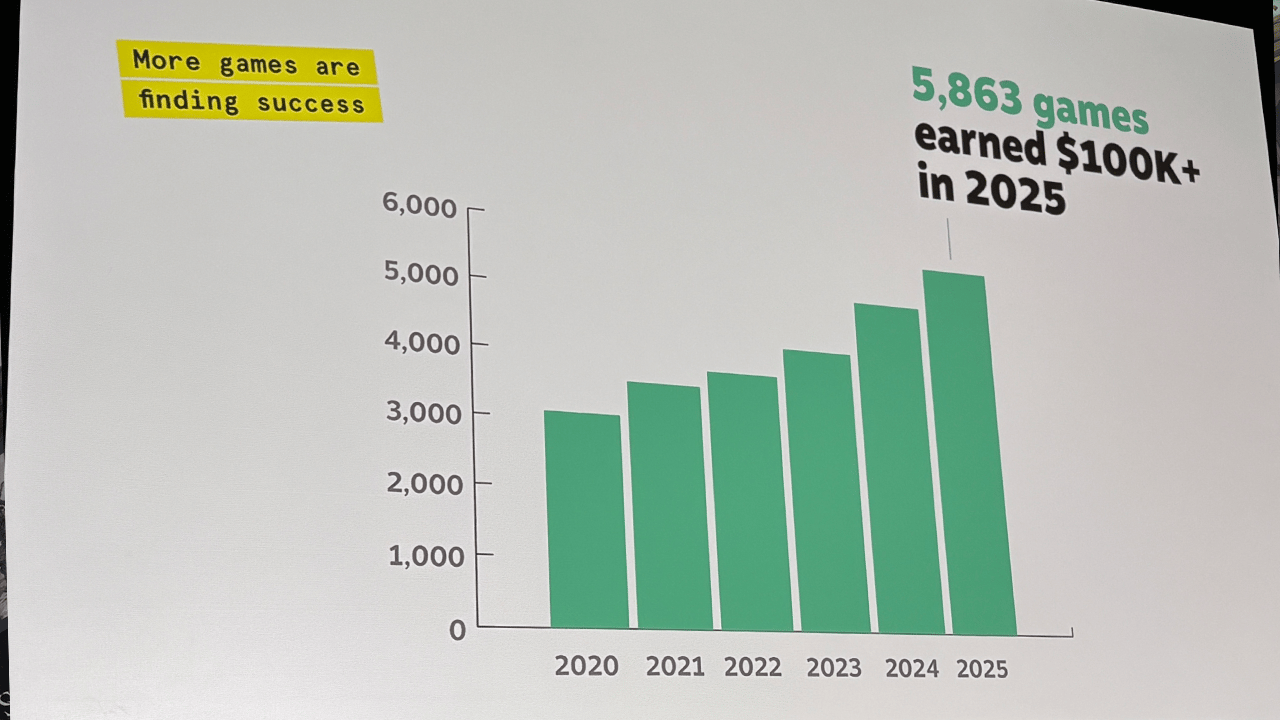
Valve has revealed that 5,863 games released on Steam earned over $100,000 in 2025.
The company shared the news during a talk at GDC Festival of Gaming alongside a deluge of other metrics (posted on Bluesky by yours truly) it claimed indicate the platform is in rude health and fulfilling its mandate of serving video game developers.
Offering some context, Tom Giardino, a member of the Steam Business team, explained that only around 3,000 titles earned over 100,000 in 2020—underlining the scale of growth on the platform.
He conceded that earning $100,000 could mean wild success for one team or “total disaster” for another, but reiterated his belief that “dramatically more games” are finding success on the PC storefront.
“We also look at these numbers for other thresholds, like $500,000 per year and $1 million per year, and the trend lines stay really consistent there,” added Giardino.
“The other nice thing is thinking back to some of the user numbers we shared [earlier in the talk], and the number of games finding success on Steam is generally keeping pace with user growth. Both the number of concurrent users and in-game users, and the numbers of games finding success, is about double over the last five years.”
At the top of the talk, Giardino and his colleague Kaci Aitchison Boyle—communications head at Valve and the Steam team—revealed that Steam passed 42 million peak concurrent users just a few weeks ago.
“That’s just the count of people who have the Steam client running,” clarified Giardino. “If you’re like me, sometimes the Steam client is running on your PC, even if you’re not shopping or buying a game.”
With that in mind, Giardino provided another metric of growth by revealing that in-game concurrents just hit a new record of 13.9 million users. “To put those numbers into context, if you go back about five years to the 2020 phase—this is double the peak concurrent and in-game users from five years ago.”
Giardino suggested those numbers are “good news” for developers (while acknowledging concerns over platform saturation), and stressed that Valve remains laser focused on “making the opportunity bigger on Steam.” That’s why, he said, Steam will always answer to its users.
“A lot of companies are structured in a way where the numbers and the growth—and number go up—is kind of the driving force,” he continued.
“That structure of problem solving creates a lot of short-term thinking and a lot of short-term incentives and sometimes incentivizes decisions that aren’t necessarily great for players or for long term sustainability of a platform.
“Valve is pretty different. We’re a relatively small company in terms of headcount. We are private. We don’t have investors. We don’t have a stock price, and we don’t have impossible expectations around infinite growth.”
Evidencing that point, Giardino said the company tweaked Daily Deals in service of developers by “leaning really hard into personalization” while also increasing the volume of available deals.
Those changes provided developers with direct access to Steam’s internal calendar so they can claim the open Daily Deal slots that best suit their needs. The result? Giardino said “way more games” featured in Daily Deals.
In 2025, Steam Daily Deals featured over 1,500 individual titles. 69 percent of those video games had never been featured in a Daily Deal spot before. Meanwhile, 8.2 million customers purchased a Daily Deal in 2025— representing a 125 percent increase year-on-year.
“This is what we mean by making the pie bigger,” added Giardino. “Thanks to those improvements, developer revenue from Daily Deal spots increased 274 percent year-over-year. That substantially outpaced our revenue growth and user growth, and literally allowed a lot more devs making a lot more money from Daily Deals because we invested in this new system.”
Game Developer and GDC Festival of Gaming are sibling companies under informal Festivals.