

Microsoft shared more technical details about its next generation console, codenamed Project Helix, at GDC Festival of Gaming.
Xbox VP of next generation, Jason Ronald, kicked off a day of talks by explaining how the device—which Microsoft already confirmed will play both console and PC titles—will serve developers
“Project Helix is designed to play your Xbox console and PC games, delivering high performance and providing the ultimate player-first experience. We’re partnering closely with AMD to define the next generation of rendering and simulation,” said Ronald.
Project Helix will be powered by a custom AMD-based SOC and is co-designed for the next generation of DirectX. According to Ronald, the console will “bring intelligence directly into the graphics and compute pipeline” to deliver step change functions and gains in efficiency, scale, and visual ambition.
It will include an “order of magnitude” increase in ray tracing performance and capablity, beyond what’s currently possible with Xbox Series X | S, while unlocking GPU directed work graph execution to eliminate CPU bottlenecks.
Ronald said this means the GPU can generate its own workloads in real time to deliver a “massive uplift” in performance and enable massive real-time simulations that involves complex worlds using runtime generated geometry and large scale interactive worlds. The console has also been designed for the “next generation of neural-assisted rendering,” according to Ronald.
“We’ve reached some of the limitations of what’s possible with traditional rendering techniques, and if we want to continue advancing the state of the art we have to invent brand new technology,” he added.
Key to achieving that aim will be the integration of the next version of AMD FSR into the Project Helix development kit.
“This is really designed for that next generation of neural rendering techniques. Whether that’s neural materials. Whether that’s generated images. Or even if you think about things like the latest ML (machine learning) based upscaling techniques or super resolution techniques,” said Ronald.
“You think about brand new ML based multi-frame generation. There’s even new capabilities, such as a brand new ray regeneration technique that’s really designed to deliver high performance ray tracing for both real-time ray tracing and path tracing.”
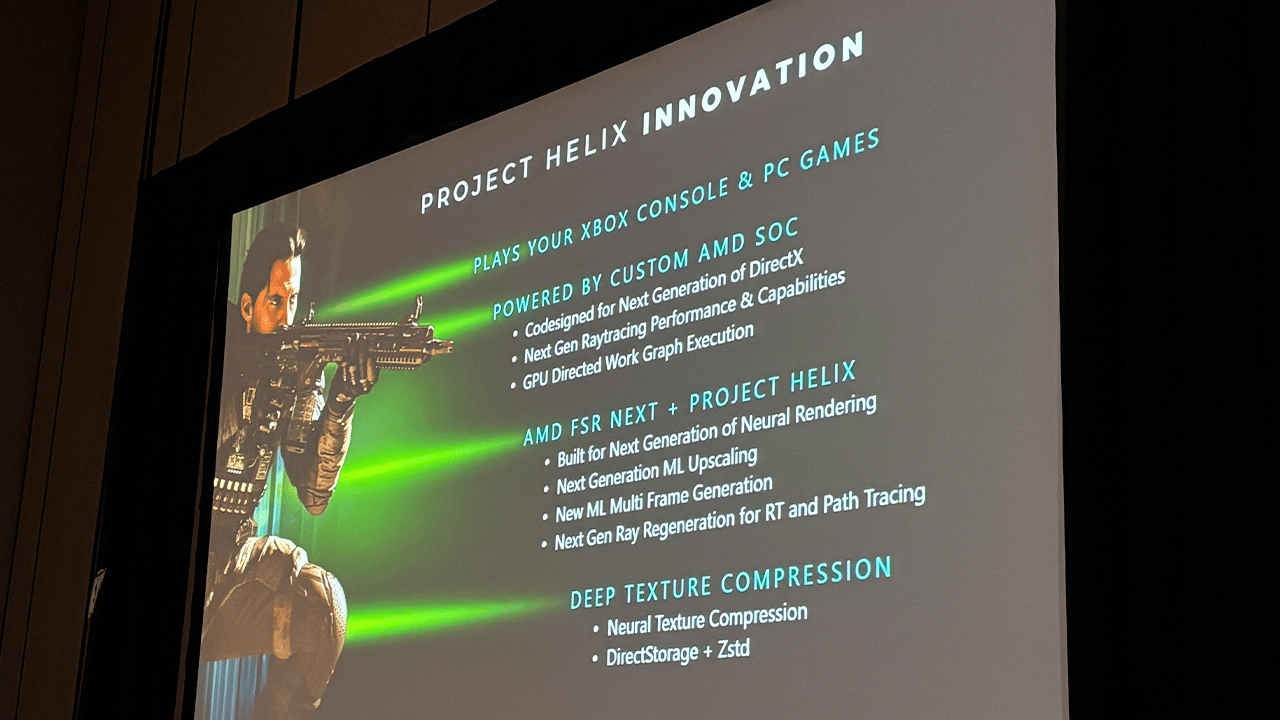
Another area Microsoft is focused on with Project Helix is what the company calls “deep texture compression,” which Ronald claims will allow developers to continue pushing bounders while levering the hardware in more efficient ways. Notably. he said this could be a key feature as storage and memory prices continue to swell.
“There’s a ton of work that we can do on the hardware side. There’s a ton of work that we can do on the software side, but it’s also about how you take advantage of this as developers. And so when we talk about deep texture compression, that includes the latest neural texture compression techniques, but we’re also leaning in very heavily into Z standard as well,” said Ronald.
“So, that is a capability that allows you to use the latest version of direct storage and be able to stream assets directly off of the storage drive and be much more sensitive in how you’re actually using memory, because you can actually stream it directly off of the SSD itself.”
So, when will developers get their hands on the hardware? Ronald said Microsoft will begin sending alpha versions of Project Helix to developers starting in 2027. Admittedly, that’s a big window, but at least it’s there in black and white.