
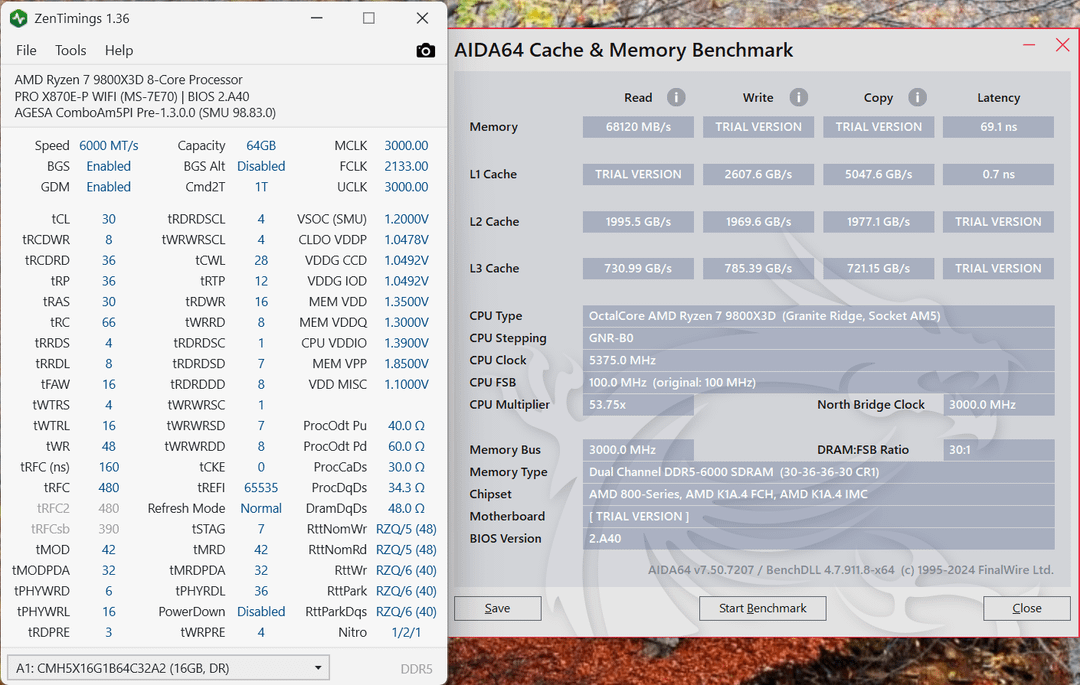
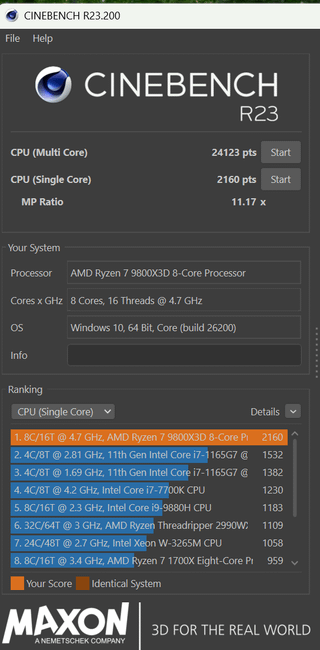
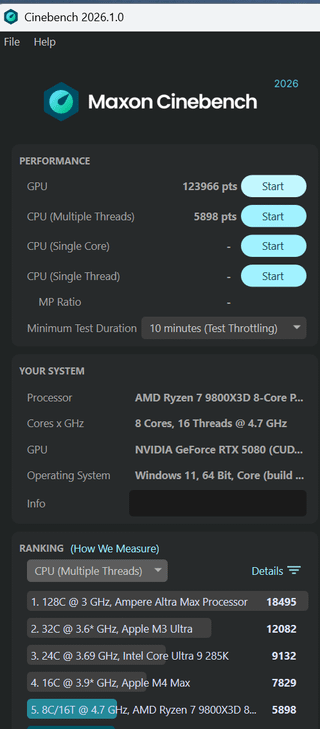
Hey all, I think that I have run out of changes that I know of for tweaking a 4-DIMM DDR5 setup. AIDA latency 69.1ns (real-time priority). Cinebench scores in images are with high priority set.
I've posted a couple times along the way, and greatly appreciate the help people have given.
4x16GB M-die Hynix RAM. The two sets were manufactured over a year apart. Both sets are Corsair Vengeance RGB rated 6400 CL32.
Hidden parameters:
VSOC is actually 1.15 (reported in HWINFO)
XMP on, DRAM high volt enabled (so I could alter VDD and VDDQ independently), UCLK == MCLK, FCLK UDCI mode predictive, nitro robust training mode enabled, rx/tx burst 8x/8x, PPT limit 148W, TDC 120, EDC 160, thermal limit 87C, MCR enabled.
Will not post with any lower tRFC.
9800X3D CPU is running +175 with per-core with 2 top cores -20 and others at -25. Any further reduction in voltage causes y-cruncher errors. PPT limit of 148W allows CPU to reach full PBO (+175) while limiting heat.
Zotac OC 5080 GPU – set Mem +3000Mhz, and then edited curve so 900mv at 3000MHz and then flat at 3200. Power limit 97%.
The whole rig is stable, passes y-cruncher and OCCT without errors.
Temps while running Cinebench R23: CPU temps get to 84.9C max, while DIMM temps stays nice and cool near 45C.
I had issues with RAM temps early on (initially preventing max REFI), but after adding an additional 140mm intake to the bottom-right of my corsair 3500x case, the max DIMM temps stay under 51C on all my testing. The extra 140mm fan allowed me to also reduce the overall flow on my intakes, so the noise is 35db at rest and 45db at full tilt.
After getting everything stable at FCLK 2000, I took the risk and upped to 2133. Happily everything stayed peachy!
I would appreciate any advice. I started this as very naive and have learned a huge amount. I have made strong use of Google AI to assist with advice on iterative testing. Prior to using it I was chasing my tail and trying to ignore issues I didn't know how to sort…