
The Spire has risen again, and this time, five heroes (sort of? hero-ish?) have come to stop it. Here’s what you need to know about the central cast of Slay the Spire 2.
Slay the Spire 2 Characters Guide
When you first start StS2, only one character is available: the Ironclad. Your next character, the Silent, is unlocked by simply by playing as The Ironclad.
Each of the five main characters in StS2 has their own arsenal of cards, which works to support their unique individual game plans. Here’s a quick and dirty breakdown of each character’s strengths, weaknesses, and core mechanics, to help you decide who to focus on and where to start once you’ve got the whole crew unlocked.
Note: Slay the Spire 2 is, at time of writing, newly released in Open Access. While it’s fully playable and all 5 characters are available in the day-1 build, many of the fine mechanical details are subject to change. We’ll be keeping on top of this wiki as StS2 continues to evolve through its EA period.
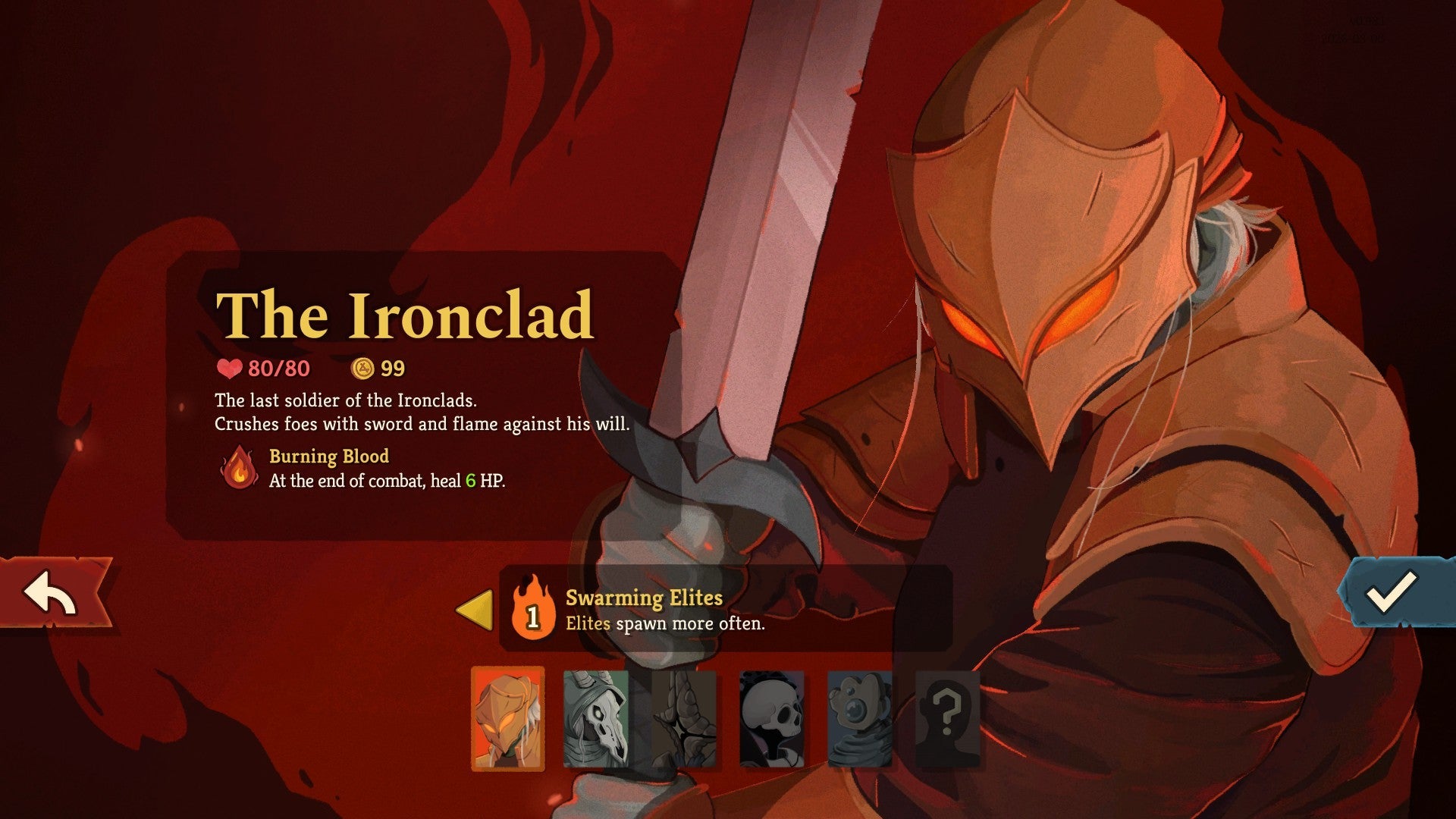
The Ironclad

“The last soldier of the Ironclads. Crushes foes with sword and flame against his will.”
Starting Relic: Burning Blood
Starting Cards: Strike x5, Defend x4, Bash
Starting Health: 80
Unlock Conditions: None
Even if you didn’t have to start with the Ironclad, he’d be a good starter character. His Burning Blood Relic restores 6 HP whenever he wins a fight, and while that might not sound like much, it’s consistent and useful in a game that otherwise attaches significant costs to healing.
In addition, the Ironclad has some of the easier-to-grasp character builds in StS2. There’s no subtlety here; he is about running up on somebody and beating them into paste. Stack Strength as high as it’ll go and watch monsters explode.
If you just want a simple deck that can carry you through to Act 3, try to pick up and build around Body Slam, which directly converts Block value into offensive punch. Just focus on maximum defense, and when you draw a Body Slam, ideally upgraded, use it to slap down whatever’s in your way.
The Silent
“A huntress from outside the Spire. Ready to stab and poison anything in her way.”
Starting Relic: Ring of the Snake
Starting Cards: Strike x5, Defend x5, Neutralize, Survivor
Starting Health: 70
Unlock Conditions: Play as The Ironclad.
The Silent is a little more subtle and a lot less direct than the Ironclad. As in the original game, she has two basic plans: either you drown your enemies in the Poison debuff, or you generate and throw as many daggers and Shivs as you possibly can.
The advantage to a Poison build is that it bypasses many enemies’ defensive gimmicks, such as Plating or Hardened Shell. It doesn’t do a thing about Intangible, however, and it’s not useful for any kind of burst damage outside of a couple of niche circumstances. You’ll want to keep your Block high for a Poison build while you wait for your enemies to keel over. Noxious Fumes is the usual go-to here, but if it delivers Poison, it’s got a place in the deck.
Shiv builds, conversely, take a bit of work and a lot of support before they’re viable, but it’s a lot of fun to mow down your enemies with what’s essentially a machine gun that fires knives. Look for cards like Blade Dance, Knife Trap, Cloak and Dagger, and especially Accuracy.
The Regent
“Heir to the Throne of Stars. Wields cosmic powers but his minions do the work.”
Starting Relic: Divine Right
Starting Cards: Strike x4, Defend x4, Falling Star, Venerate
Starting Health: 75
Unlock Conditions: Play a run as the Silent.
When you play as the Regent, you’re asked to balance a second resource, Stars, alongside your Energy pool. Any Stars you’ve got are permanent until spent and you can stockpile at least 24 of them at a time.
Many of the Regent’s Cards cost both Energy and Stars to use. As a tradeoff, the Regent’s deck does have more and varied ways to build and generate Energy than other characters’, but you also have to keep your Stars rolling. It’s an elaborate push-pull, but it’s more intuitive than you might think once you’ve played a few rounds.
The simplest build for the Regent revolves around his Forge mechanic. Whenever you Forge, you activate an Innate 2-cost card, Sovereign Blade, that starts as a powerful single-target attack. With more cards like Seeking Edge, Conqueror, and Falling Star, you can eventually build each swing of Sovereign Blade up into a virtual apocalypse.
Another option is to focus on high Star generation, along with Powers that passively boost your Block or provide free damage whenever you build or spend Stars. If you stockpile them effectively, you can then burn them all at once on some of the Regent’s high-end rare cards like Seven Stars as a simple, straightforward nuke.
The Necrobinder
“A Spireborn lich who seeks revenge. Calls upon her trusty left hand, Osty, in combat.”
Starting Relic: Bound Phylactery
Starting Cards: Strike x4, Defend x4, Bodyguard, Unleash
Starting Health: 66
Unlock Conditions: Play a run as the Regent
At the start of each fight, the Necrobinder automatically summons Osty, her faithful bodyguard. Osty has a permanent power, Die For You, which forces it to automatically block any attack that would otherwise strike the Necrobinder. Osty’s essentially an extra layer of HP on top of the Necrobinder’s low starting health pool.
Initially, Osty only has 1 HP, but any Summon effect adds to its current/maximum health. If Osty dies, any Summon effect, such as the Bound Phylactery, will raise it again at the start of your next turn. However, any extra HP will be lost; a freshly raised Osty is back at 1 HP.
If Osty dies due to deliberate sacrificial plays like Bone Shards, it’ll stay dead regardless of Summon until your next turn. You don’t appear to be allowed to blow Osty up and immediately bring it back.
Notably, Osty counts as its own unit for purposes of debuffs. If the Necrobinder is afflicted by effects such as Weak, Vulnerable, or a Strength drain, they do not target and do not affect Osty.
The Necrobinder’s two big game plans are to either turn Osty into a five-finger death punch or to focus on inflicting her unique debuff Doom. If an enemy has stacks of Doom equivalent or greater than their current HP, they die at the end of their next turn. This does give them one last chance to take you down with them, but it allows you to bypass defensive measures, ignore their Block, or set up powerful one-shot combos.
The Defect
“An automaton eternally modifying itself to survive. Deploys Orb technology when it must fight.”
Starting Relic: Cracked Core
Starting Cards: Strike x4, Defend x4, Zap, Dualcast
Starting Health: 75
Unlock Conditions: Play a run as the Necrobinder
The Defect has returned for another go at the Spire, and it’s much the same as it was. If you remember playing the ol’ lightning robot last time around, you’ll be on familiar ground here from the start. If you’re new with StS2, however, there’s a learning curve.
The Defect enters play with 3 empty Orb slots hovering above its head, one of which is automatically charged with Lightning by its Cracked Core relic. When an Orb is charged, it adds one of 5 (well, 4) passive effects at the end of the Defect’s turn:
Lightning: hits a random target for 3 + Focus electrical damageFrost: adds [2 + Focus] BlockDark: nothing unless Evoked, but gains 6 damage every turnGlass: deals [4 + Focus] damage to entire enemy team, diminishing by 1 each turn; at 0, stops workingPlasma: generates 1 Energy at the start of your turn (unaffected by Focus)
You can also Evoke your Orbs, which empties them in exchange for an active effect. This is either done through cards such as Doublecast or by overfilling your available Orb slots, at which point your leftmost Orb will be Evoked to make room.
Lightning: hits a random target for [8 + Focus] electrical damageFrost: adds more BlockDark: hits the lowest-health enemy target for [6 + Focus] shadow damage, raised by 6 for every turn the Orb was chargedGlass: deals [8 + Focus] damage to entire enemy teamPlasma: generates 2 Energy (unaffected by Focus)
This sets up a natural ebb and flow for the Defect. You set up a steady flow of channeled Orbs to keep Evoking them over time, passively generating damage, Block, and Energy along the way, letting them do all the work. The Defect also gets a lot of useful, complimentary Power cards that can supplement an Orb-heavy play style. Capacitor in particular is a slam pick, as it can give you up to 6 more Orb slots to work with.
That being said, an Orb Defect build can be effective in the mid- to late game, but it’s slow and feels more like mining work than a video game unless you find ways to stack Focus to the moon (Hotfix, Focused Strike, Data Disk).
The other traditional way to play the Defect is to ignore the Orbs entirely and focus on its array of hard-hitting zero-cost attacks. If you simply grab a fistful of Claw cards and keep spamming them as hard as you can, especially with All For One in reserve, the Defect’s perfectly capable of turning most monsters into soup by the fifth turn.
More coming soon!