
From Alphari’s buyout to eight-figure sponsorships: A deep look into Team Liquid’s finances
A Harvard Business School study published in 2023 offered a rare look inside the finances of Team Liquid, one of the most recognizable organizations in competitive gaming. The report traced how the company evolved from a community-driven gaming clan into a global esports business valued at nine figures while revealing how its revenue actually works behind the scenes.Since the publication of the study, the organization has continued to evolve. Team Liquid remains one of the most decorated teams in competitive gaming and, according to Esports Earnings, is the highest-earning esports organization in history in terms of total prize money. The company fields teams across major titles including League of Legends, Dota 2, Counter-Strike 2, VALORANT, Rainbow Six Siege, Overwatch, Mobile Legends: Bang Bang, and others, reflecting a strategy built on global presence and multiple competitive ecosystems.
Strong growth before profit
By the early 2020s, Team Liquid had become one of the highest-earning organizations in the sector. The company generated $23.5 million in revenue in 2019 and projected $62.4 million for 2023, showing the organization continuing to expand despite a tougher market during esports winter.
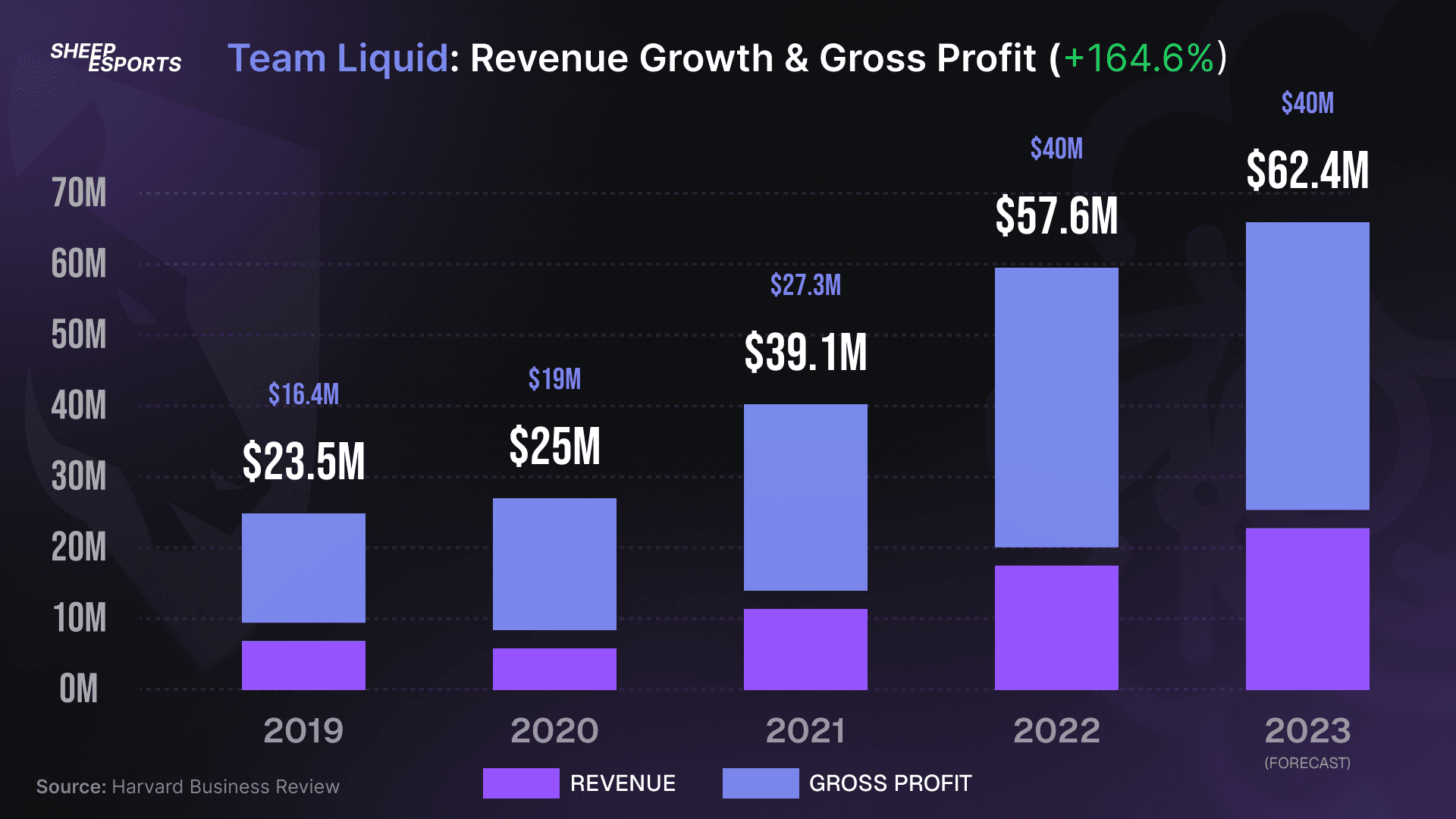
Team Liquid revenue growth as shown in the Harvard Report
Yet, like most teams, profitability remained elusive during this growth phase. Team Liquid reported negative EBITDA of $2.6 million in 2019, which more than doubled in 2022. By 2023, however, the deficit had nearly disappeared, with the organization forecasting a number on the verge of breaking even with the aim of becoming positive.
Growth after the report amplified with EWC
Like it was forecasted, Team Liquid Co-CEO Steve Arhancet revealed in an interview with Esports Insider that Team Liquid did achieve its 2024 goal of being EBITDA positive, he also stated that it was “one of the best performing years athletically and financially for Team Liquid”. According to sources who talked with Sheep Esports, the growth in 2024 was driven in particular by participation at the Esports World Cup.
Revenue generated from participating at the competition is significant due to two revenue sources: While prize money earned from competitive placements at the tournament as well as the Esports World Cup’s Club Partner Program, have both become meaningful revenue streams for the organization.
Like most esports organization, revenue from sponsorship account for a vast majority. The organization generated $12.1 million in sponsorship revenue in 2019, rising up to a projected $29.2 million in 2023.
Partners cited in the 2023 study included Honda, Alienware, SAP, Coinbase, and Monster Energy. Since the report, Team Liquid have expanded their roster of sponsors to include Duelbits, Visa, and more. Some older partnerships, such as Honda, have been terminated since then.
Interestingly, The Harvard report stated that Team Liquid did not simply increase the number of partners over time. Instead, it consolidated its portfolio and increased the value of each deal. Earlier in the organization’s history, around 14 partners collectively generated less than $1 million. In years leading up to 2023, roughly seven major partners had produced about $30 million annually.
Competitive success still matters
While sponsorships drive the business, performance in competitions still contributes a meaningful share of revenue.
In the report, Team Liquid averaged about $3.68M in tournament winnings per year. Considering this doesn’t include revenue sharing, it represents a significant number. According to Esports Earnings, as of February 2026, Team Liquid has amassed over $56.3 million in total prize winnings, which would position it as the highest-earning esports organization in history. However, it is worth noting, that a portion of the prize money might be paid back to players, depending on their contracts.
League participation agreements, revenue shared by game publishers with franchised teams, also grew steadily. These payments increased from $1.09 million in 2019 to $4.68 million in 2022, with nearly $5 million expected in 2023.
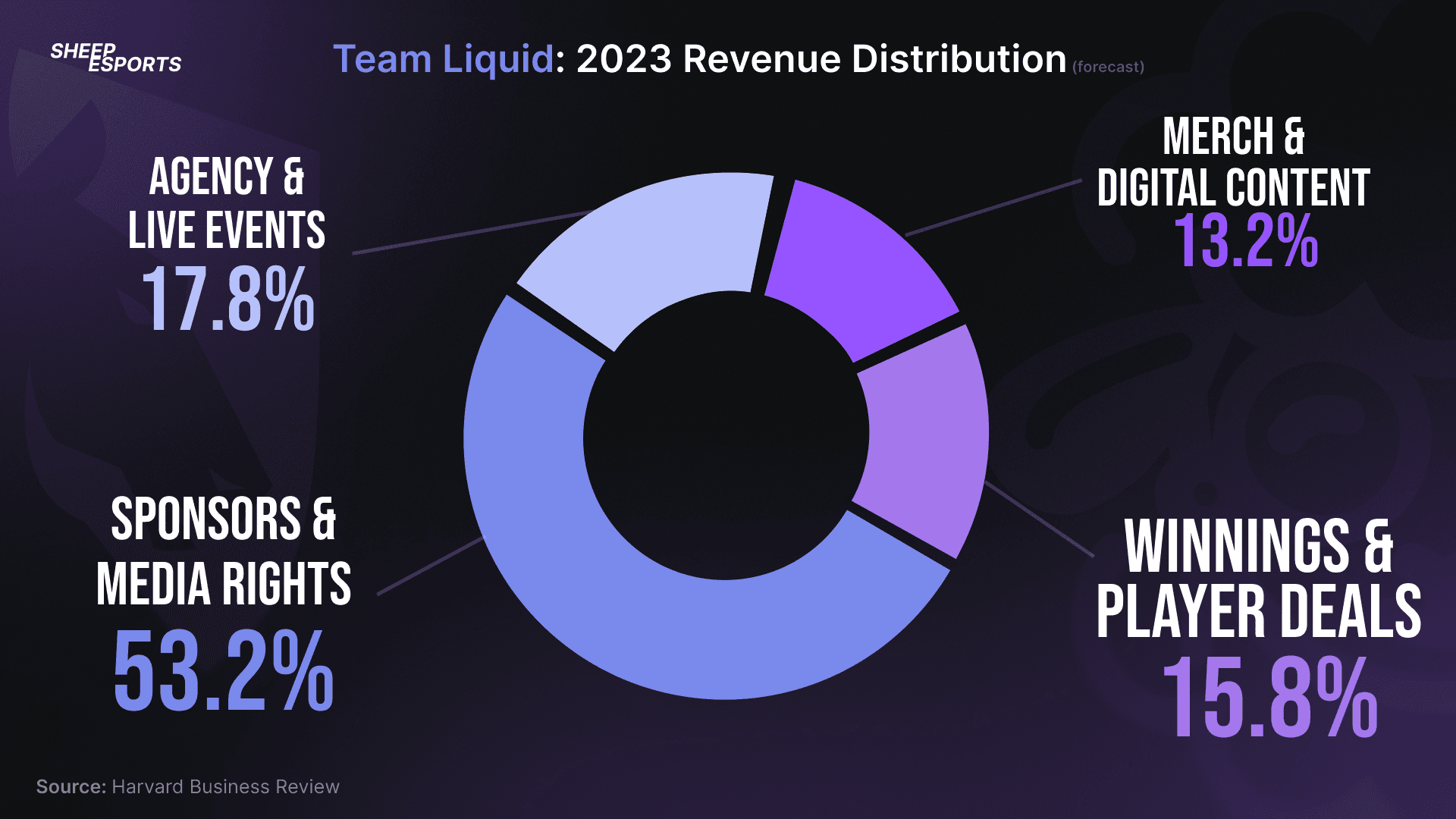
Team Liquid’s revenue distrubition in 2023 | Winnings include both Prize Money and Revenue Sharing from partnered leagues/publishers
According to Sheep Esports, Team Liquid still earns revenue from multiple participation agreements in 2026, including nearly $1 million from Riot Games as a long-time LCS franchised partner.
Buyouts matter less
While Harvard’s report shows no significant revenue from buyout in early years, Team Liquid earned over 1 million $ in transfers in both 2021 and 2022, with estimed numbers going back down steadily the year after.
Coincidently, 2021 is the year that Team Liquid sold League Of Legends player Barney “Alphari” Morris to Team Vitality. According to G2 Esports’ former CEO, the transfer price accounted for 1.5million, but it is not possible to confirm this number just from the report. In fact, only a payment split over multiple years would make this number possible, as no year exceeded 1.5 million from buyouts for Team Liquid.
However, it’s worth noting that even at its peak, revenue from buyouts remains minimal compared to other sources, showing that no business model could rely solely on this strategy.
Fans remain a core of the business
Another portion of the company’s finances comes directly from its audience.
Merchandise sales have fluctuated but remain an important revenue stream, moving from $1.3 million in 2019 to a projected $3.0 million in 2023. Digital licensing, largely tied to in-game items and related content, has become increasingly significant, rising from $392,000 in 2020 to an expected $5.2 million in 2023.
In recent years, Team Liquid has further leveraged fan engagement with platforms like Liquid+ and its successor MyBlue (launched in 2024), which offer fans both digital and real-world rewards. Merchandise collaborations, such as Naruto Shippuden and Death Note collections have also added to revenue and fan engagement.

Team Liquid x Death Note
Diversification beyond just esports
As profitability remains a challenge in esports, many organizations have diversified into new ventures, such as Karmine Corp’s trading card game and G2 Esports’ cryptocurrency-related assets. Similarly for Team Liquid, one of the key themes of the Harvard study is Team Liquid’s push to avoid relying solely on competitive results and sponsorships.
Among its most notable initiatives is Liquipedia, a massive community-driven esports wiki that has become one of the most widely used sources of information in competitive gaming. Still in 2026, Liquipedia remains a central asset, attracting millions of monthly visits.
The company has also expanded into enterprise services. Its creative agency, Liquid Media, produces marketing campaigns, content, and strategy for outside clients ranging from gaming companies to global brands. Another initiative, IRL URL, focuses on apparel and fashion collaborations.
In recent years, TL’s MyBlue platform and the launch of a dedicated OTT esports channel in 2025 further diversified revenue streams, with 24/7 content airing across Sling TV, Plex, Fubo, and other platforms.
In the Harvard report, leadership sees these activities as a way to stabilize the business and reduce dependence on sponsorship deals. Internally, executives have discussed a long-term scenario where enterprise activities could eventually represent around 30% of total revenue, Sheep Esports does not know if recent years point into that direction.
Overall, Team Liquid remains a leader among esports organizations. Despite strong revenue from sponsorships and record-breaking income from tournaments, even at its scale the organization continues to value diversification. It is reassuring to see a leader in the industry posting encouraging numbers, but diversification remains essential to limit risk. Team Liquid’s own sudden loss of Honda reminds how quickly the esports landscape can change, and why even the most successful organizations must stay focused on sustainable growth.
Note that this article only provides a brief perspective on the figures reported by Harvard Business Review. We encourage readers to consult the original report for a more in-depth look at the data and Team Liquid’s perspective.
EDIT: Added source on our images for more clarity.