
7800X3D Tuning: PBO, UXTU (Universal x86 Tuning Utility) Workaround + Memory Optimization
I tuned a 7800X3D on a budget B650M-CW board, pushing it from stock performance to a realistic, daily-driver stable peak. The process combined per-core PBO offsets, structured manual testing, memory tuning, a UXTU workaround, and thermal control via Remoo Fan Control on a basic Thermaltake 240mm AIO.
Claude produced a .docx summary of the tuning process (linked separately), and I'm providing timing screenshots setting screen shots as well as a cheat sheet in comments.
System Overview
- CPU: AMD Ryzen 7 7800X3D (average bin)
- GPU: RX 9070 XT
- RAM: 32GB DDR5 Thermaltake Tough XG RGB — Hynix M-Die SR (EXPO 36-38-38-78, CL36 kit)
- Motherboard: ASRock B650M-CW | BIOS 3.50 | AGESA ComboAM5PI 1.2.0.3g
- Cooler: Thermaltake 240mm AIO
Starting Stock Performance (EXPO Enabled)
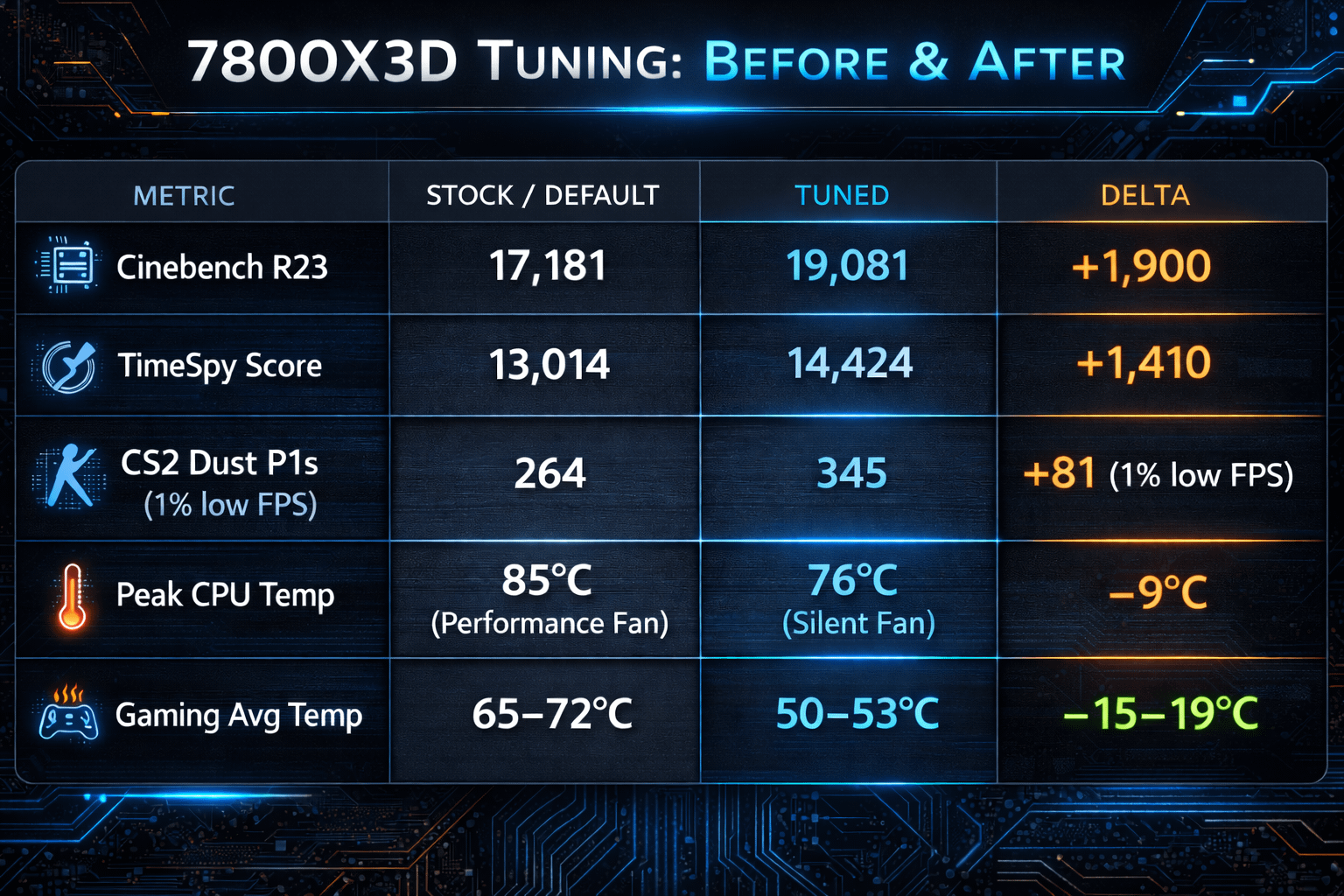
- Cinebench R23: 17,181
- 3DMark TimeSpy Total: 13,014
- CS2 Dust P1s 1% Low FPS: 264
- Peak CPU Temp: 85°C
- Gaming Avg CPU Temp: 65–72°C
- AIDA64 Latency: ~80 ns
Final Performance Summary
- Cinebench R23: 17,181 → 19,081 (+1,900)
- TimeSpy: 13,014 → 14,424 (+1,410)
- CS2 Dust P1s 1% Low FPS: 264 → 345 (+81)
- Peak CPU Temp: 85°C → 76°C (-9°C)
- Gaming Avg CPU Temp: 65–72°C → 50–53°C (-15–19°C)
- AIDA64 Latency: ~80 ns → 60–61 ns
Memory stabilized at 48°C during long stress tests and never exceeded 52°C.
Tuning Methodology
BZ Baseline & Community Research
I started from the BZ baseline and collated posts, comments, and videos from Reddit, YouTube, and overclocking forums to build a structured BIOS profile.
Research focused on:
- Hynix M-die tRFC scaling
- tRC correction theory (tRC < tRCD + tRP creates hidden IMC overhead)
- AM5 IMC voltage sensitivity
- Fabric synchronization and DF-C state behavior
This was done to avoid guessing and instead apply a formulaic approach.
Per-Core PBO Cycling (No Guessing)
I used traditional one-core-at-a-time PBO cycling.
Process:
- OCCT core cycling with 10-second windows per core
- HWiNFO logging to monitor per-core clock behavior
- Identify which cores failed to sustain 4500+ MHz during their solo window
- Adjust Curve Optimizer offset by 1 step after crashes
- Re-test immediately
Core5 was the weakest silicon:
- Pinned at 3233 MHz at CO -27
- Across 29 logged sessions it averaged 86 MHz below every other core
- Ranked last in 7 of 29 runs
Loosening Core5 to CO -23 completely stabilized it.
Core4 then exposed instability at CO -21 only after Core5 was corrected.
Final CO offsets:
- C0: -30
- C1: -28
- C2: -26
- C3: -22
- C4: -21
- C5: -23
- C6: -26
- C7: -26
TimeSpy graphs initially looked unstable under load even after traditional CO tuning. Logs from HWiNFO, TimeSpy, and OCCT single-core runs were used strictly for observation and validation. Every adjustment was manually tested.
AI Usage Clarification
AI was not used to “auto tune.”
It was used only to:
- Read HWiNFO logs
- Help identify weak cores via clock deltas
- Suggest tightening or loosening memory timings one step at a time
All changes were applied manually, one variable at a time, with CMOS resets and retesting across days/weeks.
Memory Tuning (Hynix M-Die CL36 Kit)
Default:
- EXPO 36-38-38-78
- AIDA latency ~80 ns
Final:
- DDR5-6000
- FCLK 2000 MHz
- UCLK = MCLK
- AIDA64 latency: 60–61 ns
Key voltage stack:
- VSOC 1.275V Fixed Mode with LLC2 (reads 1.265V in Zen Timings)
- VDDP 1.150V
- VDD Misc 1.100V
- VDDIO/VDD/VDDQ 1.440V
- SoC/Uncore OC Mode: Enabled
The slight VSOC droop via LLC2 appeared to help IMC boost consistency during all-core workloads. This range was extensively tested on this board and chip.
tRFC was scaled properly to MCLK (160ns × MCLK GHz principle).
tRC corrected to avoid hidden IMC overhead.
EXPO was not blindly trusted.
UXTU Workaround
BIOS PPT limits were hard-locking the CPU at 0.5 GHz.
UXTU (Universal x86 Tuning Utility) was used strictly to modify:
- PPT
- TDC
- EDC
Combined with ECO Mode 65W, this stabilized all-core clocks under load and eliminated TimeSpy instability.
Important note:
Windows Defender may silently quarantine UXTU after updates. When that happens, CS2 P1 can drop from 345 to ~305–316. Add a Defender exclusion for the UXTU directory.
Stability Stack (In Order)
- OCCT core cycling (10s per core) with logging
- OCCT all-core (AVX512 coherency)
- y-Cruncher VT3 90 min (AVX512 + VSOC/IMC stress)
- TM5 8-hour Ryzen X3D configuration
- Real-world CS2 Dust P1s testing
Fan Management
Remoo Fan Control was used to create silent curves.
BIOS fan profiles were set to Performance Mode as a fallback in case software control failed during real-time benchmarking.
Fan Step Down: 25 seconds to prevent oscillation.
The Thermaltake 240mm AIO maintained:
- 76°C peak under load
- 50–53°C average while gaming
Key BIOS Changes & Rationale
CPU & Boost
- Precision Boost Overdrive: Advanced
- CPPC Dynamic Preferred Cores: Frequency
- ECO Mode: 65W
- Core CO offsets per above
These allow strong cores to boost higher while weak cores are stabilized.
Fabric & Memory
- DDR5-6000
- FCLK 2000 MHz
- UCLK = MCLK
- DF-C States: Enabled
- Global C-State Control: Disabled
- ACPI _CST C1: Disabled
- Memory Context Restore: Disabled
- Power Down Enable: Disabled
DF-C was critical for DDR5-6000 stability. Disabling it previously caused instability.
Voltage & Power Delivery
- SoC Voltage: Fixed Mode
- VSOC 1.275V LLC2 (1.265V effective)
- VDDP 1.150V
- VDD Misc 1.100V
- VDDIO/VDD/VDDQ 1.440V
- SoC/Uncore OC Mode: Enabled
Misc / Security / Compatibility
- AMD CPU FTPM: Disabled (removes firmware overhead)
- WAN Radio: Disabled
- IOMMU: Disabled (reduces latency)
- SVM: Disabled
- SMEE / TSME: Disabled (removes encryption overhead)
- PCIe ARI Enumeration: Auto
- FCH Spread Spectrum: Disabled
- REP-MOV/STOS Streaming: Enabled
- Enhanced REP MOVSB/STOSB: Enabled
- Advanced Error Reporting: Not Supported
- dGPU Only Mode: Enabled
- Auto Driver Installer: Disabled
These changes collectively reduce background overhead, power gating, and frequency modulation that interfere with sustained boosting.
Key Takeaways
- An average-bin 7800X3D can reach realistic peak performance with disciplined per-core CO tuning.
- Core cycling with clock verification reveals weak cores — not guesswork.
- tRC and tRFC tuning matter more than most expect on Hynix M-Die.
- VSOC tuning with controlled droop helped IMC boost stability.
- UXTU + ECO Mode is essential on ASRock B650M-CW boards with PPT lock behavior.
- DF-C and C-State configuration are critical for DDR5-6000 stability.
- Logs were observational; every adjustment was manually validated.
- Memory stabilized at 48°C and never exceeded 52°C during extended stress.
TL;DR
- Per-core CO tuning with validated offsets
- VSOC 1.275V LLC2 (1.265V effective)
- DDR5-6000 Hynix M-Die CL36 tuned to 60–61 ns latency
- UXTU PPT/TDC/EDC workaround for BIOS lock
- Cinebench +1,900
- TimeSpy +1,410
- CS2 Dust P1s 1% Low +81
- CPU peak temp -9°C
- Gaming CPU temp -15–19°C
- Memory stable under 52°C