
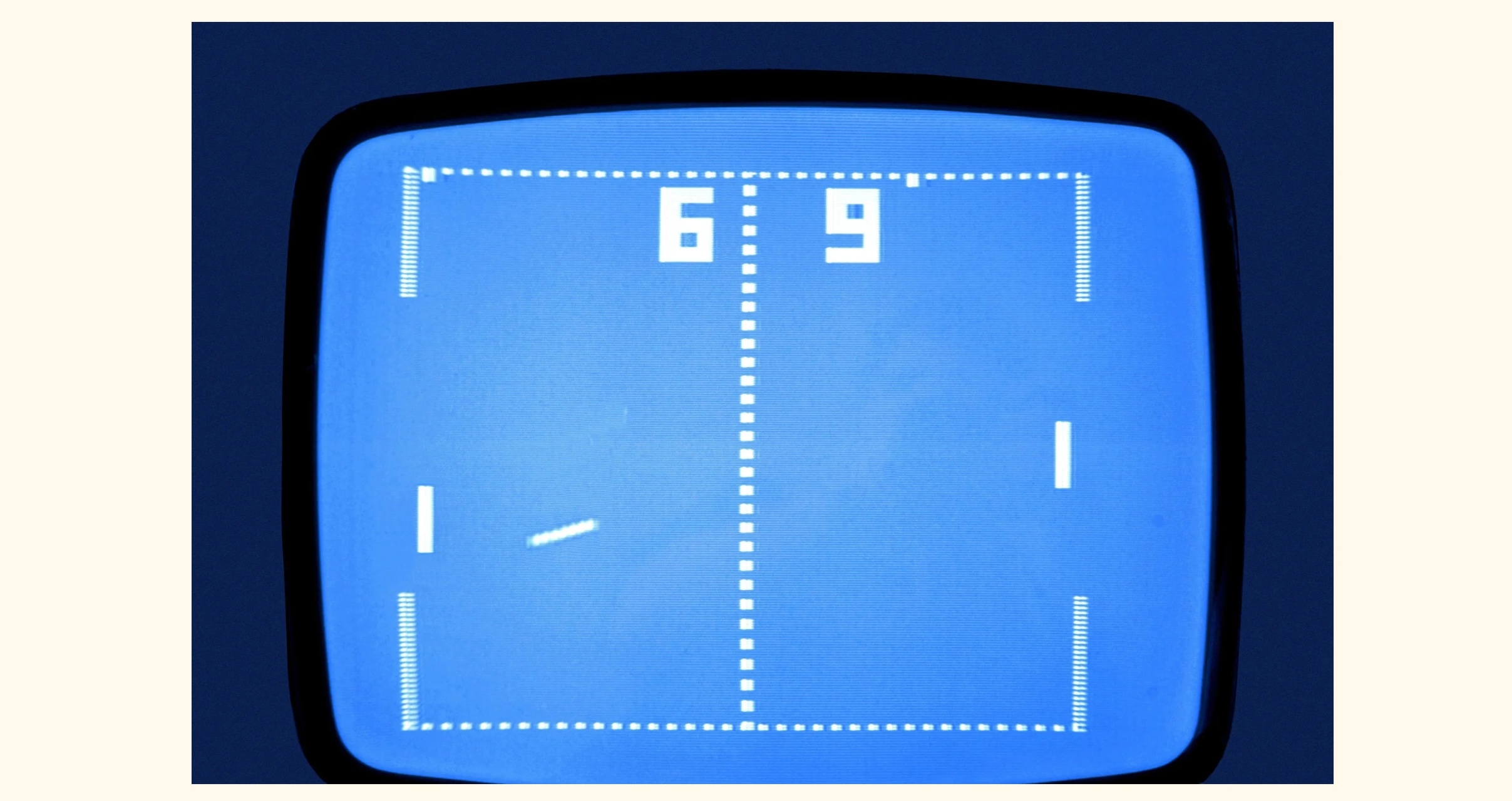
A revolution was televised in 1972. It cost beer drinkers 25¢ a play. After work, thirsty folks rambled into Andy Capp’s Tavern in Sunnyvale, CA to knock back frothy, cool mugs and test their skill against the cruel silver ball. Cheap beer and pinball characterized this workaday watering hole, as did peanut shells casually tossed to the floor. One late summer day, those eager to pull the plunger on Bally’s Skyrocket or Gottlieb’s groovy 4 Square encountered a strange, sedate intruder encroaching upon the world of titillating backglass art, hypnotic playfields, and the cacophony of clamorous clang.
Article continues after advertisement
There, conspicuously perched on a wooden barrel-cum-pedestal, sat a small hand-painted orange contraption with contact paper decorating its sides in the sordid splendor of woodgrain, its earth tones very much of an era steeped in a melody of harvest gold, rust, and avocado hues. The gizmo’s stout bluntness raised the question: “What is it?” Its modest cabinet revealed nothing more than a small, black and white Hitachi TV. This tube emitted weird photons set deep in a cabinet of curiosity with its protruding wooden bezel deceptively amplifying the dimension of the TV screen, a diminutive 13-inches.
In contrast to a conventional TV, this screen didn’t display broadcast television. A mesmerizing phosphorous square ball “bouncing” across the small screen divided by what resembles a “net” has replaced All in the Family. Thin rectangles, possibly “paddles” move vertically. Numbers—“the score”—flash left and right above the “court.”
One spot. Two paddles. A square ball, net, and score. That’s it.
Sparse, frighteningly minimal compared to the tawdriness of the typical pinball playfield. Beneath the screen a brushed steel plate houses two knobs, one for each pair of hands to turn. Whereas with pinball a player can prod, pulsate, and press on their own here, a player has no choice but to compete directly against another person. This thing’s a social mixer, taking two to tango. Knobs are intuitive, familiar. They already twist to adjust a Volkswagen Beetle’s AM/FM radio tuner or lower the volume on a wooden TV console at home. Instructions are absent. A single, monosyllabic word appears in all-caps SHOUTING this thing’s name: “PONG.”
Article continues after advertisement
The prototype to PONG proved so wildly popular and profitable, its innards couldn’t digest the success.
It isn’t accompanied by “PING” to make this device legible, a little more obvious to the uninitiated or inebriated. Christening the machine took priority over explaining what to do with it, though its on-screen score, divided court with oppositional paddles make it largely perceptible. The basic ingredients are all there.
Until now, people only watched TV. Why imagine anything else beyond Mary Tyler Moore? A ruddy coin box, one probably liberated from a mechanical pony ride, or laundry machine signals that to play this TV requires 25¢. Another symptom of the era’s Great Inflation: a single game of pinball costs a dime; a beer ran just shy of a buck. Will anyone pay to play?
That question brews at a certain table in the bar. Quietly clutching their beers with an eye keenly fixed on this anomaly are two of the three men responsible for its existence: Nolan Bushnell and Allan “Al” Alcorn. They sit back, looking on in apprehension, hoping someone spots the machine on its barrel, walks up to it, inserts a coin, and plays… all before their beers go flat along with the hopes they’ve pinned on this experiment.
A few weeks later, Bushnell and Alcorn’s telephone at their newly formed company, Atari Inc., rang angrily. An annoyed voice on the other end belted: “the damn machine is broken.” Alcorn drove frantically over to Andy Capp’s to diagnose the problem. As he opened the cabinet, he quickly discovered that the malfunction wasn’t the circuitry or the hardware. No, instead, the makeshift bread pan used to collect quarters had spilled over causing the coin-mechanism to jam. Alcorn started scooping up quarters from the floor by the handfuls. The prototype to PONG proved so wildly popular and profitable, its innards couldn’t digest the success. Hardly a glitzy image—a burly engineer panning silver from a peanut shell laden bar floor—for the dawn of the video game industry but a marvelous problem to have for a tech start up.
Half a century later, PONG still resounds. The prototype from Andy Capp’s Tavern now rests as an illustrious object at the Computer History Museum in Mountain View, CA, and PONG at large basks in the prestige of being one of the first video games inducted into the World Video Game Hall of Fame at The Strong National Museum of Play. NPR’s popular “Morning Edition” reported the game’s golden jubilee on November 28, 2022 with a short segment entitled, “Where did the time go? Video game ‘Pong’ turns 50.”
Article continues after advertisement
Contrasting Elden Ring’s blockbuster quality soundtrack with that of Pong’s primitive mmPUCK tone, host Rachel Martin quips that listener’s radios are not glitching. Atari SA marked the occasion of Pong’s 50th with Atari 50, a “greatest hits” multi-platform software collection, rebranding its slogan with the retro-luscious “Since 1972” in celebration of its legacy.
Like Peter Parker’s radioactive spider bite, Atari’s origin story is renowned.
Even more recently, The New York Times referenced Atari’s inaugural product to address concerns over President Joe Biden’s age after his poor debate performance with Donald J. Trump in June of 2024. The article’s author, Peter Baker, reminds readers that Biden’s years of service to national politics began “the same year that the video game Pong was introduced.” Perhaps one of the highest accolades bestowed upon PONG can be found on fashionable Friedrichstrasse in central Berlin. Here at the Volkswagen Group’s ICONIC: A Timeless Journey of Culture, Society and Mobility exhibition, PONG mingles alongside the Porche 911, VW Beetle, and the Egg Chair by legendary Danish designer, Arne Jacobsen, as a celebrated icon of modernity.
Who would have thought that anyone still cared about PONG let alone, Atari, when popping shields in another season of Fortnite Battle Royale, anchoring in Apex Legends, scoring a hat-trick as Raphinha in EA Sports FC 25, madly counting down the days to Grand Theft Auto 6, or wishing Bethesda would by-pass The Elder Scrolls 6 to fast-track Fallout 5?
Like Peter Parker’s radioactive spider bite, Atari’s origin story is renowned. Told and retold across countless blogs, newspapers, magazine articles, and books written by fans, journalists, and academics, confirmed in interviews and oral histories, revisited and recreated in documentaries, even shared at museums the world over. That pile of loose change collected by Alcorn seemingly grew into a mountain of riches that presaged “the birth of the video game industry” too often followed by the inevitable listless cliché, “and the rest is history.”
For Atari, this moment launched the fresh-faced company as a major West Coast player in the coin-op amusement industry back East, eventually enabling the company to profitably shift into consumer electronics for the home market, before crashing down to earth ten short years later. But in that time, PONG begat an entire industry, an iconic and enduring brand, not to mention a cultural and social phenomenon with revenue now well into the billions globally.
Article continues after advertisement
Just the same, let’s step away from the cliché. For me, reprising that fanciful moment at Andy Capp’s Tavern is neither cause to tell a revered story the same way, nor to refute, revise, or relegate its importance. No photographs exist of the prototype at Andy Capp’s Tavern. Bushnell and Alcorn did not take any they assure me. Why would they? Pong’s installation wasn’t a beta test, as often claimed. They weren’t even confident that they had a viable product to warrant any type of planned pre-release cycle. Drinking beers to observe if patrons take an interest in their expeditiously assembled prototype is worlds away from the dressed down pageantry of Steve Jobs on stage at the Macworld Expo in San Francisco in 2007 announcing Apple’s new iPhone, or Elon Musk, unveiling the electric automobile company’s highly anticipated Tesla Model 3 in 2017.
Even if I did, magically, have a yellowing snapshot of Andy Capps Tavern from 1972 in hand, I’d forgo the futuristic photo-analysis device that Rick Deckard employs in the original Blade Runner to probe deeper into a photograph, uncovering the minutest details through the commands of “move in,” “enhance,” or “track right.” Meticulous details on Atari’s history are already, indeed, immense. Instead, I’m after a wide shot that doesn’t focus tightly only on a charismatic, visionary entrepreneur, or highly skilled engineer, or isolate that innovative hunk of technology plopped down on a barrel choking down quarters.
The recipe for Pong’s success: mix the central ingredient of place with equal parts engineering and business strategy, a twist of dumb luck, shake well, strain, enjoy.
A jammed prototype reveals little about the place, period, other people and other products that were essential to the making of the moment itself: the business culture of Silicon Valley in the late 1960s. The development of PONG, along with the founding and rapid ascent of Atari, benefits from the rich business and technical research housed on the San Francisco Peninsula. PONG and its progenitors were forged by the bleeding edge technical skills nurtured in the temperate climate of Santa Clara Valley yet channeled into the cold steel of a coinbox for entertainment. Atari didn’t look to the likes of Intel, Advanced Micro Devices, or Teledyne for inspiration. It turned to coin-op amusement companies based in Chicago where names like Bally, Gottlieb, and Chicago Coin reigned.
This contrasts with investment in aerospace, medical, or military research prominent in the region in the late 1960s and early 1970s. Not only did the foundering figures Nolan Bushnell, Ted Dabney, and Al Alcorn—three former Ampex Corporation engineers with no experience in manufacturing let alone marketing—conceive of a consumer product when the rest of the Valley’s industry directed efforts to research or business, they did so in an area two thousand miles West of the coin-op amusement industry. They envisioned different markets for their products, markets unknown to coin-op amusements. Their approach to market positioning and new product category creation proved just as innovative as the technology running their products. The recipe for Pong’s success: mix the central ingredient of place with equal parts engineering and business strategy, a twist of dumb luck, shake well, strain, enjoy.
To enhance the significance of PONG and the early days of one of the most revered companies to blossom in the Valley, King Pong serves (pun absolutely intended!) a story of innovation in market development. Atari’s success isn’t reducible to a single factor but multiple. And this story is best told with a blend of business history and strategy, Silicon Valley history, and electronic game history.
Article continues after advertisement
The book shows how Atari’s strong product positioning and category creation in the early to mid 1970s—first within the coin-op amusement industry then in home consumer electronics—enabled the company to quickly emerge as market leader. In doing so, Atari’s approach to business solved two problems: the expansion and transformation of the amusement industry and successful commercialization of technology for amusement.
Atari’s impact with its new product category of the coin-op video game combined emergent technology with legacy amusement to drive consumer manufacturing in Silicon Valley. Andy Capp’s Tavern, no mere opening scenery gloss for this story, demonstrates sublime market awareness.
As Bushnell often quips when reflecting on that moment, the new company needed a game so simple that even drunks could play it: one enjoyed in the most ordinary of places at a time when access to electronic games displayed on monitors were mainly encountered at research laboratories, and coin-op amusements like pinball were limited to certain locations. PONG quickly became ubiquitous, winning broad social acceptance in public places and in people’s everyday lives. More places, more profits. A simple equation, difficult to master…unless you are Atari.
__________________________________
Article continues after advertisement
From King PONG: How Atari Bounced Across Markets to Make Millions. Used with the permission of the publisher, MIT Press. Copyright © 2026 by Raiford Guins