
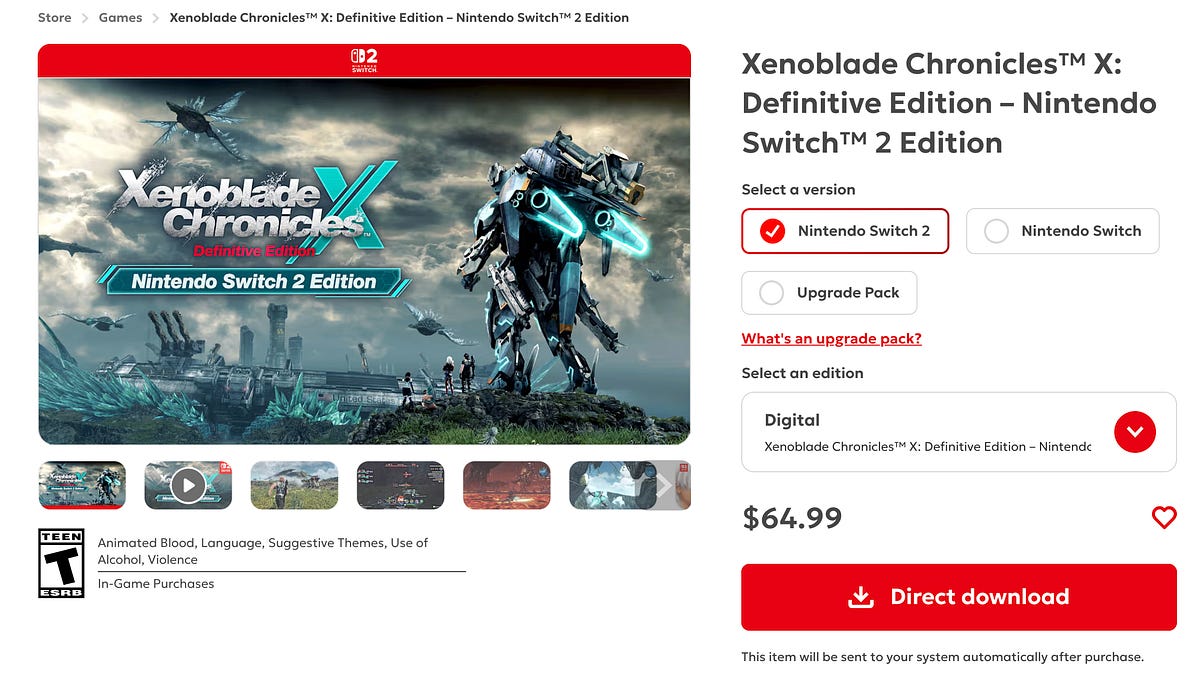
 Listing from Nintendo’s eShop
There were at least three surprising things about Nintendo’s recent announcement regarding Xenoblade Chronicles X Definitive Edition Switch 2 Edition:
Wow, this visually improved Switch 2 version—of a 2025 Switch version of a 2015 Wii U sci-fi role-playing game—was released immediately (at least digitally)
Nintendo actually was using the word “edition” twice in a single same game title
The upgraded Switch 2 version will sell for … $64.99??
$65 is not a common price for video games, and not even one that commonly comes up in game pricing discourse.
$60 was the default price for premium games in the Switch/PS4/XboxOne era
$70 has been the norm for years for PS5/XboxSeries games (and was the special price for the content-rich 2023 Switch game: The Legend of Zelda: Tears of the Kingdom)
$80 is the audacious price Nintendo charged for Switch 2 launch game Mario Kart Word last June and that Microsoft floated charging for The Outer Worlds 2, before reverting to $70
But $65? We’re in an age when it’s unclear whether plateauing game sales should drive publishers to charge more or less. Drive that price down! Clair Obsur: Expedition 33 was a multi-million-selling Game of the Year-winning hit at $50. You, uh, could charge more, though? NBA 2K 26 cleaned up last year with a “superstar edition” priced at $100.
Nintendo, ever the innovator, has now floated $65, and done so twice in 2026.
In January, the company released a $65 Switch 2 Edition of its 2020 Switch hit Animal Crossing New Horizons.
Nintendo did not reply to a request for comment about this price point, but the special circumstances of both $65 releases offer hints at the logic behind them.
Both games originally cost $60 on the Switch and are now being re-offered with a $5 upgrade.
Nintendo has been dabbling with how much more to charge for these original Switch game upgrades to Switch 2. Last year, Nintendo charged $20 for upgrades that added new levels and modes for Switch 2. In some cases it charged nothing for upgrades that simply improved the game’s graphical and technical performance.
Twice in the fall, Nintendo simultaneously released big new games on Switch 1 and 2—Pokémon Legends: Z-A and Metroid Prime 4: Beyond—for $60 on the old system and $70 on the new. Across versions, there was little difference besides better graphics (and mouse controls). That pricing implied that Nintendo believed that better technical performance could command a $10 premium.
The Switch 2 upgrades for Animal Crossing and Xenoblade that are part of this $60 + $5 experiment offer relatively little. Animal Crossing’s upgrade improved the game’s graphics, added mouse controls and a voice-activated in-game megaphone. Xenoblade Chronicles X Edition Edition offers better framerates and 4K graphics, but no new content. They are, in other words, somehow comparable to a) the 2025 Switch 2 upgrades that Nintendo charged $0 for and b) the pair that they retailed last fall at a $10 premium.
But they’ll cost $5 more instead.
Last year, then-Nintendo of America president Doug Bowser told the Washington Post that the company uses a “variable pricing” strategy, weighing the best cost for each game it sells, factoring in such things as “the breadth and depth of the gameplay, if you will, the durability over time and the repeatability of gameplay experiences.”
Nintendo is still varying its pricing. And somehow testing out a price we just don’t see for other games these days, at least not until they start going on sale.
Speaking of all this…here’s a recent Twitter thread:

Also in this article, below the paywall: The fate of Sony’s recent studio acquisitions, the original pitch for last week’s surprise God of War game, the early highlights of a very noteworthy Steam Next Fest, an Atari Hotel update and more.