
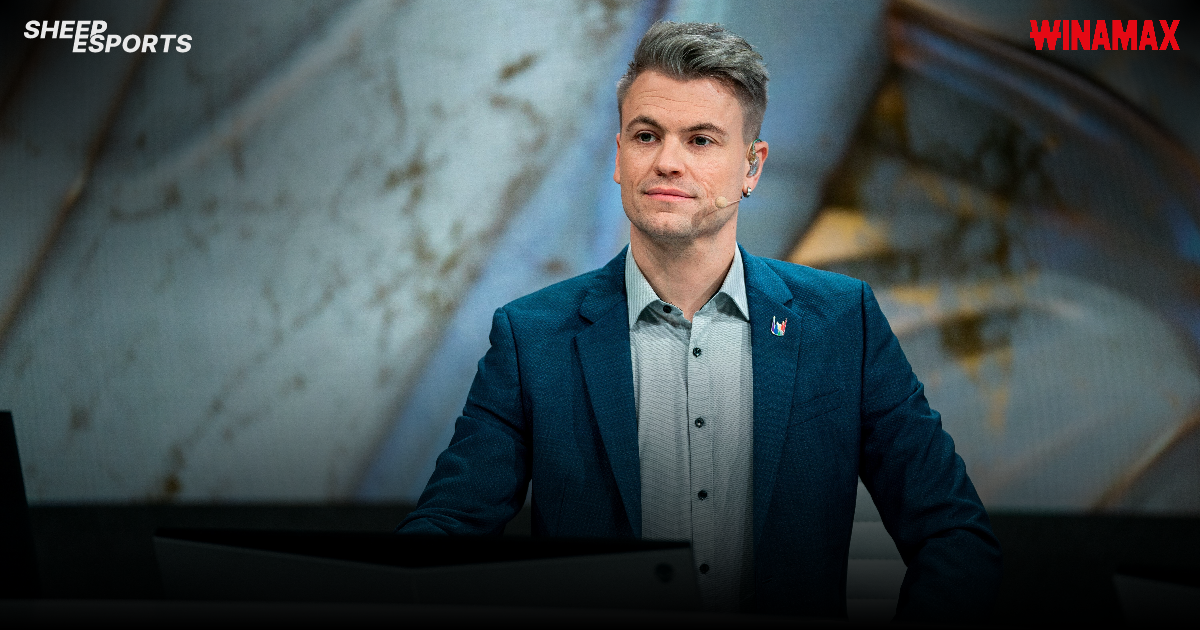
Quickshot on the analyst desk. Image via Riot Games.
“No game, no content, no league has ever existed in this type of environment before.”
The EMEA League of Legends’ landscape looks different than it did just a few years ago. Regional communities have become increasingly visible within the wider ecosystem and co-stramers now play a central role in matchday coverage. As formats shift and viewership habits change, the question is no longer whether the scene is transforming but what it is transforming into.
In an interview with Sheep Esports, Trevor “Quickshot” Henry discusses these transformations and more. The former LEC caster, now host for G2 Esports’ podcast HopEUm, speaks about co-streaming’s impact, generational audience shifts, and whether esports should lean closer to traditional sports structures or entertainment-first models.After stepping away from the LEC broadcast and Riot Games-affiliated events two years ago, Quickshot also addresses the reasons behind that decision. He reflects on personal growth, industry changes, and the new chapter he is building beyond the broadcasting desk.
It’s been a while since I’ve heard from you. How are you feeling? Are you excited to come back to League?
Quickshot: “I am, and I’ve done really well these last two years. I don’t know how many people in League know this, but I have watched and played pretty much every esports that there is. My name’s Quickshot because I come from a First Person Shooter background. So over the last two years, I’ve actually been very lucky to work on Counter-Strike, Apex Legends, Rainbow Six. I’ve done content for YouTube, I’ve done content live broadcasts, but it is really nice coming back to League of Legends. It’s a game that will always hold a very special place in my heart. And I’ve got a really fun project with HopEUm.
Can you tell us what it is? Introduce the project a bit?
Quickshot: Yeah, for sure. I mean, look, it’s a podcast, but in the most Gen Z, Gen Alpha interpretation of the word, and by that, I mean, it’s on video, we have replays, we look at screenshots from social media and Reddit. And it’s a League of Legends show.
The uniqueness about HopEUm is that even though G2 is organizing it, they’ve hired me as the host and the project lead. Because for 2026, G2 has got a significant amount of LEC co-streamers in all different languages—Skyyart (Willy Dias) in French, Caltys (Maya Henckel) in Swedish and English, Solar (Nico Linke) and German, Brizz (Luca Brizzante) in Italian, Wadid (Kim Bae-in) in Korean—so they’ve got this army of co-streamers. And what’s really fun about our podcast and show is that every week we bring a couple, two or three of them together, they stream to their audiences, and we have conversations. What does the French community think about this? What does the German community have to say about that?
So we actually bring the different language perspectives together. Talk about reviews, discuss things about the meta, discuss things about the business of esports and talk about predictions. So it’s just your weekly, all European, League of Legends fix.
Do Europeans still rally behind the EU, like the ‘EU, EU, EU’ chant, or has regional fragmentation taken over?
Quickshot: Why not both? So first of all, I think the word regional fragmentation implies or infers a negative shattering, a negative break. I see it as a positive. I adore seeing the rivalries between Spain and France. I love poking fun at my Italian co-stream and asking when the next Jiizuke (Daniele di Mauro) is going to come up?
Europe is strong because of that. Go look at any of the sports. Go look at any of our competitions. I think the regional rivalries should be celebrated. I do think, however, when you look at international events, when there is one team standing, that’s where the “EU, EU, EU” comes together for the most part. I mean, hell, when Europe sucked at Worlds two years ago, we got behind North American teams and we’re like, “Let’s go FlyQuest!” So there’s definitely that camaraderie that comes together. And I think when you look at ERLs, you look at EMEA Masters and you look at LEC, I really like that regionalism—tribalism to a degree—communities are actually growing louder and stronger. I think it’s actually a really powerful way forward.
HopEUm is meant to kind of take over this space or “bridge the gap” that was left behind from the absence of EUphoria. Do you feel losing EUphoria is symbolic of something bigger going on in the LEC?
Quickshot: First of all, not to be a little combative, but no, HopEUm is not meant to replace EUphoria. We just happened to have timing that we announced our podcast at the time EUphoria was going down. Plans were in the works prior to us knowing that publicly. I mentioned this already, but because G2 had this opportunity of all these different regional content creators, they actually reached out and said, “Hey, what ideas do you have? What could you do?” And I kind of pitched them the idea of this show.
The other thing is it’s a different product. While this is backed by G2, it’s very different to EUphoria, which had exclusive access to every single team, to coaching staff. They focused very much on one player or one team story per week, and we’re a lot more broad and holistic. So that’s the first part.
The second part is, is it indicative of something more LEC or European focused? I think, yeah, it’s a sign of change. The LEC debuted in 2019, and over the last six or seven years, a lot has changed. The tone of voice, the content, the supplementary supporting pieces, the tournament format, the stadium, the teams that are playing. And I think as with all things changing, we’re also seeing the rise of co-streamers and the rise of influencer-created teams. So I think it’s just the league and the sport and the viewership experience adapting to the modern ecosystem.
Do leagues like the LEC underestimate how much fans care about losing long-format, personality-driven content?
Quickshot: It’s really tough because on one hand, the value is obvious. On one hand, it’s really easy to see how important it is to create those connections and to invest in telling the stories and building those bridges. But when the audience doesn’t connect with it and when you do look at viewership numbers, when you do look at contributions and social and its interactions, you do need to acknowledge that sometimes either the content needs to shift or the audience has shifted.
And I think specifically with something like EUphoria and something like the LEC, I think over the last few years, it’s become very apparent how there has been a big audience shift. Ibai (Ibai Llanos Garatea) and his pull in the Spanish community, Kameto (Kamel Kebir) and Karmine Corp and their fans in the French speaking [audience], Caedrel (Marc Robert Lamont) and obviously the English-speaking viewers who’ve made an ERL in the NLC and their meme team arguably the most famous team in Europe. So I think those shifts are very important to acknowledge.
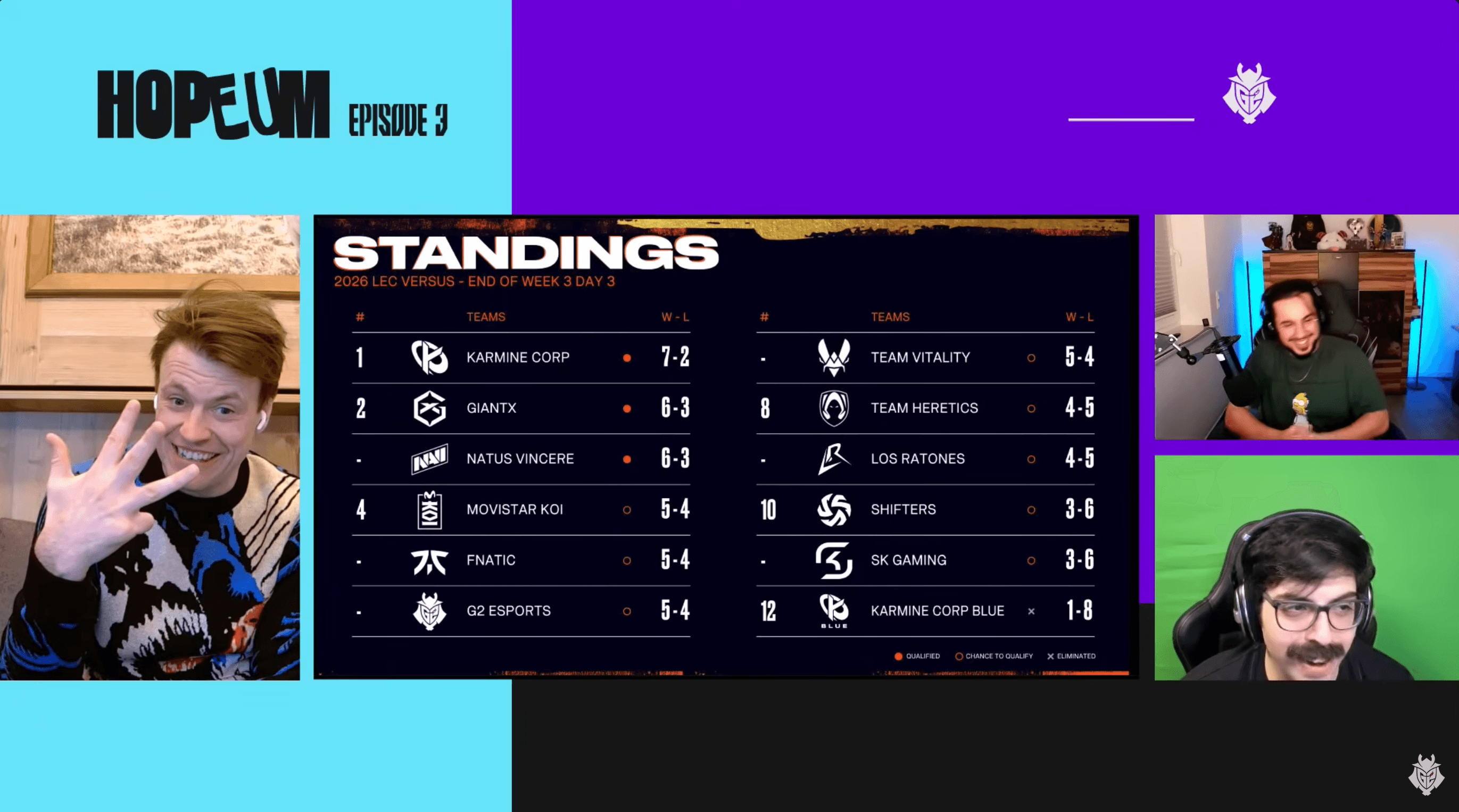
Image via G2 Esports.
Then let’s move on to co-streaming since you mentioned a couple of, or maybe the biggest names in the ecosystem right now. Is co-streaming enhancing the ecosystem or cannibalizing the official broadcast? And it can be both, but I want you to explain why.
Quickshot: I really like the question, and I think it is both. I think it also depends very much on your perspective. I will sit here and personally, as Trevor Henry, say that I think co-streaming as a viewer and somebody who consumes the content, I think it’s cannibalizing it—but that’s because I like a traditional broadcast. I like an analyst desk. I like pre-games. I like post games.
I’m nearly 40, I grew up watching traditional sports. I like a traditional sports broadcast. I don’t watch streamers. I never have. Even pro players that stream, I will look at their stats, I will look to study. But when it comes to a form of entertainment, for me as a fan and a viewer, I consume competitive, professional content. Not to imply that co-streamers are not professional, but the most successful ones tend to be more about community, more about the inside jokes, the memes, the feeling of belonging.
So is it cannibalizing? Is it enhancing? On one hand, I think the traditionalists will say it’s cannibalizing, but on the other hand, you have to acknowledge the GenZ, Gen Alpha.
I’m aging out as a League of Legends player. I’m not the only one. So this is also a fascinating question to ask, like, how do we appeal to these different age demographics and brackets? Because millennials don’t really talk to GenZ and GenZ don’t talk to Gen Alpha. They’re all different tastes, all different preferences, and there’s no one to look at. No game, no content, no league has ever existed in this type of environment before. So it’s all very new and it’s all very interesting. So I think both realities are true and it just depends on your perspective.
Is esports a sport or should it become fully focused on being entertainment?
Quickshot: I mean, I don’t know why they have to be mutually exclusive. That’s my biggest thing. So is esports an entertainment product or is it a sport? I love the debate because frankly, I don’t care. And I’ll tell you why. You can look at any competitive venture. Go look at chess. Is chess a sport? Is it a strategic… How do you classify it? It’s a board game, right? It’s one-vs-one. How is chess less competitive than tennis? It’s still one-vs-one. Instead of it being physical prowess and maybe longevity, it’s more mental stamina and planning ahead and things like that. But I really like that comparison of ones-vs-ones. And then we start looking, okay, well, how about Quake? So older ones. It’s also one one-vs-one again.
Football, how is it different from League of Legends? They’re not. Because you have your traditional leagues, you have your traditional competition that is team-versus-team, that’s formal, that’s structure, that’s rules. But you also have five-a-side. You also have in NFL football, you have touch football, flag football—I think it’s called that—you have all-star events, you have trick shows, you have Brazilian dancing football sport. There’s variations on it. Go look at League of Legends, go look at Red Bull Homegrounds, go look at ARAM competitions, go look at Twitch Rivals with stream teams. It can be both.
Now, for a product like LEC, I think sometimes maybe because you try to make it both, you can dilute both at the same time. But I think primarily a product like LEC is a sports product and many other League of Legends products are more entertainment products.
Should esports lean more towards a tennis ecosystem and narrative official broadcast driven, if that makes sense, or should it look towards a product more similar to WWE?
Quickshot: That is a great question and it’s probably one that will be answered in the coming years. Look, I’ve been out of the Riot ecosystem for about two years. I’m fully freelance and this is just a prediction of sorts. I’d love this question because I’ve also heard “Why don’t we make esports in other titles like WWE, like UFC.” In the UFC you have headline fights, you have undercards, and it’s a big event, but it happens a limited number of times. I don’t think the WWE or the UFC comparison will work because I don’t think you have an audience that consumes that.
In order for WWE to work, you need to have a disbelief of reality. We know it’s planned. We know that there’s elements of scripting to the story, but you buy into it. You let that reality go because you like the characters. You like the story that’s unfolding.
With UFC, it’s more about the intensity of it. These people train for months and months and months. Fighters will have two to four, two to five fights a year, and the stakes are incredibly high because some of the best, the goats of UFC have records of like 18 and 0. That’s it. That’s it! Super, super high stakes.
Video games, I don’t think can work that way. I think a normal person can play five to 10 matches a day. You can watch three to five, three to 10 games a day. And I think because of that, that comparison doesn’t work.
I would far rather look at it like more of an NFL in the way that NFL works. They have 10 to 12 games a day. They’re scheduled at the same time. You just watch the ones you want. And the hope in my head is that there’s enough viewers either for the language, rivalries, for the individual broadcasts to pick and choose the ones that they want, and they come together for a big EML masters or playoffs at the end of it. That would be my personal preference.
How important is for LoL Esports, and more in general for various esports ecosystems, to have one consistent format throughout multiple years?
Quickshot: Unfortunately, that will never have a good answer, in my opinion. And the reason I don’t think so is when you look at formats that are good, that work, that are consistent and can generate returns on investment like football, nobody owns football, but there’s Premier League, there’s Bundesliga, there’s Euros, there’s World Cup. There’s individual tournaments where you have to play nicely with other people and work together.
In an ecosystem like League of Legends, Riot Games owns the game. Riot Games is partnered with the teams. Riot Games owns the league. Riot Games broadcast of the league. So there are all of those different impacts, there’s all those different verticals that will impact the decision making. I mean, look at best-of-ones, okay? Best-of-ones, I believe, are a stopgap to keep production costs down while trying to keep as broad a viewer base interested as possible and hopefully keep viewership up. It’s a bit of a cynical answer. Do best-of-threes work, have best-of-twos work, there’s all these different attempts. And I think it’s really, really hard when all of the decision-making is kind of under one umbrella, and then it comes down to each year or each format, or which specific vertical has a higher priority than the other for that year.
Then do you think right now, when we look at the LEC, and after maybe also hearing, outside of the HopEUm podcast, what the other co-streamers had to say, do you think the LEC knows exactly what it wants to be?
Quickshot: I think we’re in a period of change. And I think this is true also for the wider ecosystem. When you look at other titles like Counter-Strike, when you look at games like Apex Legends, these are also titles that have huge either co-streaming or watch parties. Ohnepixel (Mark Zimmermann) on Counter-Strike is massive. He’s basically the Caedrel [of CS]. Apex Legends has different teams that follow different things and their watch party vibes are way more like which rivals energy, even though it’s the ALGS. So I think as we’re seeing this shift to creator or influencer personality-driven teams, Ludwig (Ludwig Anders Ahgren) and MoistCr1TiKaL (Charles Christopher White Jr.) in the US, Ibai, Kameto, I’ve talked about them already, Caedrel… These really big streamers who are passionate about competition are now becoming a disruptor in the old model, and that’s why I think we’re in a period of change.
Do I believe that the LEC knows what it is? No, but I also think it’s dealing with a lot of various factors at the same time. And that’s why I think you are seeing things like the LEC Versus change into including EMEA Masters teams and why you’re seeing things like firsthand being added. There’s obviously the tournament at EWC being added. So we’re in this period of change right now, and I think there’ll probably be more changes to come.
Is the product changing because the audiences are changing or are the audiences changing because the product is not enough anymore?
Quickshot: Both, it is both. I have very strong feelings on this one and I will just say this very briefly: product investments, supplementary content, changes as well as teams and players. So there’s always going to be a waning and a growth of viewers, but it’s true. And they’ll always be cyclical; there’s no way to ever break that chain in anything. Go look at the NBA, it’s a good example. They had to learn how to go online to try to bring younger viewers in and then it worked. Baseball didn’t and it isn’t. So I think it’s very true in any competitive format.
You’ve been in esports broadcasting for much more than a decade now. What’s fundamentally changed, according to you? If you had to take a step back and analyze the timeline of esports broadcasting, what is something that 2026 has that could not have been ten years ago?
Quickshot: The quality, the consistency, and the clarity of the content that you’re seeing. I know it’s quite a metaphorical thing, but as somebody who watched esports broadcasts and was on them ten years ago, but was also watching ten years prior to that, I’m talking 2006, as well as looking at lives from the late ’90s. When you look at stages, when you look at graphics packages, when you look at camera cuts and you look at steady cam operations, spider cams flying through stadiums, go pick any game. Go look at Mobile Legends Bang Bang that sold out Bird’s Nest in Beijing. Go look at Krakow for Counter-Strike that had incredible events. Almost every single game has just leveled up the quality. They’ve leveled up the experience that you get as a viewer. And in 2026, it is the best that it has ever been, just period.
The content itself will change, the tone itself will change. Go listen to a Counter-Strike broadcast now in comparison to ten years ago, go listen to League of Legends now to ten years ago. Things change, voices change, tastes change, but it’s never been better than where it is right
The majority of the audience knows you for your time in League of Legends esports. After two years, would you be comfortable sharing your reasoning as to why you take a step back from it? If it was your decision to take a step back.
Quickshot: Yeah, of course. I’ll be explicitly clear: Riot and I agreed to part ways. I had done everything that there was to do in League of Legends. I completed it. I am very fortunate that I got to experience so many amazing things. I got to cast as many finals as I did. I got to be a team leader. I got to hire people. I got to train people. And for a while, I had actually been ideating and discussing moving on because I wanted to work at other games. I wanted to spread my wings. I wanted to follow in Sjokz (Eefje Depoortere)’s footsteps and go freelance and do things. And obviously, look, I’ll tell you this over the last two years that I’ve grown a lot personally and professionally.
I regret making a very dumb joke that has affected how some people think about me and my work. And I’ve learned from it, I’ve grown from it. I’m a professional broadcaster and it is what it is, but I’m very happy about the fact that I have been able to spread my wings and I’m very grateful that I’ve been able to work with so many other games and so many other teams and content creators and some work behind the scenes, some work on camera, and I’m in a really good place today.
What is something that maybe you find, or general audiences are leaning towards, that little esports products have not seen you in, but you were really, really proud. Maybe it was like a breakout moment for you being like, “Oh, I feel like I’m at home even here.”
Quickshot: I will say that I’m doing a podcast series, another one with the Esports Awards, and it’s called Origins. And the whole point of it is to look back at people’s careers before they’ve started. There are a lot of fans of any esports. There are a lot of professionals in any game, and I’ve had the pleasure of meeting a lot of them that have no idea about the wider market. And I’m not judging, right? I’m a try-hard and to an unhealthy degree. So I know Apex Legends casters, I know Rainbow Six people. I know who’s doing well in chess, because that’s my thing. And it’s been fascinating being able to speak to all of those individuals, the players, the casters, people who inspired me, people who have made massive impacts on the industry. So Origins is something I’m particularly proud of that I think anybody that’s just a fan of esports or content creators, things like that would probably get a kick out of.”