
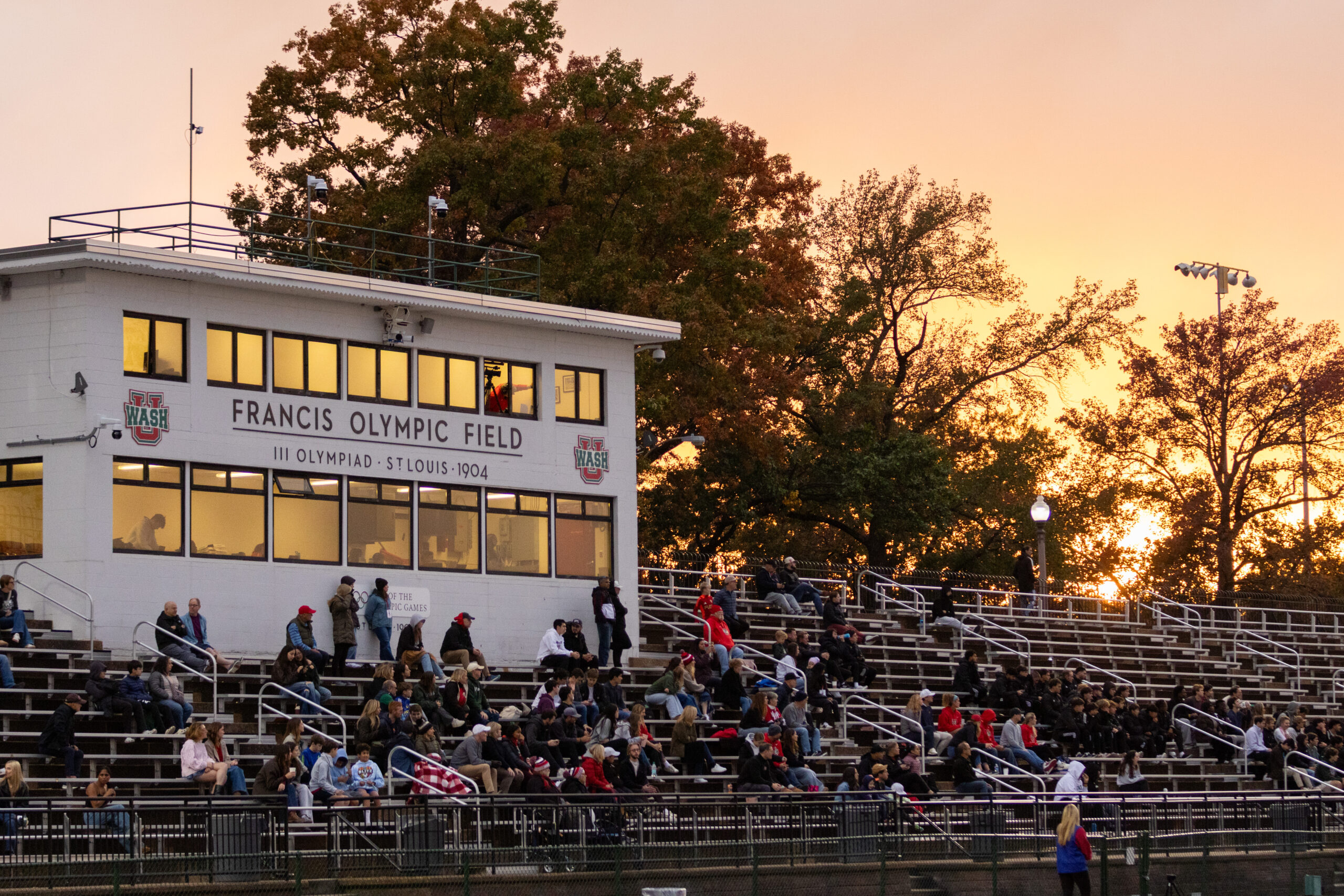
Francis Olympic Field hosted a variety of events, including soccer and the marathon, at the 1904 Olympics. (Bri Nitsberg | Managing Photo Editor)
One hundred and twenty-two years ago, the third-ever Olympic Games took place on Francis Olympic Field. In two years, St. Louis will again play a role in hosting the Olympics, with Energizer Park, home of St. Louis City SC, hosting soccer matches for the 2028 Summer Games.
In early February, the 2028 Los Angeles Olympic and Paralympic Games Committee announced that St. Louis will be one of six additional venues outside of host city Los Angeles, that will host soccer matches in the group and knockout stages of the Olympic Games. St. Louis is joined by New York City, Columbus, Nashville, San Jose, and San Diego.
St. Louis is one of three American cities (along with Los Angeles and Atlanta) to have hosted the Summer Olympic Games. The 1904 St. Louis Olympics were the third-ever games in the modern era, and they took place in part on WashU’s campus. St. Louis will join Los Angeles, Paris, London, Tokyo, and Athens as the only host cities to host events in multiple summer Olympic Games.
The announcement comes amid a time of growing soccer culture in Missouri. St. Louis City SC has gained increasing popularity since its creation in 2023, while neighboring Kansas City has already scheduled matches for this year’s upcoming FIFA World Cup.
Today, WashU’s Francis Field is the oldest still-in-use Olympic facility in the world. In 1904, Francis Field held events in 11 sports, including archery, soccer, and wrestling, while Francis Gymnasium (now the Sumers Recreation Center) hosted boxing and fencing.
The current Olympic Games are far different from the games that St. Louis previously held. The 1904 competition was far smaller, with just 15 countries represented, and held in conjunction with the 1904 World’s Fair. The St. Louis games also left behind a complicated and troubling legacy, including “anthropology days” where indigenous people from around the world were forced to participate in sports for the amusement of Americans, among other displays of racist caricatures of foreign cultures.
According to political science professor Zachary Bowersox, who has conducted research on the Olympics and teaches the course “Sports, Policy, and Politics,” the 1904 Olympics were “the worst Olympics of all time” due to both racial prejudice and their poor execution of events. The Marathon was an especially egregious example of terrible planning, taking place during the hottest part of the day, on a dusty road, with minimal water supply. Only 14 of 32 runners finished. The athlete initially declared the winner was later disqualified for hitching a ride during the race.
Bowersox made it clear that while he expects some of the history of the 1904 Games to be celebrated, other parts may be minimized.
“The last thing you want is people bringing up … the segregation of the audience or anthropology days,” he said. “Yes, we’re going to celebrate [Francis] Field. Talk about that history. [But] how much of the Olympic experience of 1904 do we celebrate?”
Bowersox also explained that he expects certain facts about the 1904 Games to be omitted in any commemoration of the Games.
“There’s probably going to be some commercial interest … in keeping the story and the narrative sanitized,” he said.
Hosting an Olympic Games across multiple cities is also a relatively new phenomenon, but it has become more common in recent years as cities are reluctant to front the cost of infrastructure for the entire competition.
Bowersox sees this multi-city Olympic model as a trend that will grow in the future and allow cities like St. Louis to gain some economic benefit with little risk.
“This could be a solution for St Louis or other small cities, or even larger cities that just don’t take on the whole cost, as a scaled way to engage the Olympics,” he said. “ [It could] reduce burden, but also potentially provide a scaled financial return,” he said.
The Olympic Committee has yet to release details about the timing and specifics of the matches. More details are expected to come this April.