
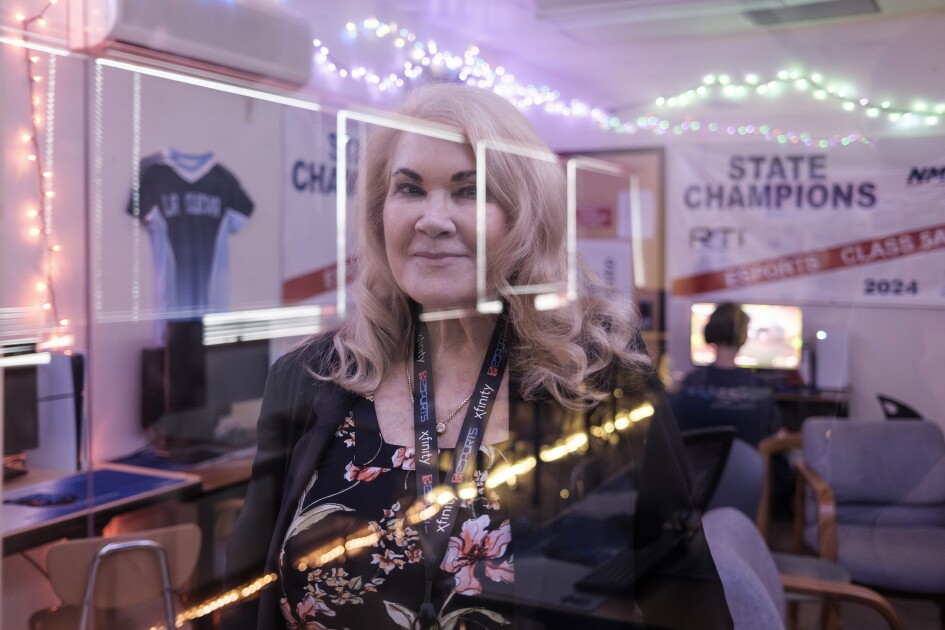
At 75, Laurie Lehman is an unlikely champion for the buzzy and decidedly young world of esports.
Her knowledge of popular video games is vast. She’s mastered gamers’ insidery jargon: peripherals, shoutcasting, controllers, switchers.
Lehman isn’t just a septuagenarian with an unusual affinity for what makes younger generations tick. She’s a bona fide force to reckon with in the national esports landscape.
Over the last seven years, Lehman has built one of the most robust and well-funded esports programs in the country for the Albuquerque public school district.
She created the program from scratch, raising over $120,000 in grants and sponsorships, including $20,000 for students who went on to play competitive esports in college, and another $20,000 for students who participated in state-level esports championships.
She’s coaxed, cajoled, and collaborated with parents, principals, students, and district bigwigs to take esports from a marginal after-school club activity to a full-blown curricular and career pathway for the district’s students.
Esport clubs and classes within APS have also become inviting spaces for all students. Kids involved with esports are now more keen to attend school, feel more involved, and make and keep friendships more easily, according to district surveys.
APS has close to 45 esports clubs in its elementary, middle, and high schools, run by over 100 esports coaches. Lehman directed over $160,000 additional school district dollars to fund these positions and to provide professional development for the educators who fill them.
“I love breaking the mold and breaking the rules and bringing esports as an ambassador,” Lehman said. “I love it.”
For most of the time Lehman spearheaded the program, the esports work came on top of a full-time gig as the district’s budget and project supervisor.
“I would work all day for all these years, and then in any free time I got, or after I finished all my work, that’s when I got this whole program going,” said Lehman.
In January 2026, Lehman passed on the budgeting job to a colleague so that she could concentrate solely on esports. She plans to help create unique career and technical education esports pathways in drone management and mass communication.

The esports program Lehman built from scratch rivals that of larger, better-resourced districts
By 2018, when Lehman started to build APS’s esports program, the field had already exploded, as schools and colleges sought to tap into the multibillion-dollar gaming industry.
That trend has only continued to accelerate in recent years.
Over 300 universities in the United States now offer scholarships to talented esports players. And scholastic esports—gaming that embeds learning —can launch related careers in event management, cybersecurity, podcasting, and graphic design.
Lehman wanted a piece of that action for her roughly 65,000-student school district, New Mexico’s largest. And she knew just the partner to tap: the Network of Academic and Scholastic Esports Federations, an international nonprofit that promotes the growth of scholastic esports in schools in the United States and abroad.
Esports “is the proverbial Trojan horse way to bring kids [in] and have them thrive and reach their potential,” said Gerald Solomon, the founder and director of NASEF, which has helped establish over 3,500 high school esports programs across the country.
Lehman stands out among the hundreds of district leaders he’s collaborated with, Solomon said.
“Innovation is a big part of who Laurie is and what she’s built over the years,” said Solomon, who began working with Lehman on the Albuquerque program about eight years ago.
Lehman leaned on NASEF’s free esports curriculum to create one for APS, adapting it to New Mexico’s standards.
“She took something that kids enjoy … and turned it into something that was educational and also fun for the teachers to teach,” Solomon said.
These days, the district’s esports program, with its state-approved curriculum, multitude of clubs, multiple annual events, and funding from big-ticket sponsors like Microsoft and XFINITY, easily stands shoulder to shoulder with the opportunities offered at much larger, more prominent school including in Los Angeles, Miami, New York, or Nashville, Tenn., Solomon added.
“Her primary goal in the next few years is to have APS be a shining example to school districts around the United States and possibly around the world,” said Solomon.
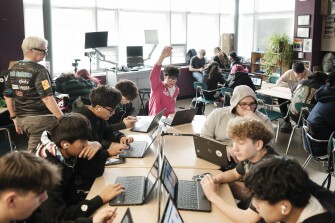
From 100 students to 1,500: Why esports became a hub for every type of student
For Lehman, esports was never just about playing video games.
She envisioned esport clubs and classes as spaces that would welcome all types of students, regardless of their families’ income level or their own physical abilities.
Esports have lit up pathways for students who weren’t thinking about pursuing a college degree or technology-related careers, she said.
“At events, kids come up to me and ask, “What can you do with esports?” said Lehman. She makes the connection for them, explaining that playing computer games can pave the way for college courses in computer technology.
That’s particularly exciting for kids who excel at gaming but are still trying to find their academic and social footing.
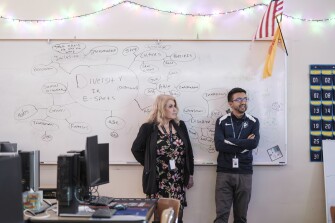
Participation in esports can pay dividends for student engagement
When Lehman started off in 2018, only a handful of students—about 100—from a few high schools played or showed interest in esports. That number has now swelled to over 1,500, according to Lehman.
At Del Norte High School, for instance, esports coach Marta Anderson said 25% of the school’s 1,000-plus population is now involved with esports as an after-school activity or study it as an elective.
Del Norte’s esports lab got a glow-up too: Back in 2018, the program began as five PCs shared among about half a dozen students in a closet-like room. Now, Anderson runs two labs with 27 gaming computers, a video production lab, a racing simulator, and a 3D printer.
“Laurie is amazing at finding the money,” said Anderson, who has worked with Lehman to build the esports footprint within the district.
Lehman’s efforts have put at least 90 gaming computers at 18 of the district’s high schools, Anderson added.
And Lehman is always on the hunt for more financial sponsors. Past funders have included marquee names like Microsoft—tapped for free computers—and the cable company XFINITY. Building and maintaining partnerships with these players to fuel esports’ expansion in APS is one of Lehman’s main goals.
The bigger win, in Anderson’s view: Eighty percent of Del Norte’s students involved with esports come to school every day, a bright spot in the post-pandemic, nationwide trend of chronically absent students. New Mexico’s chronic absenteeism rate—defined as missing more than 10% of school days in a year—peaked at 40% in the 2021-22 school year. That rate declined to 30% in the 2024-25 school year, which still means 1 in 3 New Mexico students missed more than 10% of school days.
Esports has become a conduit for a better connection between students and their schools. It’s also a friendly segue into extracurriculars for kids who don’t fit into the cliques or typical clubs middle and high schools offer, Lehman said.
Esports clubs and classes, at Del Norte and other high schools, give all students a “sense of belonging” that they may not have associated with schools before, said Lehman.

In a 2025 districtwide survey of over 1,100 APS students, about half said they felt “totally connected” to their schools after they started playing esports. Just 17% of those students felt such a strong connection before getting involved with the program.
“They make friends. They learn about sportsmanship. They start believing in themselves,” said Lehman.
Lehman has brought teachers into the esports fold
Lehman’s efforts have also persuaded more teachers like Anderson to coach esports. The middle and high schools have over 100 coaches put together.
These coaches—the majority of whom are also full-time teachers— run the after-school clubs, teach esport electives, and help students master social-emotional skills like teamwork and collaboration through gaming. Esports coaches receive a stipend of $25 a hour for this work.
Institutionalizing esports hasn’t been an easy task. As the program expands, so do the challenges. A big one is money: Paying coaches may be a challenge in the new school year, as grant funding for stipends dwindles.
The school board, despite its overall support for the esports program, still hasn’t approved a budget for the program Esports is on the superintendent’s radar, but dipping math and reading achievement demand more urgent attention.

Getting allies on board
In a previous life, Lehman was an anthropologist by training and a photographer by profession. She was based in Santa Fe, but her travels took her all over the world—to the jungles of Panama, for instance, where she lived among the Kuna Indian tribe to complete her master’s thesis.
In 2011, the deteriorating health condition of a family member changed the course of Lehman’s career. She quit her freewheeling lifestyle to join the Santa Fe public school system. In 2018, she moved to APS, where she was tapped by Richard Bowman, the district’s technology director, to launch an esports program.
Bowman believed esports could be a secret weapon for student engagement. In Lehman, Bowman found a partner who shared his vision.
“It was a no-brainer. I’d seen how much kids get out of esports,” Lehman said, referencing her own sons who were gamers from an early age.
It was easy for her to slip into the role of an esports ambassador because, like her students, Lehman found the kind of close connections she craved in the esports community, both inside the district and beyond.
Esports also “opened up” something in Lehman, because it reminded her of what she had discovered about societal bonds as an anthropologist.
“When you study culture, you realize that pretty much all over the world, people are the same,” Lehman said. “We need to work together more to see all the similarities and how we can help each other. And so, I got into education. And when I got into esports, it was an easy progression.”
To make inroads with the district, Lehman and Bowman knew they had to change how others perceived esports.
For principals and parents—and crucially, district-level decision makers—esports conjured up images of lonely kids holed up in their basement, spending hours playing video games.

Eight years ago, when Lehman and Bowman went to the Albuquerque school board to talk about launching a districtwide esports program, they met stiff resistance. The board thought esports were “dangerous,” Lehman recalled
Lehman combatted that perception through a mix of data and smart storytelling, Bowman said. In 2019, she produced an “esports annual report,” a pastiche of real-life stories and student quotes. It painted a picture of how gaming helped students connect with new friends and develop a sense of belonging, which encouraged them to attend school.
Those anecdotes were backed up by compelling data. Forty-one percent of participating students said esports improved their attendance. And 57% said esports helped them to “make and keep friends.”
“I got her in the room with the right people,” said Bowman, “but she wove the stories together.”
It worked: the board softened its stance against esports, clearing the way for the duo to invite more schools to launch esport clubs and classes.
Lehman then worked to convert other key players into allies. For instance, she created a detailed playbook that principals could use to convince parents that gaming could lead to a more engaging school life for their kids.

The club to career journey
A substantive part of Lehman’s vision was to turn esports into a curricular option, not just an engaging after-school activity. If gaming could create opportunities for college, or work post high-school, Lehman knew acceptance and funding would follow.
“In a club, you get the competition. You learn how to win. You learn how to lose. But in the classroom, you learn about careers, you learn about your potential, you learn about finding what you want to do,” said Lehman.
To facilitate that work, Lehman and Bowman created the New Mexico Scholastic Esports Federation, modeled on the international body NASEF.
That enabled them to bring interested educators, esports coaches, and curriculum experts together to create curriculum that could give students pathways to college courses ranging from cybersecurity to event management, all through esports.
The curriculum took shape in 2023 and was approved by the New Mexico Public Education Department. APS created its first esports class for high school students in the 2023-24 school year.

In its third year now, the esports elective is a popular one at Del Norte High School. Anderson, a former math teacher, has pivoted to teaching the elective, which seeks to build teamwork and collaboration.
Students review the history of esports—from its penny arcade beginnings to its current status as a booming multibillion-dollar industry. They also learn graphic design, build their own websites, and create original games and figure out how to market them.
The course concludes with an essay exam that asks students to consider big picture questions about the industry.

Creating more champions
Members of Anderson’s original esports team are now graduating from college. Three former students are planning to pursue advanced degrees in cybersecurity or other STEM subjects.
Vy Nguyen, the first girl to join the esports club at Del Norte, recently graduated with a bachelor’s degree in management information systems from the University of New Mexico.
Nguyen path to college truly started from the closet-like esports lab at Del Norte, she said.
Nguyen moved to the United States from Vietnam at the age of 7. Her immigrant parents had set high expectations. Being a star League of Legends player wasn’t one of them.
“They didn’t want [esports to] impact my studies,” Nguyen said.
Nguyen, the only girl on a team of about half a dozen boys, played anyway, serving as team captain in interschool competitions.
She credits her participation in esports—both in high school and later in college—with helping her land her first internship, at a lab that was impressed by her passion for gaming.
Playing, and captaining, esports taught Nyguen to be patient and collaborate with others, even when she doesn’t agree with them.
Now, Nyguen is an important ally for Lehman, who invites her to talk to students and their parents about the career opportunities that esports can open.
Getting esports players the recognition other athletes receive
In 2023, Lehman sought to establish a “signing day” experience for esport athletes heading off to college. She wanted them to feel as recognized and celebrated as someone who’d won a football scholarship.

But the athletics departments at various district schools declined to let esports athletes join their existing ceremonies. So Lehman created one just for esports, giving each graduating player between $500 to $1,000, financed from donations and grants.
Now, even parents like Nguyen’s see the magic of esports.
“I graduated top of my class and I have an internship,” Nguyen said. “I think they realize that I play video games but can still do all this.”