
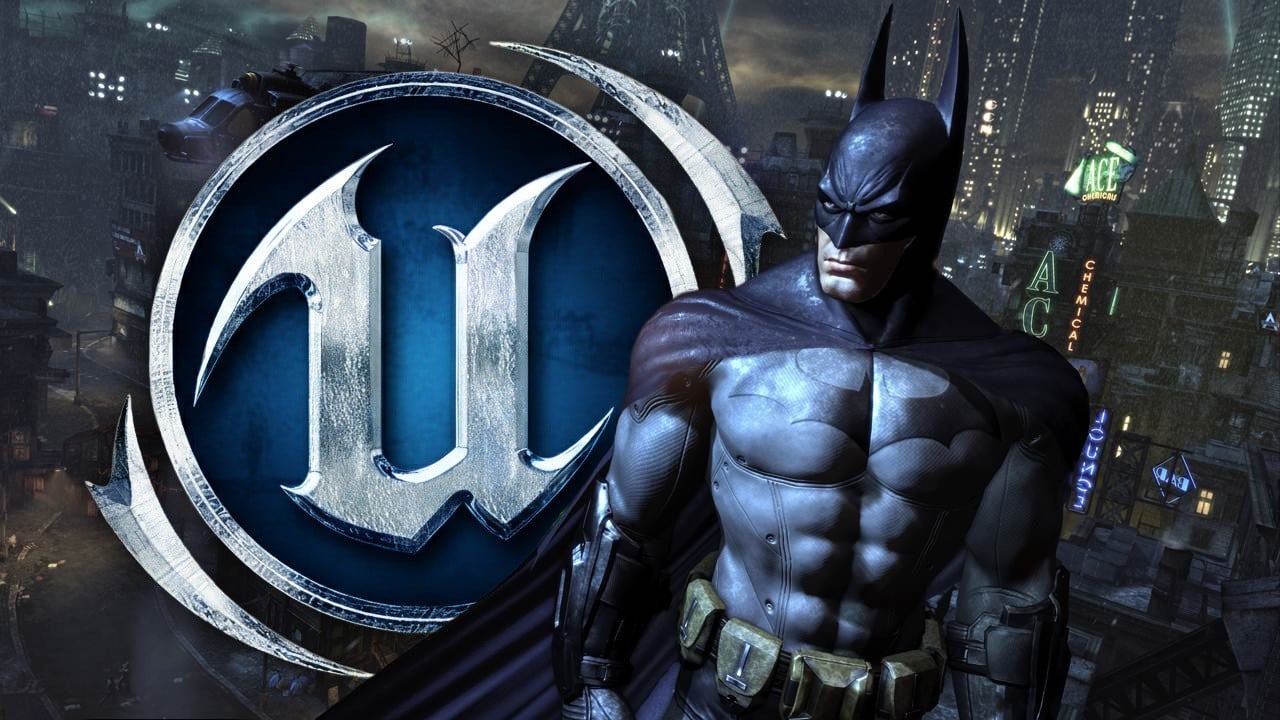
The DF Retro Super Show returns, revisiting an entire console generation – or more specifically, the impact of one engine. History is repeating itself: Unreal Engine 5 is dominating the current-gen release schedule and it’s happened before – UE3 was almost ubiquitous during the reign of the Xbox 360 and PlayStation 3 consoles, from Gears of War and Mass Effect to Batman: Arkham Asylum, Mirror’s Edge, Dishonored and so, so many more.
Its first console reveal was delivered by Epic’s Tim Sweeney himself at the now notorious E3 2005 debut for Sony’s PlayStation 3, but even then we could start to see the distinctive UE3 signature. The engine was designed to showcase a step-change in graphical detail. A focus on normal maps allowed artists to give the appearance of ultra-detailed, high polygon count models, baking that information into leaner meshes. Combined with aggressive specular highlights and flexible material definitions, the engine was able to offer up richly detailed environments and character models that were a revelation when we first saw them.
But those features also created a very familiar visual signature – the Unreal Engine 3 look, if you will. Crushed black levels, noisy specular highlights and a pervasive “gloss” could make surfaces – skin, for example – appear wet or plastic-like. High contrast lighting with bright, bloomy skies and/or point lights set against deep shadow were another element of the look. Characters could often “glow”, not always convincingly anchored into the environment. Hair rendering was also challenging – for the entire generation, really – hence the proliferation of shaved heads and helmets, another component of the PS360 era’s aesthetic.
John Linneman, Coury Carlson and Marc ‘Try4ce’ Duddleson invite you to spend a couple of hours talking about Unreal Engine 3.
Unreal Engine 3 delivered results, but similar to many other technologies of the era, performance was challenging. By far the most common target for the era was a 30fps experience, with dropped frames and bouts of screen-tearing obvious issues. UE3 also had issues in successfully streaming in texture assets. On PlayStation 3, adapting the engine to the split RAM set-up and the diminished RSX GPU often proved difficult, and many UE3 games there suffered from lower frame‑rates, longer loading times and trimmed effects compared to their 360 counterparts.
Over time, however, Unreal Engine 3 evolved significantly, and several showcase titles demonstrate just how far it could be pushed – and how varied it could look when developers sought to break free from the technology’s signature look.
Gears of War
Epic’s original Gears of War effectively set the template for early UE3: dense normal‑mapped environments, heavy specular, soft post‑processing and that characteristic chunky character design. By Gears of War 3, Epic had introduced lightmass – a precomputed global illumination system – bringing much more convincing indirect lighting and bounce. Characters sat more naturally within scenes, and the overall presentation felt less harsh and more cohesive. Gears 3 remains quite spectacular and shows us one of the best examples of late-era UE3.
Batman: Arkham Asylum and Batman: Arkham City
Rocksteady leveraged UE3’s strengths in character rendering, animation and post‑processing to deliver richly detailed environments and highly stylised yet grounded character models. While obviously an Unreal Engine 3 game, smart art direction and careful tuning of materials kept the “Unreal sheen” largely under control, while still benefiting from the engine’s lighting and shadow capabilities. The celebrated developer also delivered the last major Unreal Engine 3 title for the next console generation: dodgy anti-aliasing aside, Arkham Knight still holds up today.
Mirror’s Edge
DICE’s technical credentials are beyond doubt, so perhaps it’s no surprise to see that its first‑person parkour game is the antithesis of UE3’s muddy, brown shooters. Pre-computed, distinctive global illumination, stark white architecture and eye-catching colour accents deliver a remarkable aesthetic that remains striking today. The underlying technology is the same, but the choice of materials, colour and lighting radically alters the result.
Dishonored
Arkane’s immersive sim uses Unreal Engine 3 to power a painterly, exaggerated world. Stylised proportions, hand‑crafted textures and tuned materials create a look that sidesteps the most common limitations of Unreal Engine 3 and the less successful elements of its aesthetic. It’s a showcase of how distinctive, strong art direction can almost liberate a UE3 game from the constraints of the engine.
The Borderlands series
Initially conceived with a more conventional UE3 presentation, the Borderlands games famously pivoted to a bold, cel‑shaded comic‑book style. Heavy outlines, flat‑shaded colour regions and stylised textures transformed the same underlying tech into something instantly recognisable and largely timeless – a visual identity the series continues to use to this day via Unreal Engine 5.
Even as Epic developed Unreal Engine 4 – principally designed for the Xbox One and PlayStation 4 eighth gen consoles – UE3 still found use. Arguably, UE3’s most spectacular showcase remains the Samaritan demo, initially rendered in real-time using multiple Nvidia GPUs in real-time. Tessellation, displacement mapping, subsurface scattering, bokeh depth of field and image‑based reflections effectively segued into Unreal Engine 4‑class rendering. It underlined how much headroom the engine still had late in the generation and there are some commonalities with the spectacular Arkham Knight.
Unreal Engine 3 industrialised HD game production. It gave studios a common, evolving toolset, accelerated multi‑platform development and shaped the visual language of an entire console era. Its signature look may be easy to spot but its role in defining how big games were built, shipped and seen during the 360/PS3 years is impossible to ignore. And yes, there are eerie echoes with the way this generation is playing out with Unreal Engine 5…
I really hope you enjoy the latest episode of the DF Retro Super Show. Making this series isn’t easy, but delivering a brilliant retro podcast was one of our key pledges when Digital Foundry went independent. If you value it and want it to thrive, please consider supporting us via Patreon.