
The biggest car news and reviews, no BS
Our free daily newsletter sends the stories that really matter directly to you, every weekday.
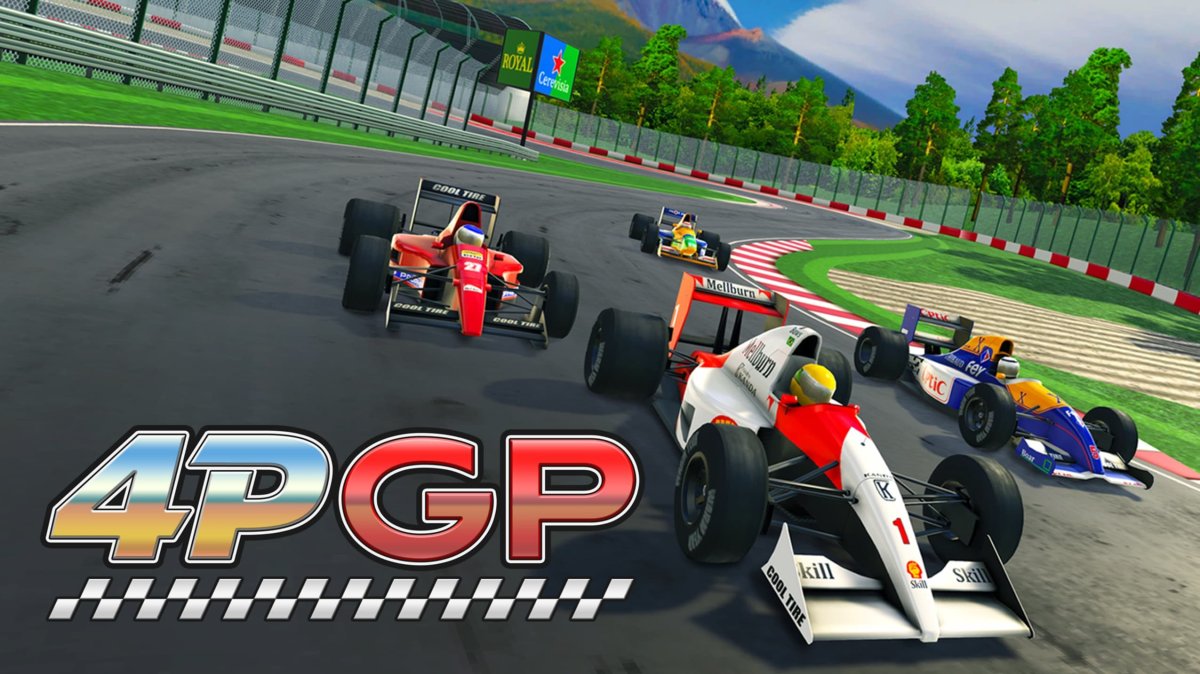
The Nintendo Switch 2 isn’t exactly hurting for new racing games in its short life thus far, following Mario Kart World at launch, Kirby Air Riders shortly thereafter, and a rerelease of F-Zero GX for Switch Online subscribers. The platform even recently got a port of the underrated Grid Legends. Still, we’re never going to complain about a new throwback racer, and that’s exactly what 4PGP is, imperfections and all.
Short for Four Player Grand Prix, this is a new indie racer developed by Vision Reelle and 3goo, very clearly inspired by Sega’s revolutionary Virtua Racing from 1992. The cars are all send-ups of famous Formula 1 machinery from the ’90s, and the tracks are essentially downscaled versions of real-life F1 circuits, the main difference being that you can complete a lap of one of them in 40 seconds rather than a minute and a half. They generally have fewer corners, too, and larger scenery with arcade-like hallmarks. 4PGP’s spin on Spa-Francorchamps has a suspension bridge and a giant tunnel, for example. I know we all love Spa, but I think it could use a tunnel, don’t you?
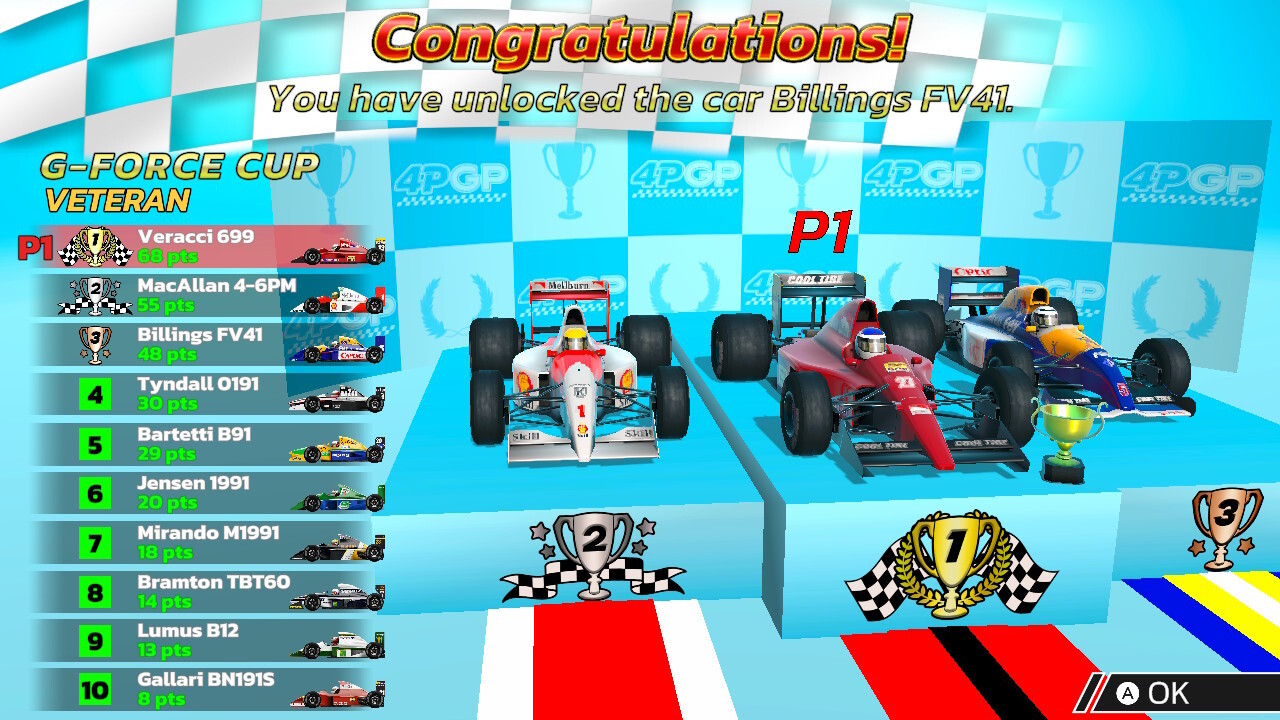
Adorable de-makes of tracks notwithstanding, 4PGP is straightforward arcade racing fare. You’ve got four championships of three races apiece, which must be won at three difficulty levels to earn all the locked cars and tracks the game has to offer. The physics are generally very grippy, not unlike Virtua Racing’s initially, though the rear tires don’t step out beyond the limit as they do in Sega’s classic. There’s no drift mechanic or real sense of weight transfer here, and most corners are best taken with maybe a light lift of the throttle. The brake is kind of your enemy in 4PGP.
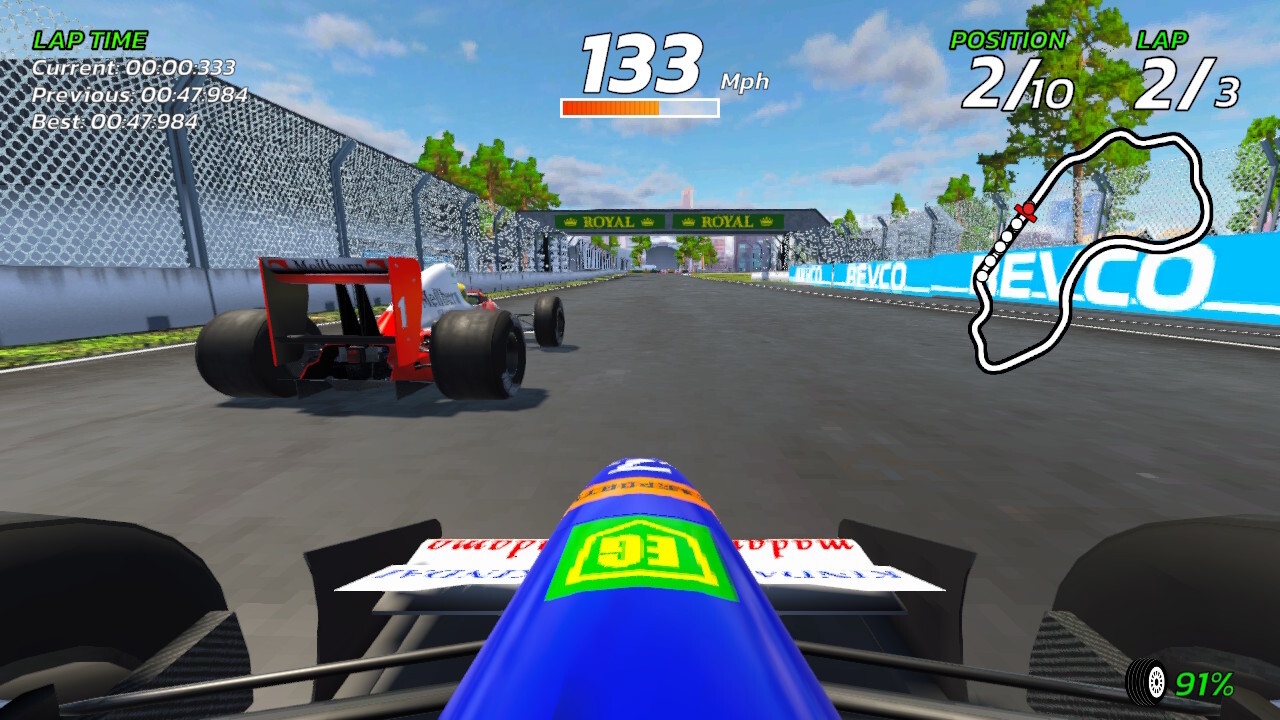
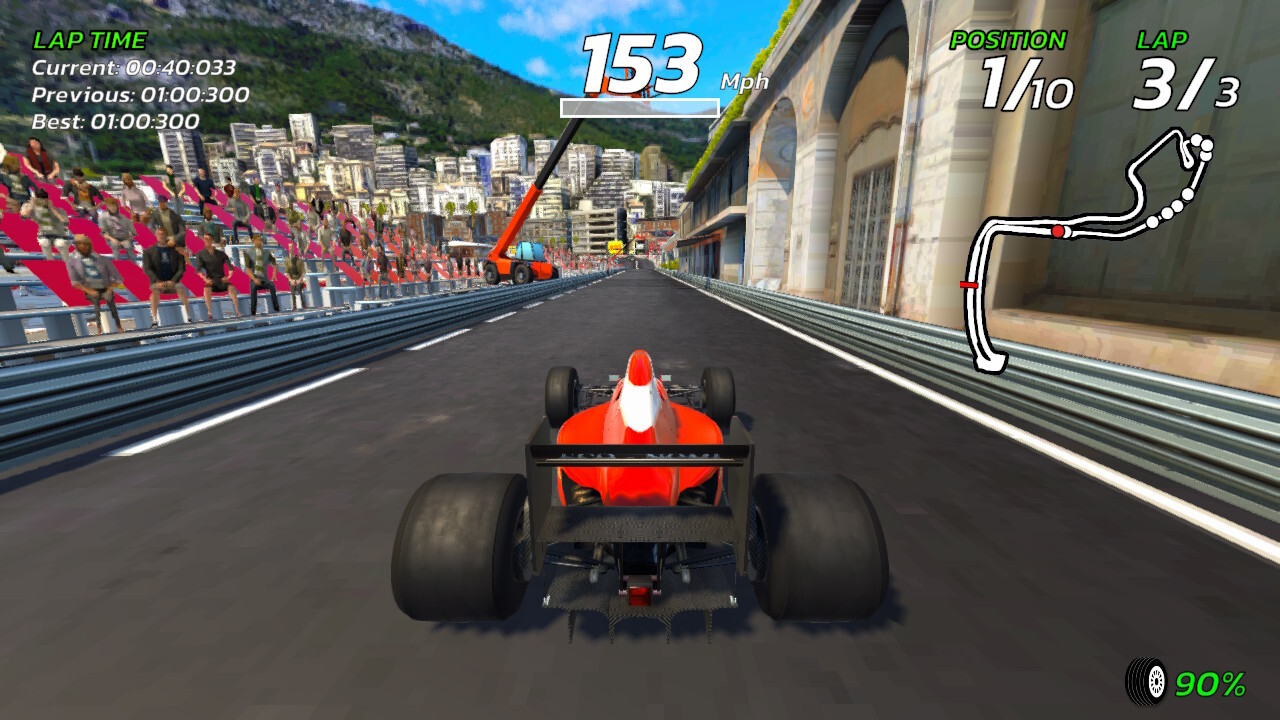
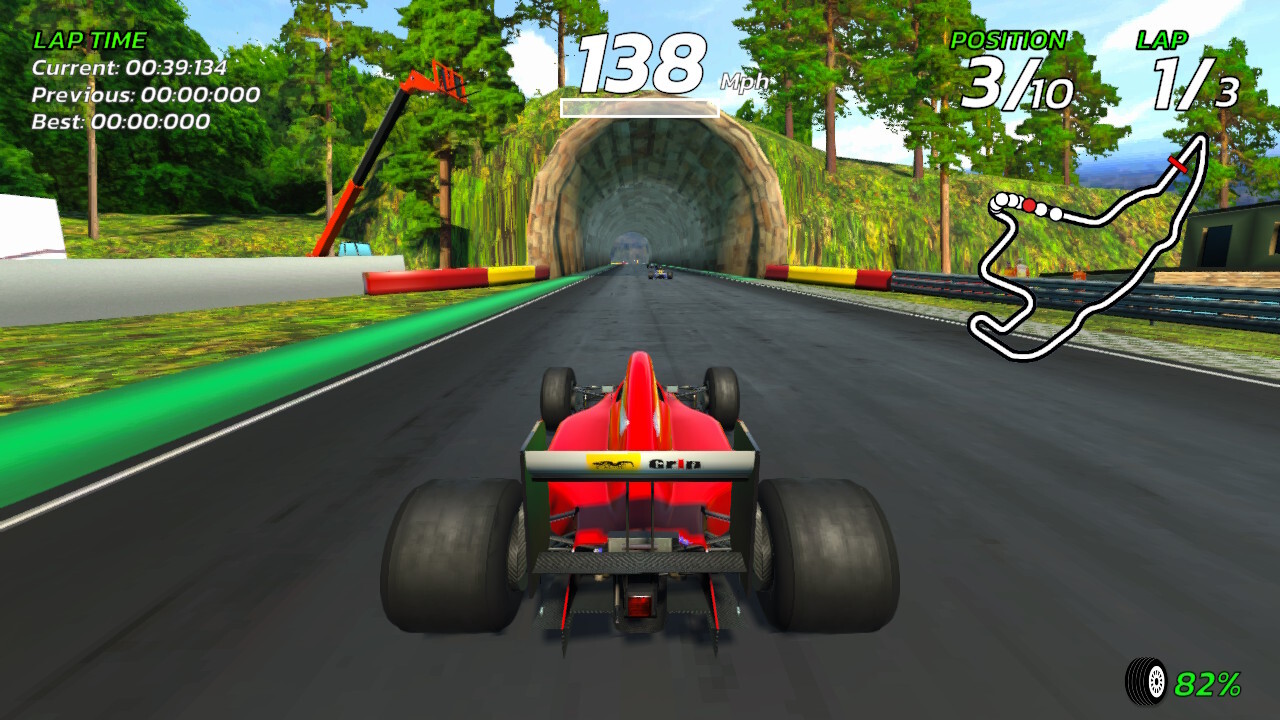
What bus stop? 3goo
It’s not your only enemy, though. Every race incorporates tire wear and “fuel” consumption, with the fuel in this case being your available turbo. You hold the Switch’s ZL shoulder button to use it, and you’ll have to dip into the pits to refill it. Pit stops in this game are a bit like replenishing energy in F-Zero; they take the form of lanes adjacent to the start/finish straight that you drive through to top up grip and turbo. As you do this, a gauge pops up on screen; press ZL as its needle passes through a green zone, and you’ll instantly refill both.
You can pit every lap if you like, or once per race, as I tend to notice the computer does. Turbo is the big factor here—tires that have lost all grip just understeer slightly and never slip, so it’s not like they make the car harder to control. And, speaking of the computer, it’s about as sophisticated as the AI from the era of games 4PGP is honoring. Opponents start the race with a massive acceleration buff relative to the player that seems to taper off over the course of the session. So if you can’t catch them at the start, or they pummel you off the line, don’t fret; drive well, and you’ll pass them later.
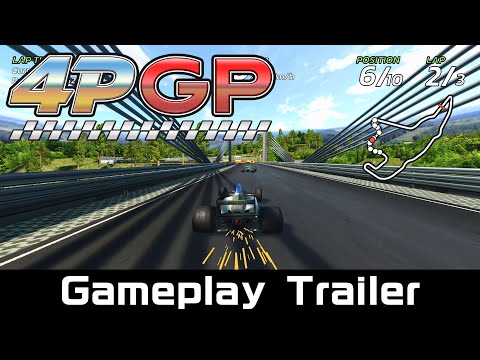
Nintendo Switch™2 4PGP Gameplay trailer
If only colliding with competitors didn’t result in a penalty that generally always goes to the player. Rival cars are immovable objects that you’ll sometimes get stuck and turned around on, and other times, completely bounce off. The collision detection in this game isn’t stellar, which is a problem because the action gets pretty fast and tight, especially in this game’s version of Monaco. The track here is so narrow, and the corners so unbearably sharp, that it really feels like a mismatch for 4PGP’s physics. The computer can round the Fairmont Hairpin like it’s tethered to a slot car track, while you’ve got to tiptoe through it, all brakes and no throttle, and you’ll still probably scrape the outside wall.
There are indeed fleeting moments when 4PGP feels like a modern Sega racer transported from three decades prior. It has a high-energy attract sequence with dynamic camera cuts and a theme song by Tomoyuki Kawamura, a contributor to Sega Rally’s soundtrack. Also listed in the credits is Kenji Sasaki, who was instrumental in the development of the original Ridge Racer before directing Sega Rally. Yeah—real golden-era arcade royalty here. Sasaki is credited as a creative advisor as well as a game and UI designer in 4PGP.
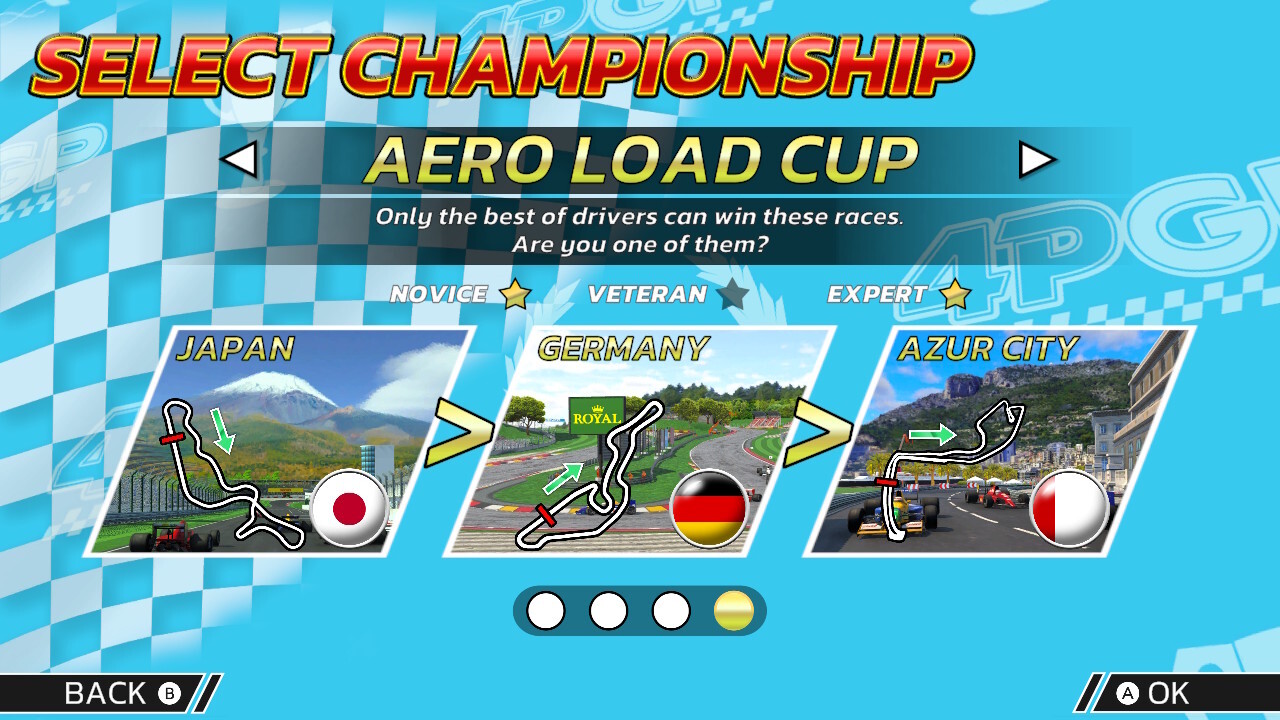
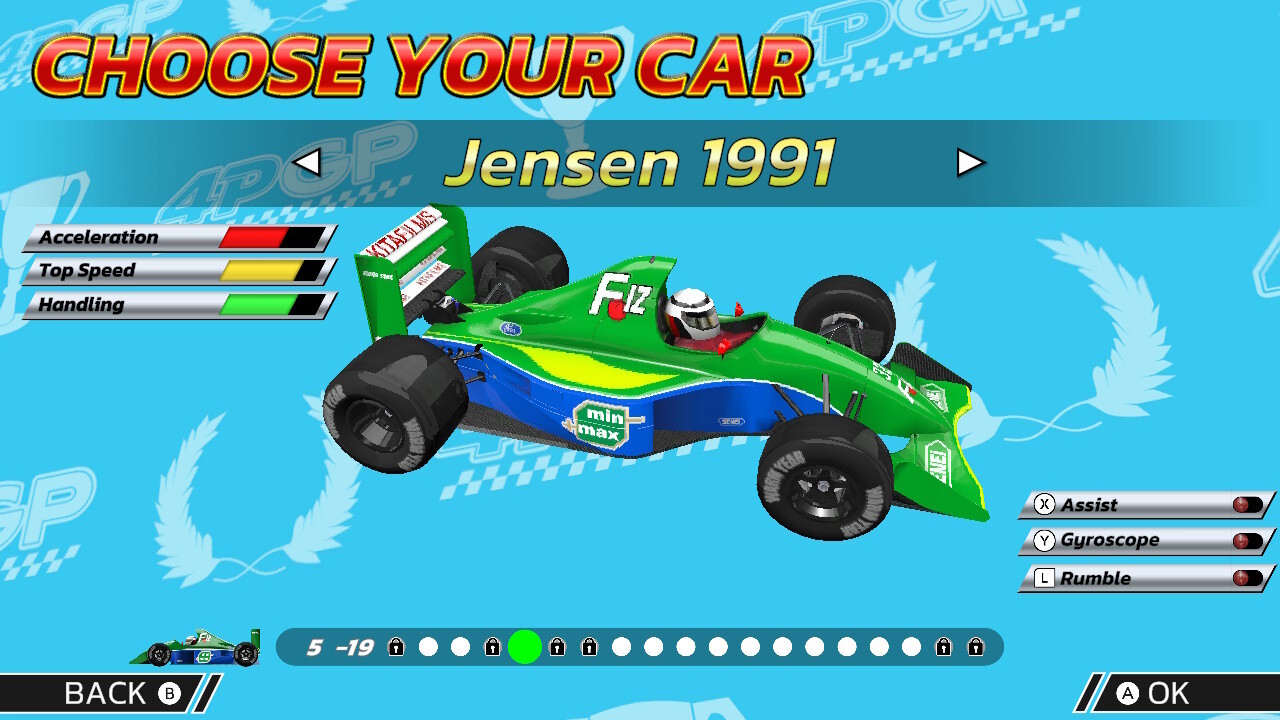
The car models look precisely the part. 3goo
There’s something about the way the cars move in this game that feels authentic to the era it’s trying to capture. It’s present in the way the bodies lean opposite the turn, and the rear tires swing out. I wish Kawamura’s music played throughout more of the race; you only hear it in full on the final lap, otherwise it’s mostly silence, save for Virtua Racing-like jingles. His work here really does sound like a lost cut from the Daytona USA 2001 soundtrack.
Visually, 4PGP is decent, but not particularly stunning. I played it on a Switch OLED, where it runs at a stable 60 frames per second in handheld mode. Textures appear to be deliberately unfiltered and point-sampled, like they would have been on the original Ridge Racer arcade hardware, while trackside objects like trees and spectators often take the form of photographic cutouts digitized into sprites. Everything is oversaturated and sunny by design, and although 4PGP doesn’t have the visual consistency of a Ridge Racer or Sega Rally (the shadows are really chunky), for an indie title by a very small team, it gets the job done.
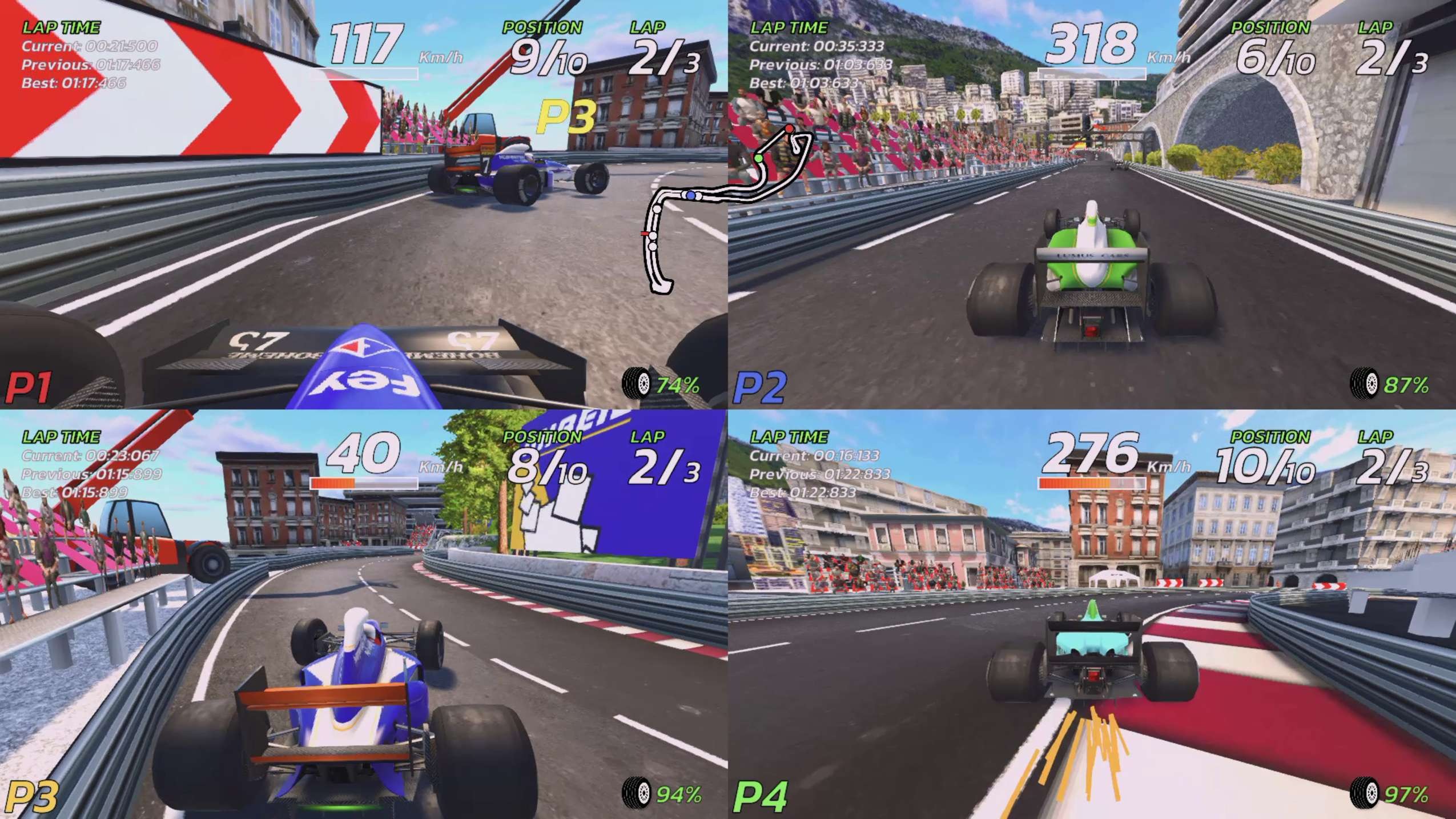 Four-player action. It’s in the name! 3goo
That’s generally my feeling on 4PGP. This is a fine game, one that understands that the basics of a timeless arcade racer lie in its fundamentals, even if its fundamentals are a bit flawed. For $18 on Switch 1 at launch today, I’d consider it. The Switch 2 version, which costs $22, supports 120 frames per second for what I imagine must be a very smooth experience, and those without Nintendo hardware can play on PC via Steam. Of course, all versions allow you to race against up to three other players, split-screen. If you’ve gotten a little bored with Sega Ages Virtua Racing’s three tracks, it’s a natural buy.
Got a retro racing game you want me to check out? Email the author at adam.ismail@thedrive.com
Backed by a decade of covering cars and consumer tech, Adam Ismail is a Senior Editor at The Drive, focused on curating and producing the site’s slate of daily stories.