
🧪 Ryzen 5 9600X Gaming Behavior – PBO, PPT & Frametime Analysis
Why higher boost clocks did NOT improve real-world gaming performance
After extensive real-game testing at 1440p across multiple engines, I found that:
Disabling PBO and capping PPT to 110 W produced:
- equal or better average FPS
- consistently better frametime stability
- lower CPU latency (CPU wait)
- lower temperatures and power draw
PBO +25 / +50 / +200 increased reported boost clocks, but:
- did not improve average FPS
- worsened 1% / 99% frametimes
- increased CPU wait time and boost oscillation
- increased temps and voltage without translating into usable performance
In short:
PBO improves benchmark numbers, not real-world gaming smoothness, on this CPU and workload mix.
Test System
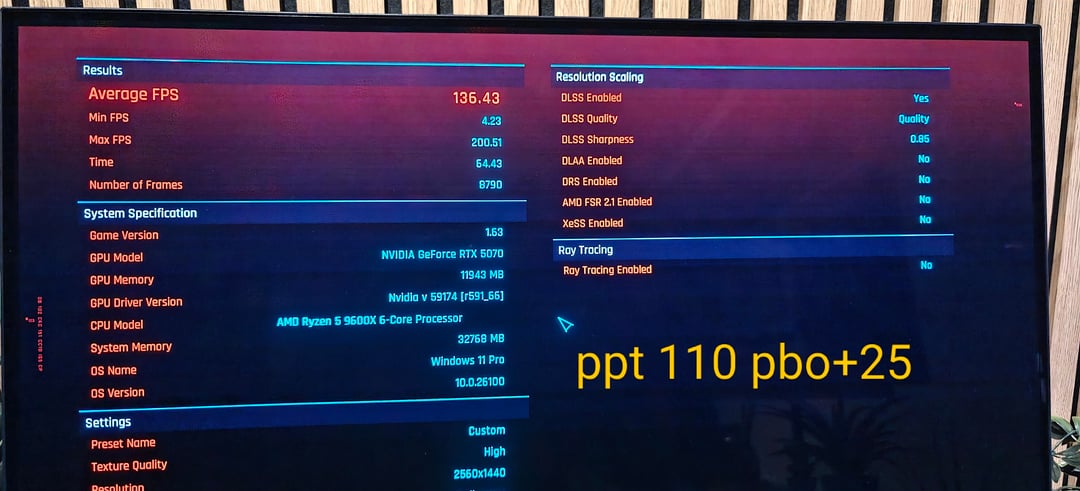
CPU: Ryzen 5 9600X (Zen 5)
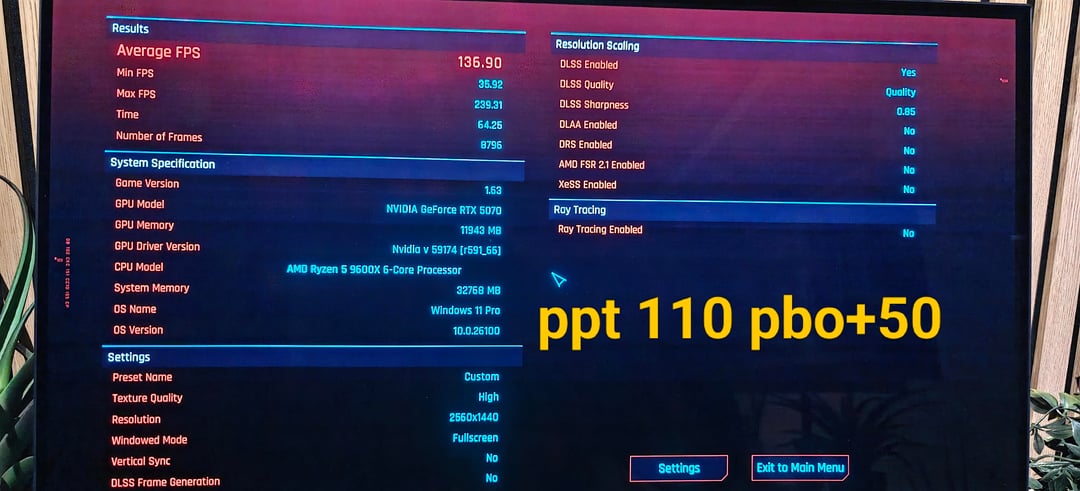
GPU: RTX 5070
– OC/UV (fixed across all tests)
– No frame generation
Motherboard: ASUS ROG Strix B650E-F WiFi
BIOS: 3057
AGESA: ComboAM5 PI 1.2.0.2a
Cooling: 360 mm AIO
OS: Windows 11 (Game Mode ON, HAGS ON)
Memory Configuration (Manually Tuned)
DDR5: 6000 MT/s Corsair Veng.Hynix M
Timings: CL30 (manual tightening)
EXPO: Enabled, then manually refined
SOC Voltage: ~1.25 V (stable)
Fully stress-tested and stable
Memory tuning was kept constant for all tests.
GPU Configuration
GPU clocks and voltage were fixed
No changes between test runs
DLSS used where applicable (Quality)
No ray tracing
No frame generation
Locked Baseline BIOS Configuration
PBO: Disabled
PPT: 110 W
TDC / EDC: Auto (never limiting in games)
Scalar: 1×
Thermal Limit (TJmax): 85 °C
Curve Optimizer: Negative (aggressive but stable)
SOC Voltage: ~1.25 V
This setup prioritizes:
– sustained effective clocks
– thermal stability
– minimal boost oscillation
– frametime consistency
Test Methodology
Games Tested:
– Cyberpunk 2077
– The Witcher 3 (Next-Gen)
– Wolcen: Lords of Mayhem (CPU-heavy ARPG)
Resolution:
2560×1440 (1440p) for all tests
How Tests Were Run:
– Same save, same scene, same camera path
– Same graphics settings
– Same GPU clocks
– Same memory configuration
– HWiNFO sensors reset between runs
– 3 passes per configuration (first discarded if shader caching occurred)
Metrics Logged (RTSS + HWiNFO):
– Average FPS
– 1% / 99% frametime
– CPU effective clocks (best cores + average)
– CPU & GPU busy / wait times
– CPU power draw
– CPU temperature
– PPT / TDC / EDC usage
Peak clocks and synthetic benchmarks were intentionally ignored.
Test Configurations Compared
All tests were done at PPT = 110 W unless stated otherwise.
- PBO OFF (baseline)
- PBO +25
- PBO +50
- PBO +200 (brief confirmation only)
Results
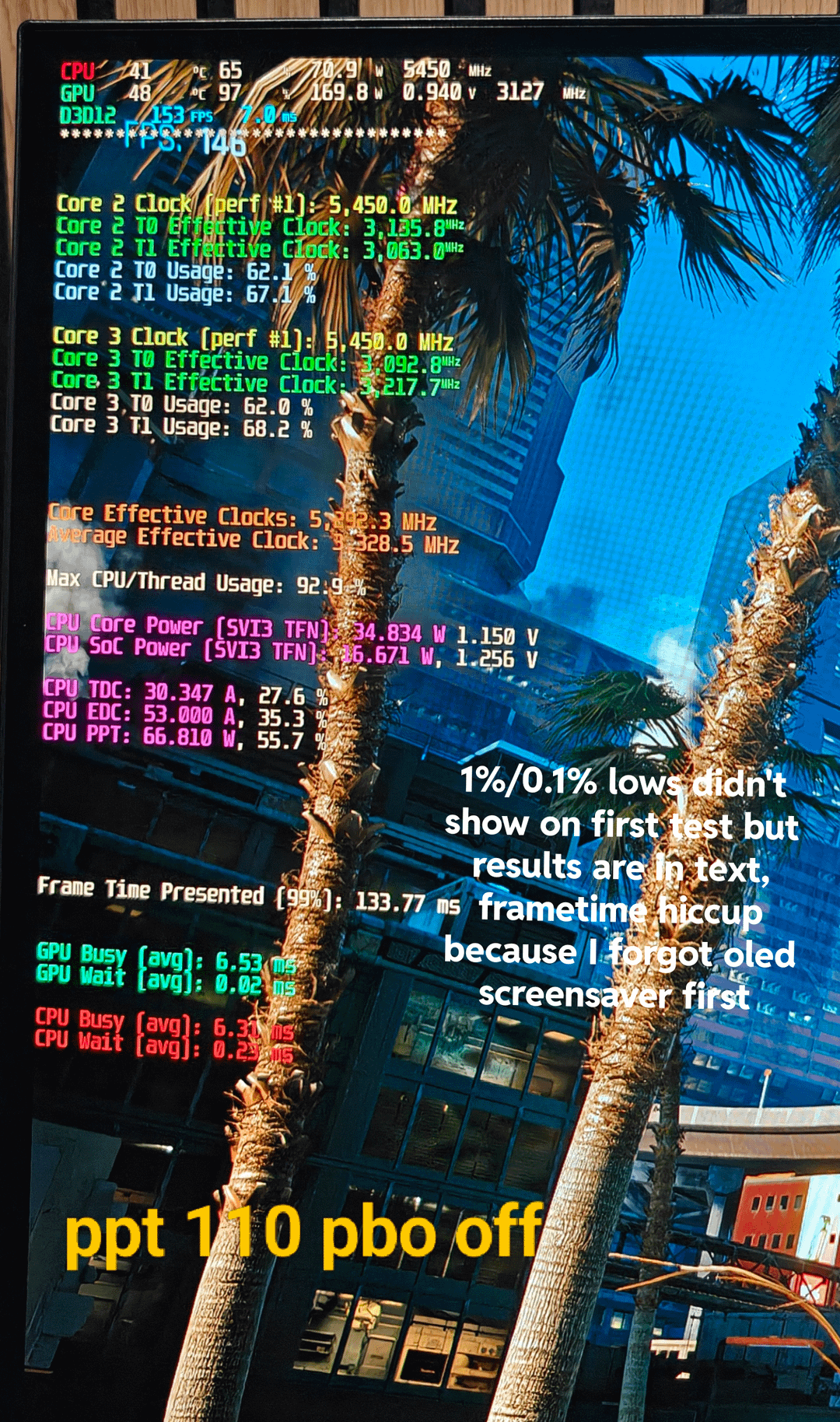
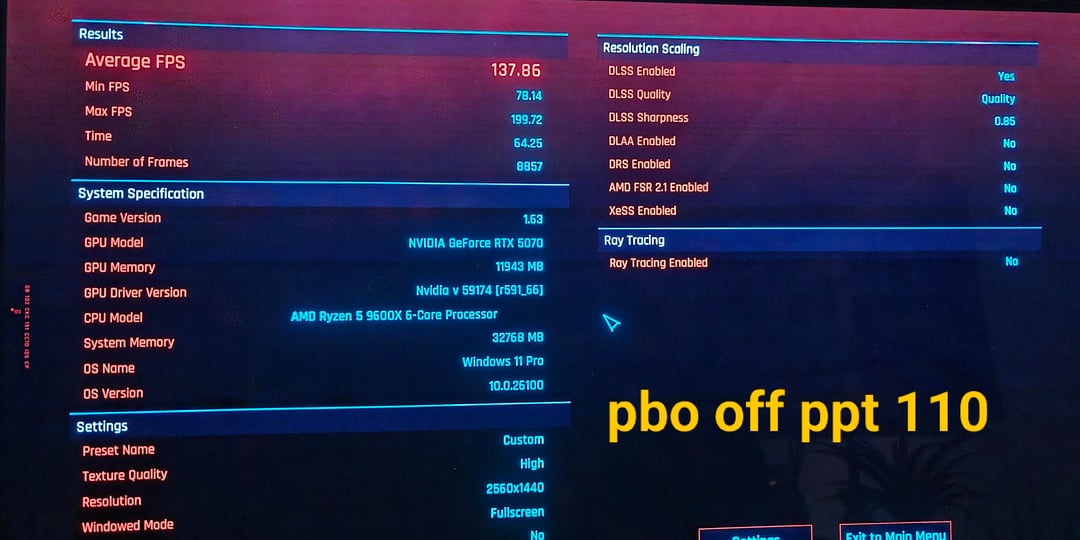
Cyberpunk 2077 (1440p)
PBO OFF:
– Avg FPS: ~137–138
– Best frametime consistency
– Lowest CPU wait and temps
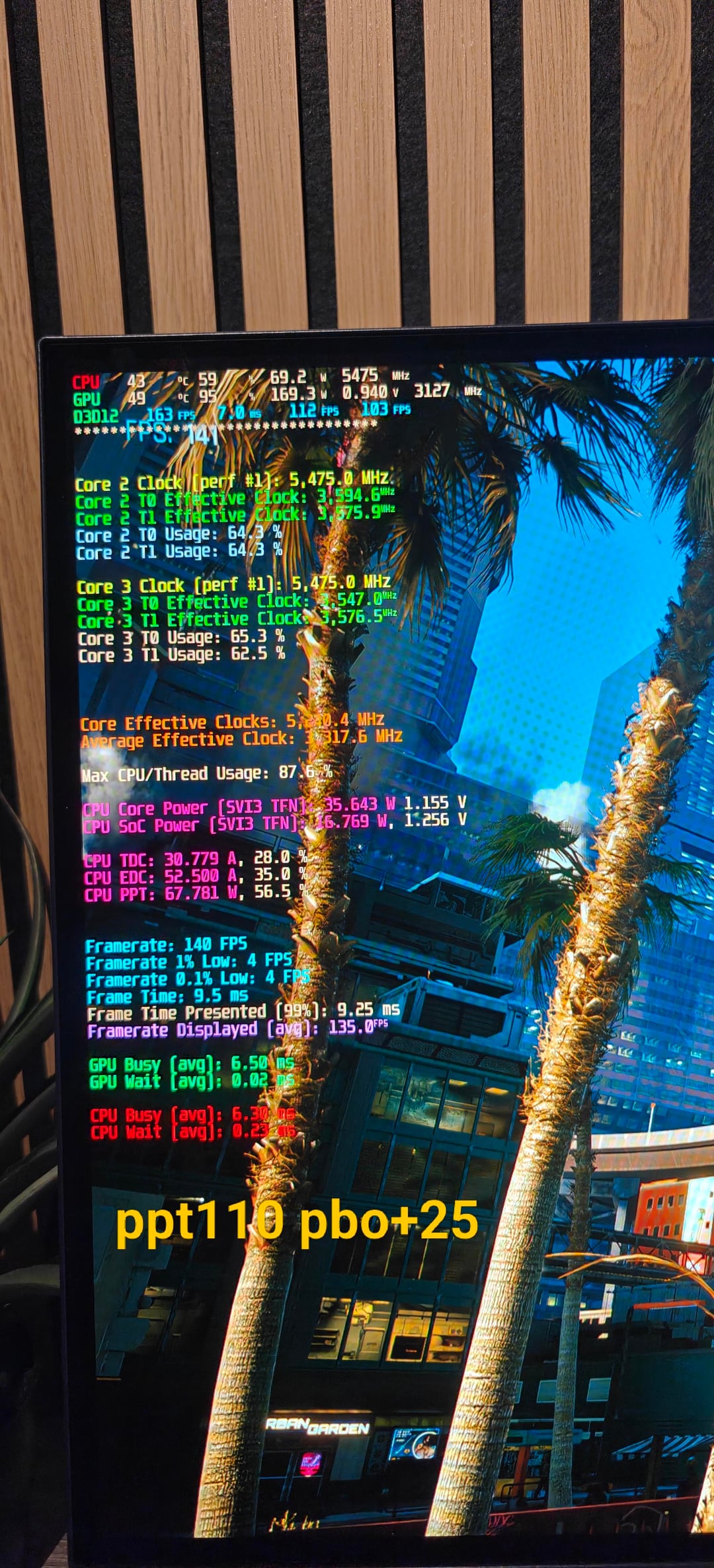
PBO +25:
– Avg FPS: ~136–137
– Slightly worse frametimes
– Higher temps and CPU wait
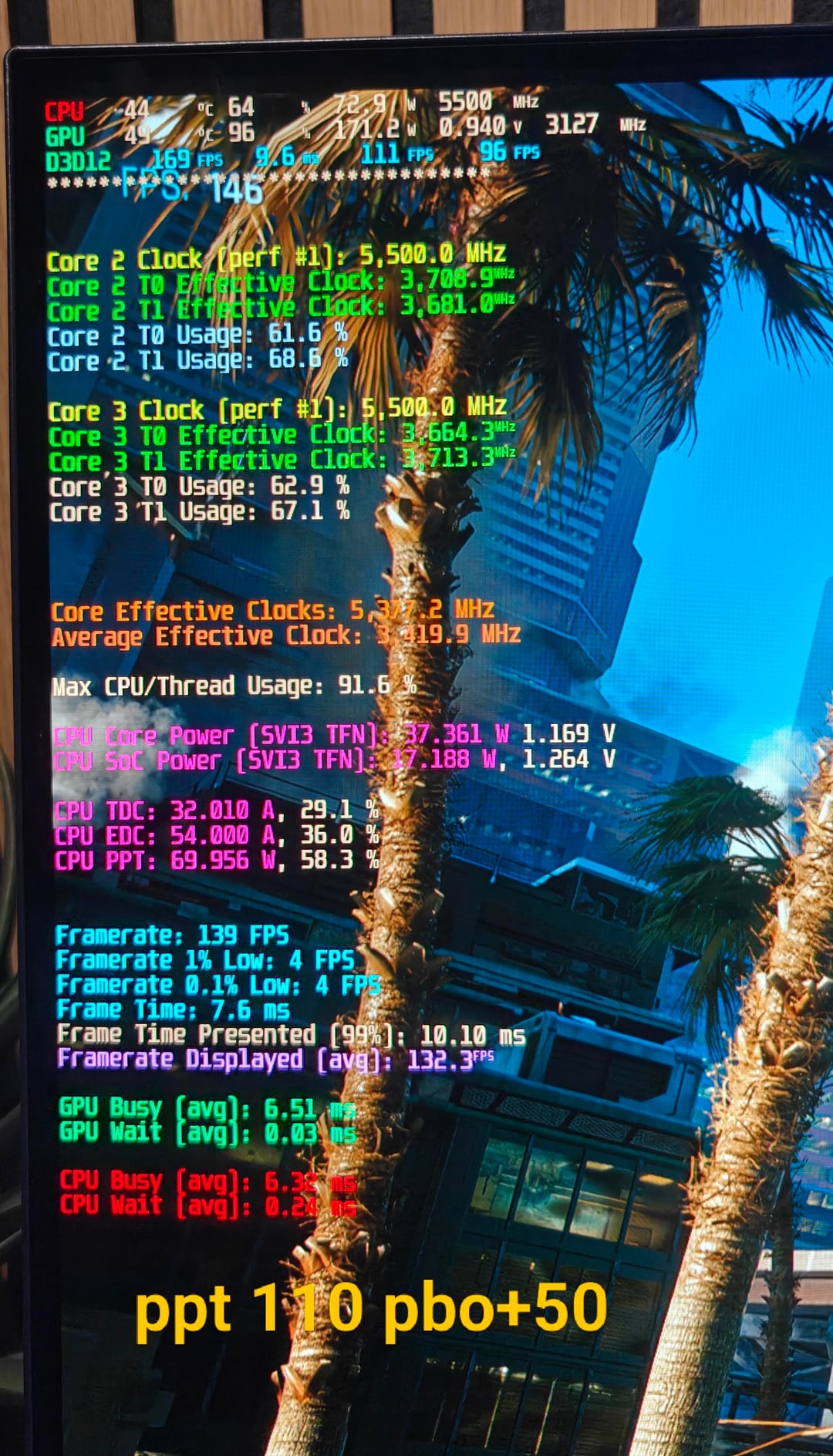
PBO +50:
– Avg FPS: ~136–137
– Worse frametimes
– Higher temps, no performance gain
Key observation:
Higher boost clocks did not translate into better performance or smoother gameplay.
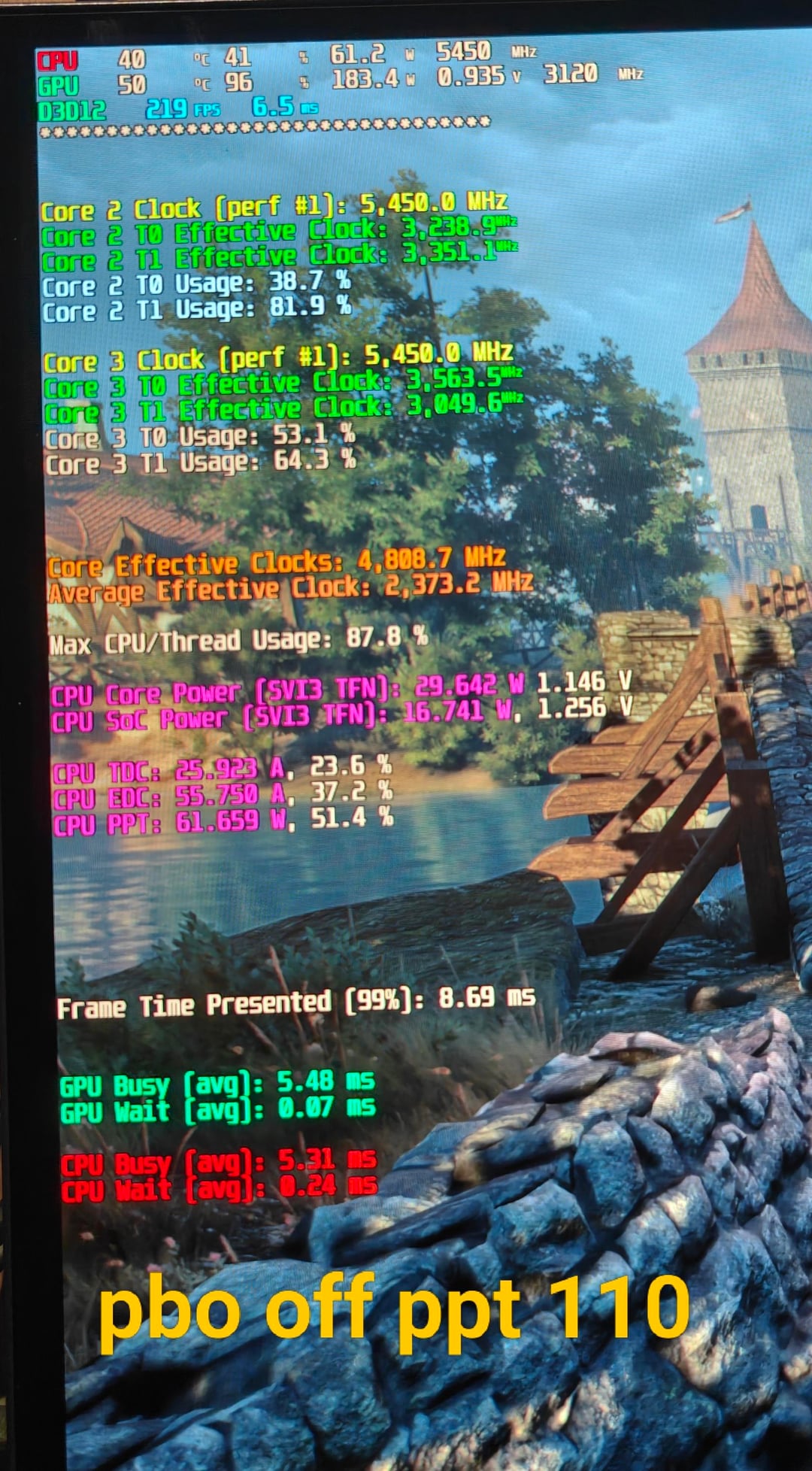
The Witcher 3 Next-Gen (1440p)
PBO OFF:
– Avg FPS: ~166–168
– Best 99% frametimes
– Lowest latency and temps
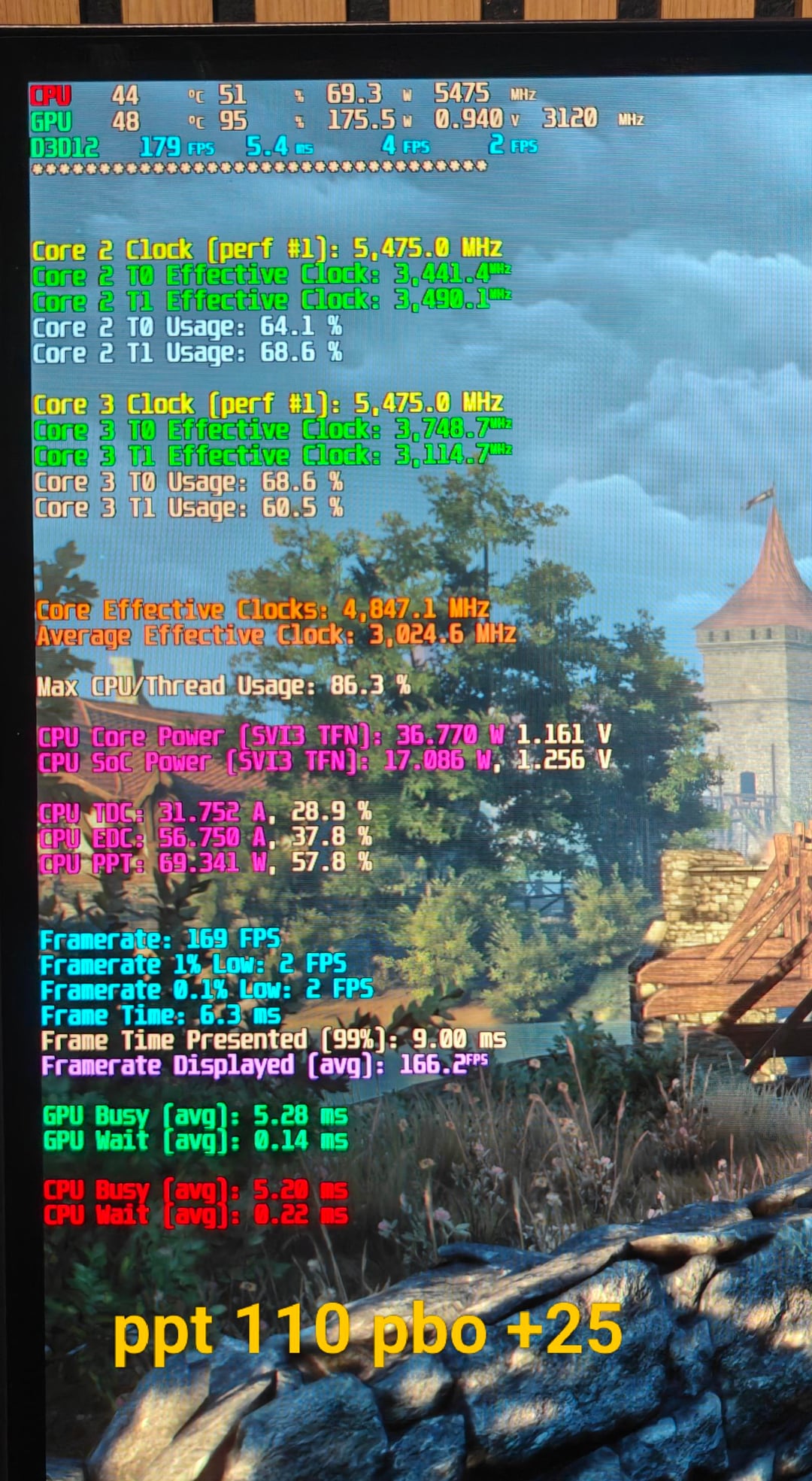
PBO +25:
– Avg FPS: ~168–169
– Worse frametimes
– Significantly higher temps
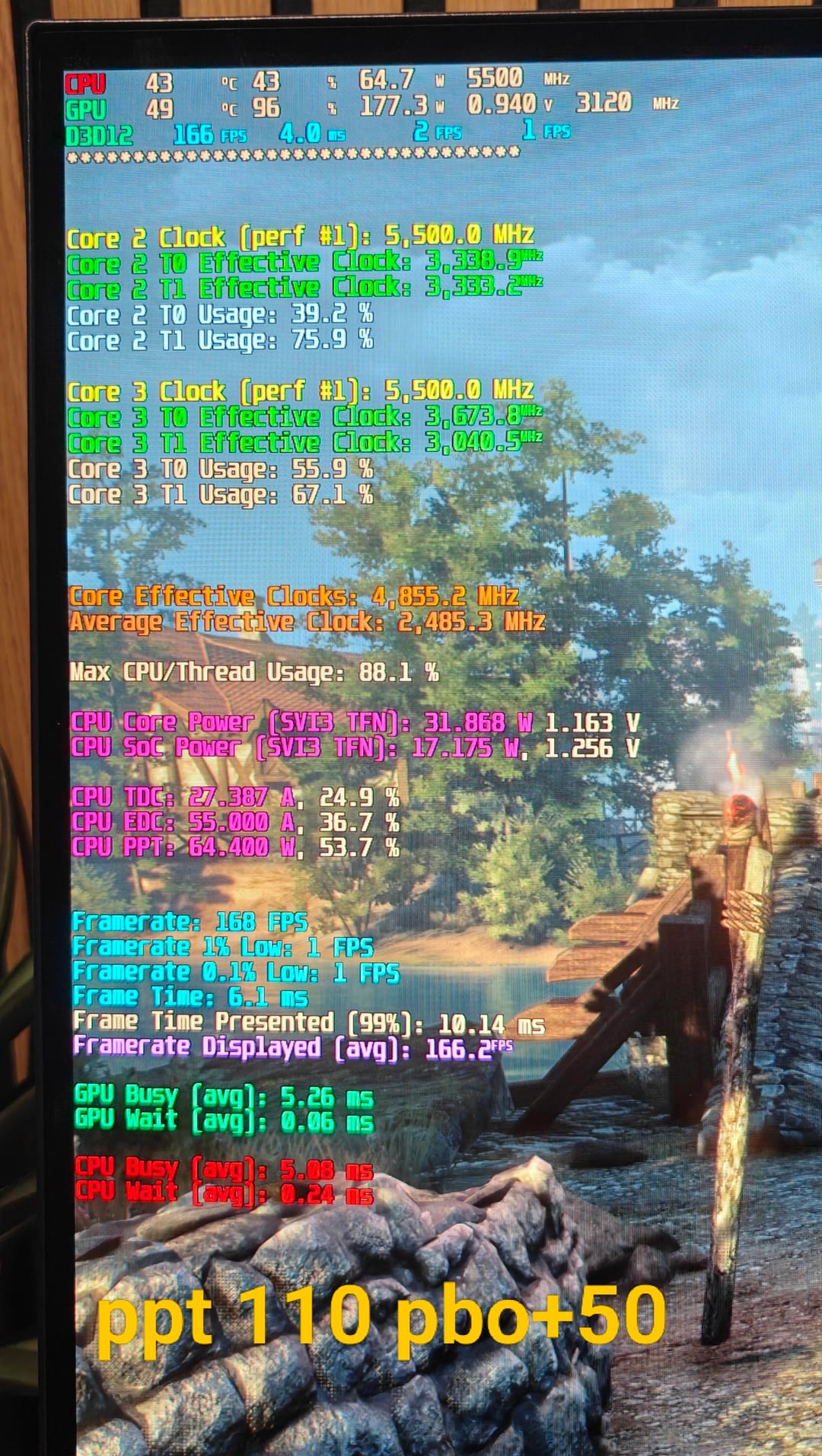
PBO +50:
– Avg FPS: ~166–168
– Worst frametime stability
Key observation:
Witcher 3 is latency-sensitive; boost oscillation hurts smoothness.
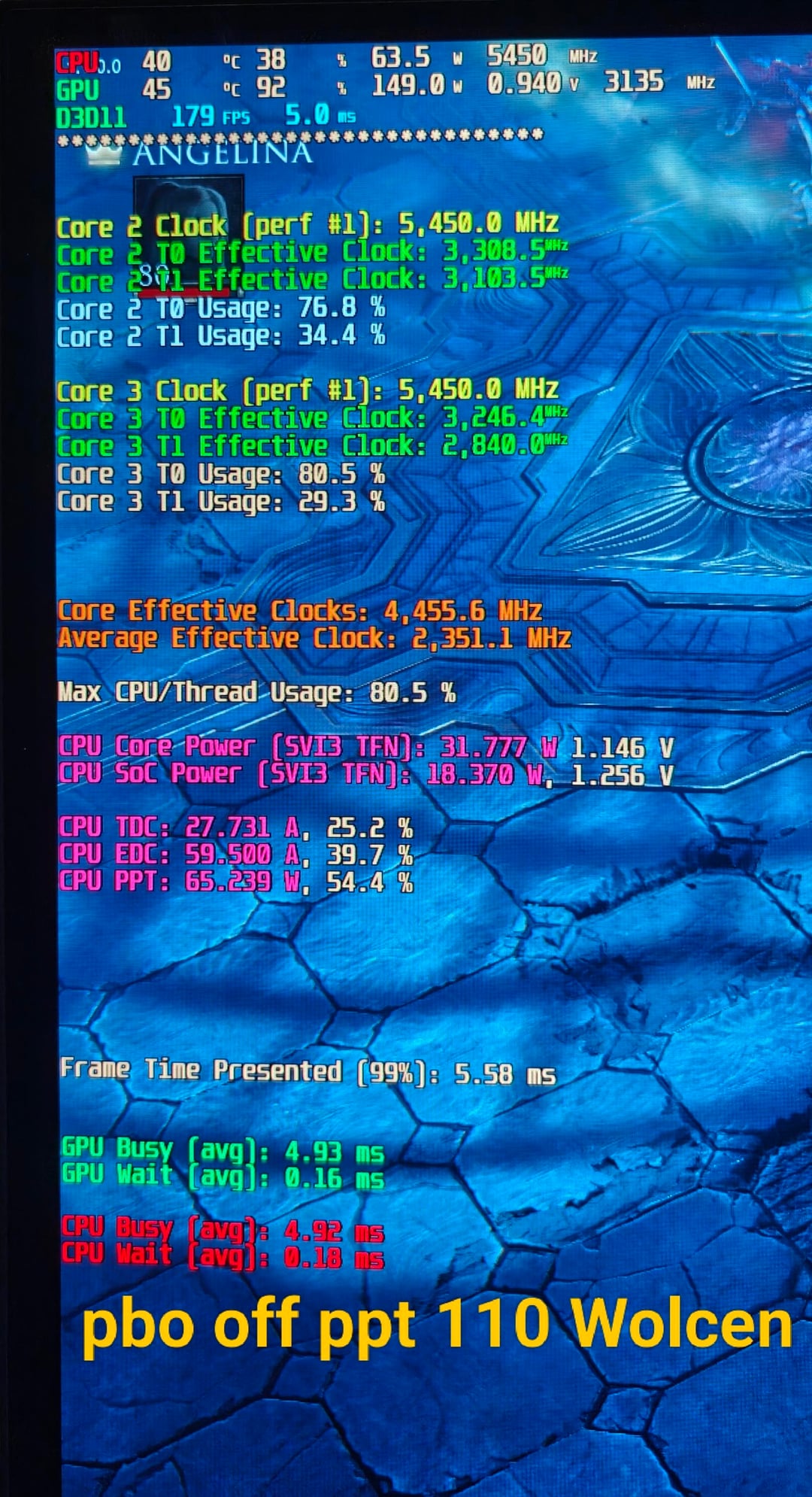
Wolcen (CPU-heavy, 1440p)
PBO OFF:
– Avg FPS: ~179
– 99% frametime: ~5.58 ms
– Very low CPU wait
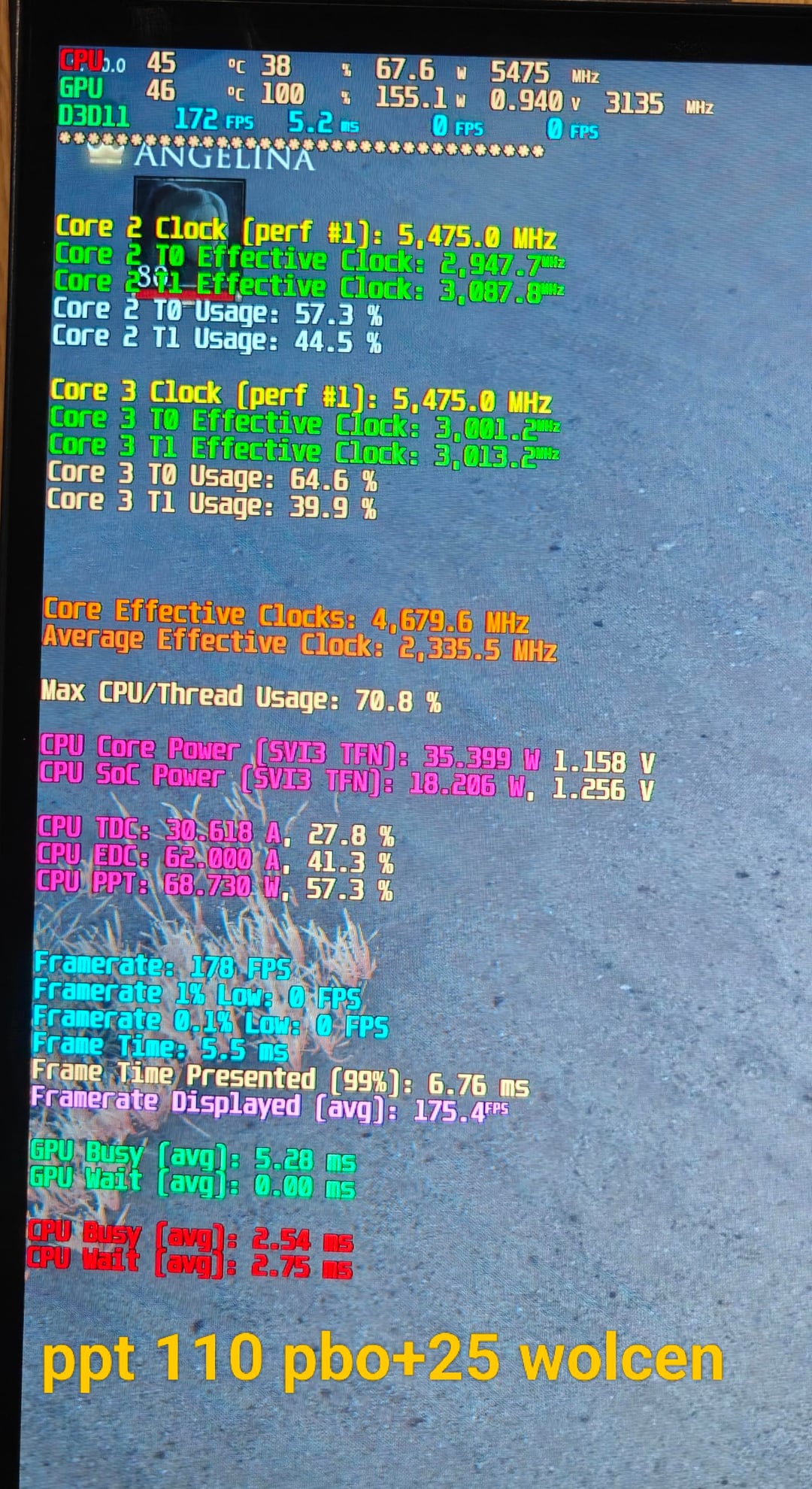
PBO +25:
– Avg FPS: ~178
– 99% frametime: ~6.76 ms
– Increased CPU wait
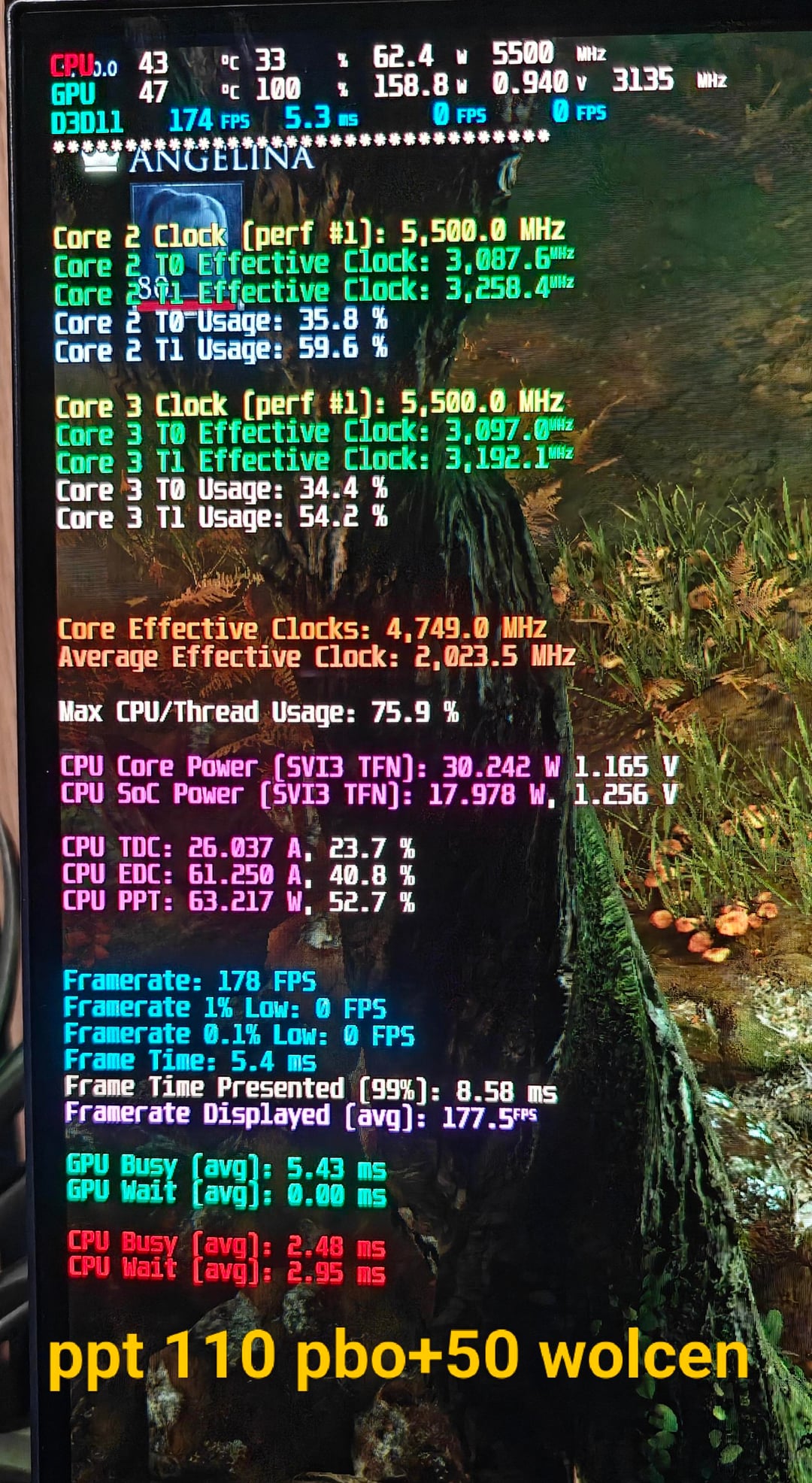
PBO +50:
– Avg FPS: ~174–175
– 99% frametime: ~8.58 ms
– Very high CPU wait
Key observation:
Despite higher effective clocks, CPU wait increased significantly, degrading performance.
Cross-Game Pattern
Across three different engines:
– PBO raises clocks
– PBO raises voltage and temperature
– PBO increases boost oscillation
– PBO increases CPU wait time
– Games prefer stable effective clocks over higher peaks
Why This Happens (Short Explanation)
Zen 5 boost behavior is:
– FIT-controlled
– highly temperature-sensitive
– latency-aware
PBO:
– increases voltage to chase higher boost bins
– introduces thermal and voltage variance
– worsens cache and memory access consistency
Games respond negatively to this variance, even when peak clocks increase.
Final Conclusions
- PBO is not universally “free performance” for gaming
- On Zen 5, with a strong GPU and tuned memory:
- PBO improves benchmarks
- PBO often hurts real-world frame pacing
- PBO OFF + PPT 110 W delivered the best overall gaming experience:
- smoother frametimes
- lower temps
- lower latency
- equal average FPS
Important clarification:
This testing applies to non-X3D Zen 5 CPUs (e.g. 9600X / 9700X) in a balanced CPU/GPU configuration at 1440p.
X3D CPUs behave differently:
– larger L3 cache reduces engine stalls
– higher sustained effective clocks in games
– far less sensitivity to boost oscillation and PBO behavior
These results should not be interpreted as anti-X3D.
Final Daily Gaming Recommendation (for this CPU class)
- PBO: OFF
- PPT: 110 W
- Scalar: 1×
- TJmax: 85 °C
- Curve Optimizer: Moderate negative (stable)
- Memory: Tuned DDR5-6000
Closing Note
This does not mean PBO is useless:
– It can help in heavily CPU-bound or productivity workloads
– It can improve short synthetic benchmarks
But based on long-duration, real-game testing at 1440p, it is not optimal for frametime-focused gaming on this class of CPU.
Posted for discussion and data sharing, not as universal truth.
Different systems, cooling, and workloads may behave differently.