
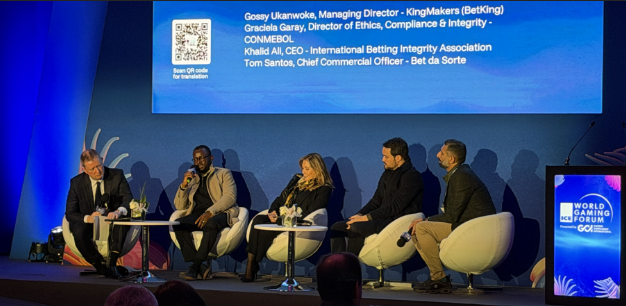
As regulated sports betting continues to expand, industry leaders increasingly view integrity as a growth enabler, rather than a constraint. That theme guided a Sport Leaders Conference panel at ICE Barcelona, where operators, regulators, sports bodies, and integrity organizations examined how collaboration and data-led approaches are strengthening betting ecosystems worldwide.
Moderated by John Hagan, partner at Harris Hagan, the session brought together Khalid Ali, CEO of the International Betting Integrity Association; Graciela Garay, Director of Ethics, Compliance and Integrity at CONMEBOL; Gossy Ukanwoke, Managing Director at KingMakers (BetKing); and Tom Santos, Chief Commercial Officer at Bet da Sorte. Each speaker offered a perspective shaped by operating in markets at different stages of regulatory maturity.
Ali outlined how integrity frameworks have evolved over the past two decades, driven by closer cooperation between betting operators and sports organizations. Information sharing has become central to that progress, allowing suspicious activity to be identified and assessed more effectively across jurisdictions. According to Ali, this collaborative model has shifted how the industry is addressing integrity.
Garay emphasized the role sports federations play in coordinating integrity efforts, particularly in regions where betting-related risks often cross national borders. CONMEBOL has focused on building partnerships with monitoring organizations, law-enforcement agencies, and international bodies to improve transparency and investigative capacity. These partnerships, she noted, are essential for creating consistent standards across markets.
Emerging markets were a major focus of the discussion. Santos described Brazil’s regulated betting environment as being in an early phase of development, where trust-building is a priority. Clear communication among regulators, operators, and the public has been critical, especially as the market works to transition players to licensed platforms. Education, enforcement, and consistent oversight were cited as key drivers of progress.
Ukanwoke echoed similar themes from Nigeria, where integrity directly influences consumer confidence. He highlighted the importance of shared reporting structures and alignment between local operators and global integrity bodies. According to Ukanwoke, these efforts support long-term sustainability by creating clear expectations for both operators and players.
Technology and data featured prominently throughout the session. Panelists pointed to integrity-monitoring platforms and shared alert systems as practical tools that allow risks to be identified early. While investigations can take time, speakers agreed that early detection and coordination significantly improve outcomes and reinforce confidence in regulated markets.
The conversation also addressed the relationship between regulation and market development. Panelists stressed the importance of regulatory frameworks that protect consumers, while supporting competitive well-functioning markets. Ongoing dialogue between regulators and industry participants was described as essential for achieving that balance.
Looking ahead, major international sporting events in 2026 were seen as opportunities to reinforce integrity standards at scale. Increased betting activity during these moments places greater emphasis on preparedness, cooperation, and transparency. Panelists noted that high-profile events also provide a platform to demonstrate the value of regulated betting environments.
The session concluded with a shared view that integrity is increasingly embedded in how sports betting markets grow. Strong partnerships, consistent standards, and data-driven oversight were positioned as foundational elements for building trust and supporting sustainable expansion across regions.