
If you were hanging out in arcades in the early 90s, the air was thick with cigarette smoke, the smell of cheap pizza, and the sounds of “Hadouken!” But underneath the noise, there was a rumor. It was whispered around cabinets like sacred text.
There was a secret master hidden in Street Fighter II. A character more powerful than M. Bison, faster than Vega, and stronger than Zangief. He was waiting for only the best players to unlock him.
His name was Sheng Long.
Countless quarters were wasted and schoolyard arguments launched over whether he was real. He was the ghost in the machine—the ultimate test of skill.
Decades later, the legend of Sheng Long remains perhaps the most famous and influential hoax in video game history. But was he ever actually in the original game? And how did a simple translation error change the future of the fighting game genre?
Here is the definitive history of Sheng Long, the character who never existed, yet changed Street Fighter forever.
The Spark: A 1991 Translation Fail
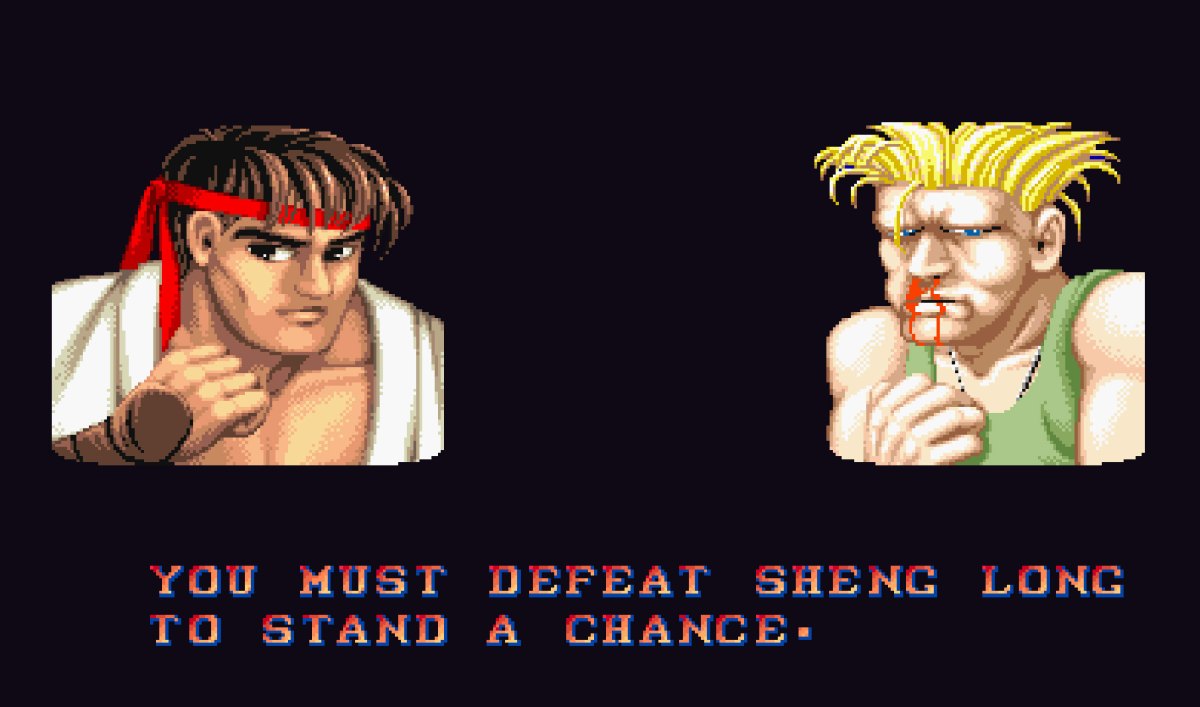 The translation error that started it all. In Japanese, Ryu was actually referring to his “Shoryuken” (Dragon Punch), not a person.
The entire legend began with a mistake. When the original Street Fighter II: The World Warrior was released in arcades in 1991, localization from Japanese to English wasn’t the precise science it is today. Translators often worked with little context, tight deadlines, and no direct line to the developers.
If you played as Ryu and won a match, one of his victory quotes flashed on the screen:
“You must defeat Sheng Long to stand a chance.”
Players immediately panicked. Who was Sheng Long?
He wasn’t on the character select screen.
He wasn’t one of the four boss characters (Balrog, Vega, Sagat, M. Bison).
The natural assumption was that Sheng Long was Ryu’s hidden master—the man who taught him the ways of the fireball.
The Linguistic Reality
Ryu was never talking about a person. In the original Japanese version, Ryu says: “You must defeat my Shoryuken to stand a chance.”
“Shoryuken” is the Japanese name for Ryu’s iconic Dragon Punch uppercut. The localization team, likely unfamiliar with the specific move names, mistook “Shoryuken” for a proper noun. They translated the characters for “Rising Dragon” into Chinese Pinyin, resulting in “Sheng Long.”
In the instruction manual for the SNES port, they even doubled down, referring to “Master Sheng Long” as Ryu and Ken’s teacher. The seed was planted. Gamers believed a secret master was waiting to be found.
The Fuel: The Infamous EGM April Fools’ Prank
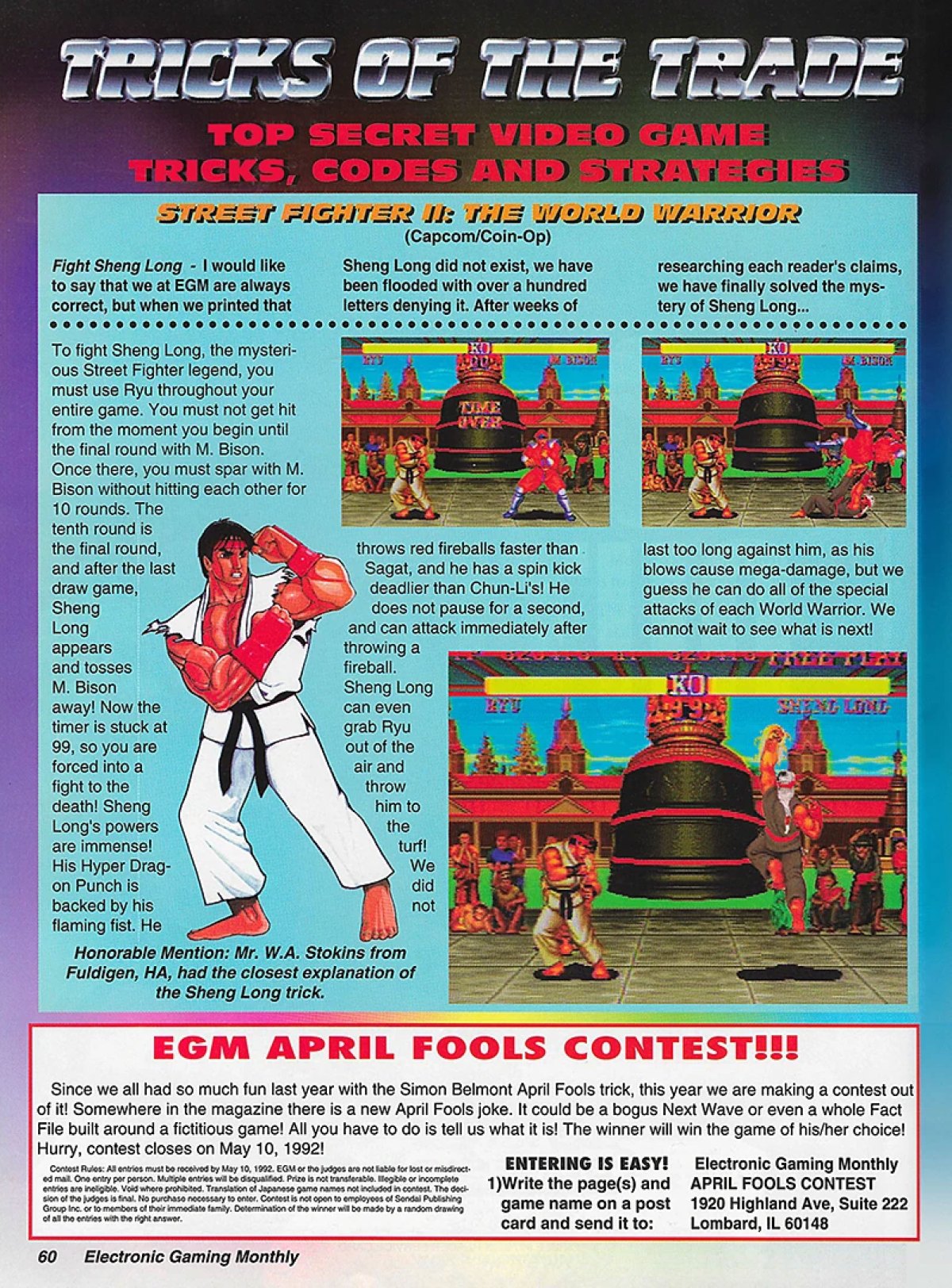 The legendary April Fools’ article in Electronic Gaming Monthly that fooled a generation. Note the “W.A. Stokins” credit at the bottom.
The translation error was the spark, but Electronic Gaming Monthly (EGM) magazine poured gasoline on the fire.
In the pre-internet era, gaming magazines were the ultimate authority. If a secret was printed in EGM or GamePro, it was treated as fact. In their April 1992 issue, EGM decided to play on the growing rumors surrounding Ryu’s victory quote.
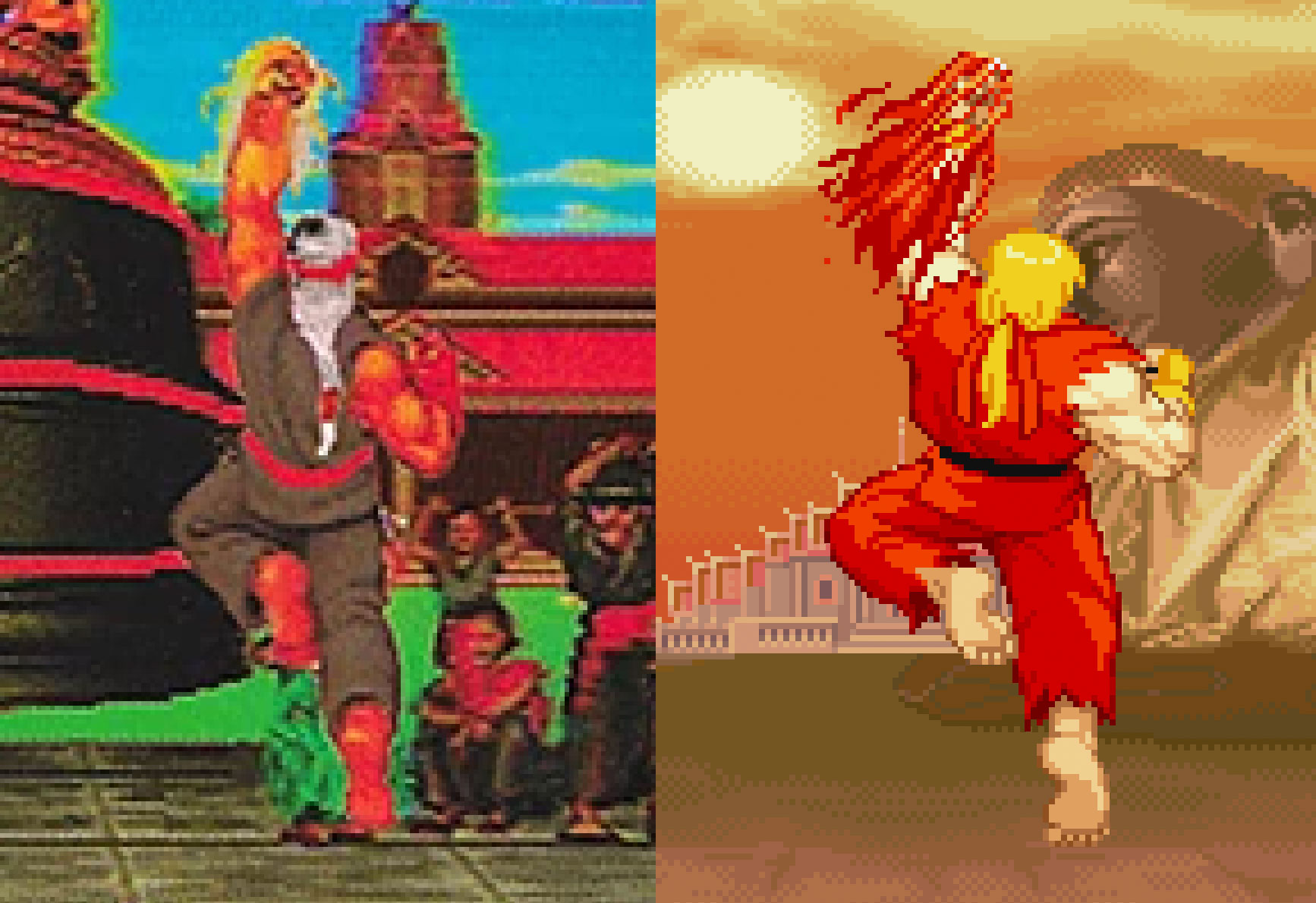
They published a convincingly written article claiming they had finally found Sheng Long. They included doctored screenshots showing Ryu fighting a mysterious, fast-moving character with a grey gi and a long beard.
The method to unlock him, however, was absurdly difficult—designed to be impossible.
 Doctored image showing Sheng Long interrupting the M. Bison fight, a concept Capcom would later steal for Akuma.
The “Unlock Method”
According to the prank, to fight Sheng Long, a player had to:
Play as Ryu.
Complete the entire game without taking a single pixel of damage.
Reach the final boss, M. Bison.
Fight M. Bison to a “Draw” for 10 consecutive rounds without either player landing a single hit (by running out the timer).
The article claimed if you managed this impossible feat, Sheng Long would jump onto the screen, throw M. Bison out of the arena, and fight you with inhuman speed and power.
The “W.A. Stokins” Easter Egg
The prank had clues that it was fake, but most readers missed them. The article credited the discovery to a “W.A. Stokins” from “Fuldigen, HA.”
If you read it closely:
W.A. Stokins = “Waste Tokens” (as in, wasting your arcade tokens).
Fuldigen, HA = “Fooled Again, Ha.”
Despite these hints, thousands of gamers across the world fell for it. They spent hours pouring money into arcade machines, trying to achieve 10 perfect draw rounds against the final boss, only to realize they’d been had.
The Psychology: Why We Wanted to Believe
Why did a hoax like this take hold so strongly? You have to understand the era.
1. The “Schoolyard Internet”: In 1992, you couldn’t hop on Reddit or Twitter to verify a claim. Information traveled via word of mouth. If the older kid at the arcade said his cousin in California fought Sheng Long, you believed him. Rumors were social currency.
2. Secrets Were Real: This was the same era as Mortal Kombat’s “Reptile.” Secret characters did exist. Developers were hiding things in games. The idea that Capcom would hide a master character behind an impossible skill wall felt plausible because games back then were notoriously difficult and cryptic.
3. The Desire for Lore: Street Fighter II had very little story. Fans were starving for context. The idea of a “Master” character gave depth to Ryu and Ken’s rivalry. We wanted Sheng Long to be real because it made the world feel bigger.
The Legacy: How the Hoax Became Canon
While Sheng Long wasn’t in Street Fighter II, the immense reaction to the hoax caught Capcom’s attention. The developers realized fans were desperate for hidden secrets and a master figure.
Instead of ignoring the prank, Capcom leaned into it, using the hoax as a blueprint for future games.
1. The Birth of Akuma (Gouki)
The EGM prank described a secret boss who jumps onto the screen and obliterates M. Bison before fighting the player.
Capcom loved this idea. In 1994’s Super Street Fighter II Turbo, they made it reality. If players met specific high-level requirements (getting 3 perfects and no continues), a new secret character named Akuma (Gouki in Japan) would appear. Just like the hoax, Akuma jumps in, kills M. Bison in an instant, and challenges the player.
The mechanics of the Sheng Long hoax directly inspired the debut of one of gaming’s most iconic villains.
2. The “Real” Master: Gouken
Fans still wanted Ryu and Ken to have a master. Eventually, Capcom canonized this figure in Street Fighter IV, introducing Gouken.
Gouken is the brother of Akuma and the man who taught Ryu and Ken the Ansatsuken fighting style. His design—an older man with a white beard and prayer beads—was clearly visually inspired by the faked screenshots from the original EGM magazine prank.
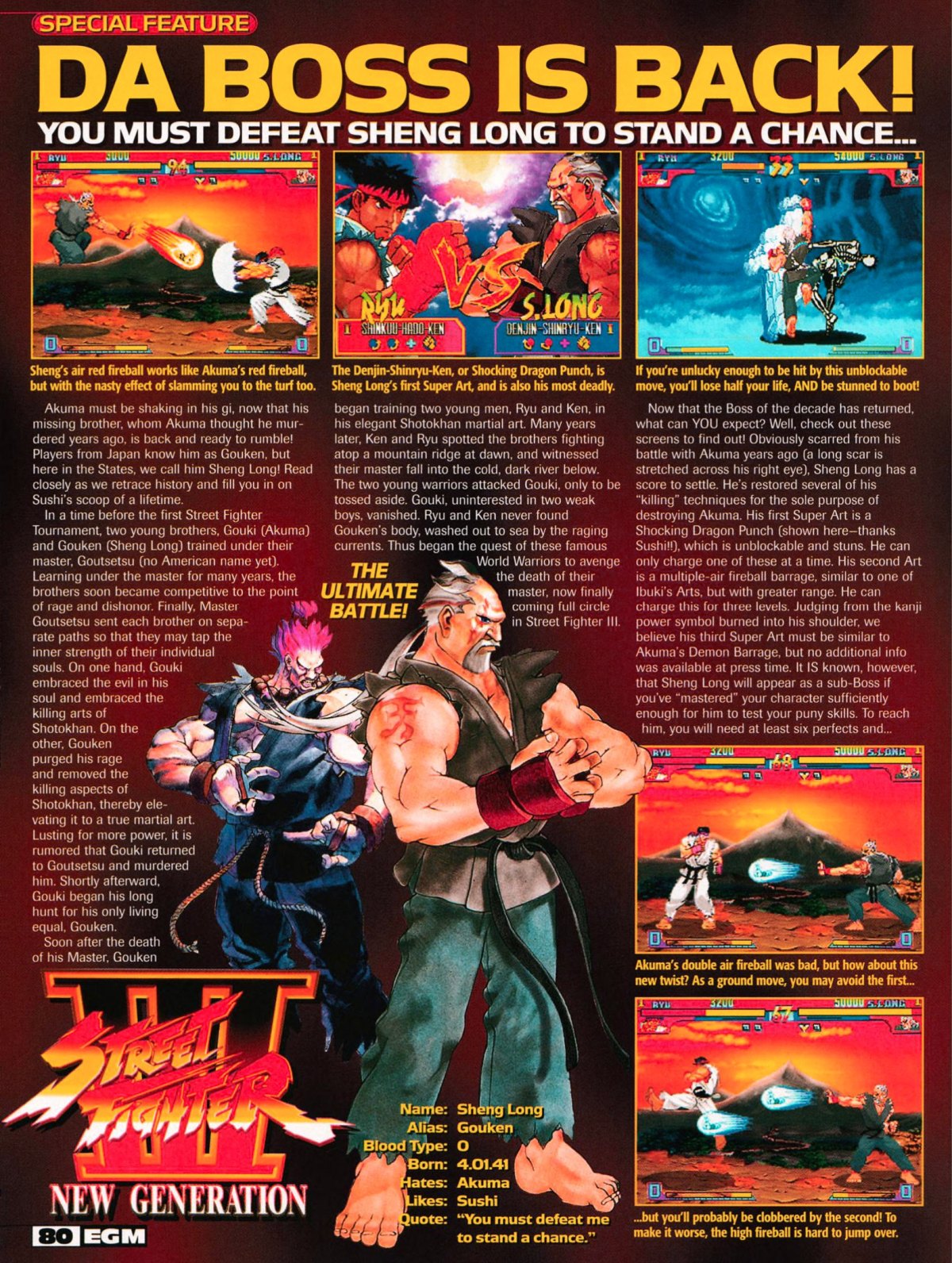 EGM tried to fool fans again in 1997 with a “Sheng Long in Street Fighter III” prank, proving the legend wouldn’t die.
The Finale: How to Find Sheng Long in Street Fighter 6
The joke ran for over 30 years. Sheng Long was referenced in victory quotes, easter eggs, and even appeared as graffiti in the background of the Disney movie Wreck-It Ralph.
But in 2023, Capcom finally closed the loop.
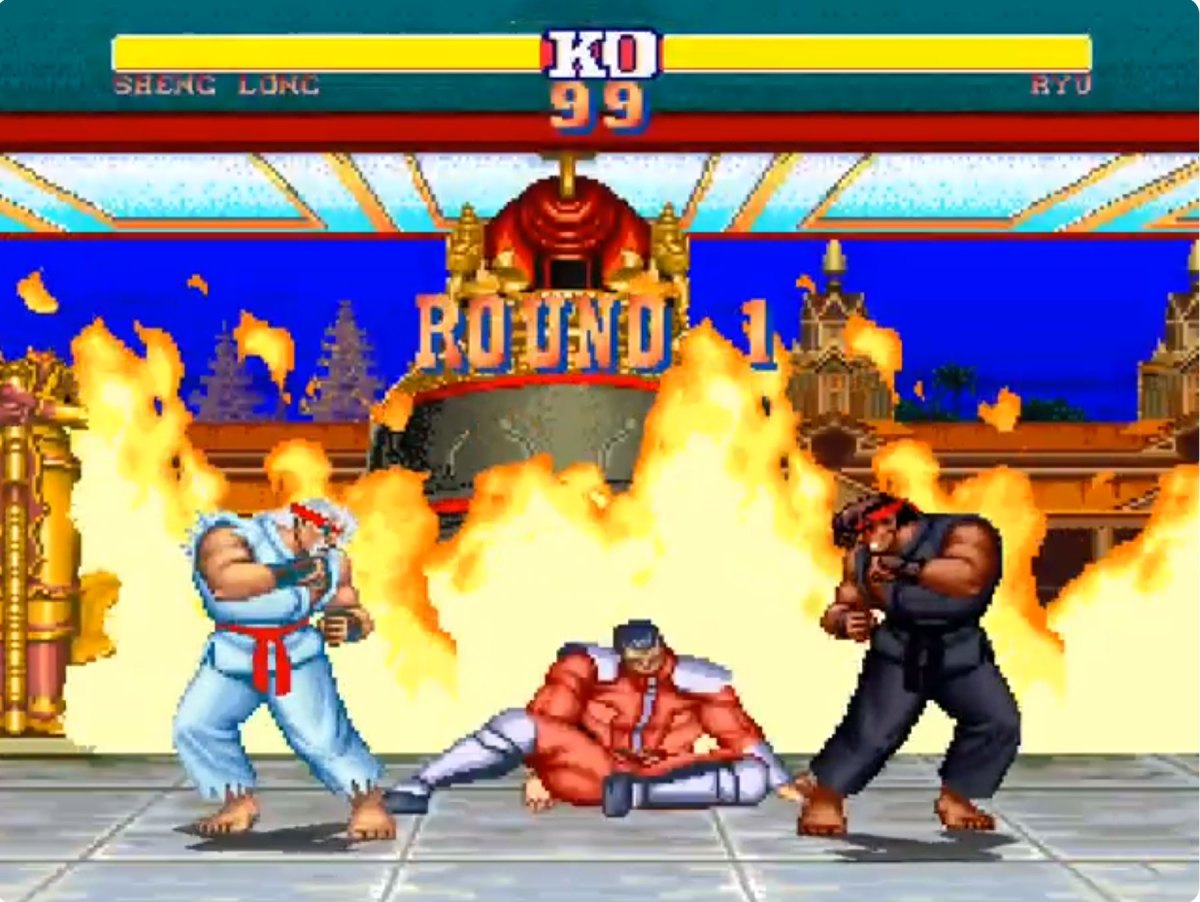
In Street Fighter 6, Sheng Long is no longer just a mistranslation. He is a real NPC that you can find and fight.
Detailed Guide: Where to Find Sheng Long
If you want to fight the legend yourself, you don’t need to get 10 draws against Bison anymore. But it isn’t easy.
Play World Tour Mode: You must progress through the main story campaign.
Finish the Game: You generally need to beat the main story to have stats high enough to survive.
Go to the SiRN Building: Head to the construction site in Metro City.
Wait for Night: He only appears at night.
Go to the Roof: Make your way to the very top of the SiRN building structure.
Look for the Legend: You will see a tall, shirtless NPC with a white beard standing near the edge.
When you approach him, his name bar simply reads: Sheng Long.
He is a Level 90 opponent—one of the hardest in the entire game. He uses a moveset that combines Ryu and Ken’s styles, fighting with the ferocity of the master players always imagined he was.
So, to answer the question that plagued arcades in 1991: No, Sheng Long was not in Street Fighter II. But the community willed him into existence, proving that sometimes, a legend is more powerful than the game itself.
FAQ: Quick Facts for the Arcade Historian
Who is Sheng Long in Street Fighter? Originally, Sheng Long was a mistranslation of “Shoryuken” (Dragon Punch) in the English version of Street Fighter 2. Later, he became a hoax character created by an April Fools’ prank in EGM magazine.
Is Sheng Long real in Street Fighter 6? Yes. After 30 years of jokes, Capcom added an NPC named Sheng Long as a high-level secret opponent in Street Fighter 6’s World Tour mode. He is located on top of the SiRN building in Metro City at night.
What was the “Waste Tokens” joke? In the original 1992 EGM prank article, the person credited with finding Sheng Long was named “W.A. Stokins,” a phonetically hidden joke for “Waste Tokens.”
Did Sheng Long inspire Akuma? Yes. The EGM prank claimed Sheng Long would throw M. Bison off the screen to fight the player. Capcom used this exact entrance animation for Akuma in Super Street Fighter II Turbo, effectively turning the prank into a real game mechanic.