
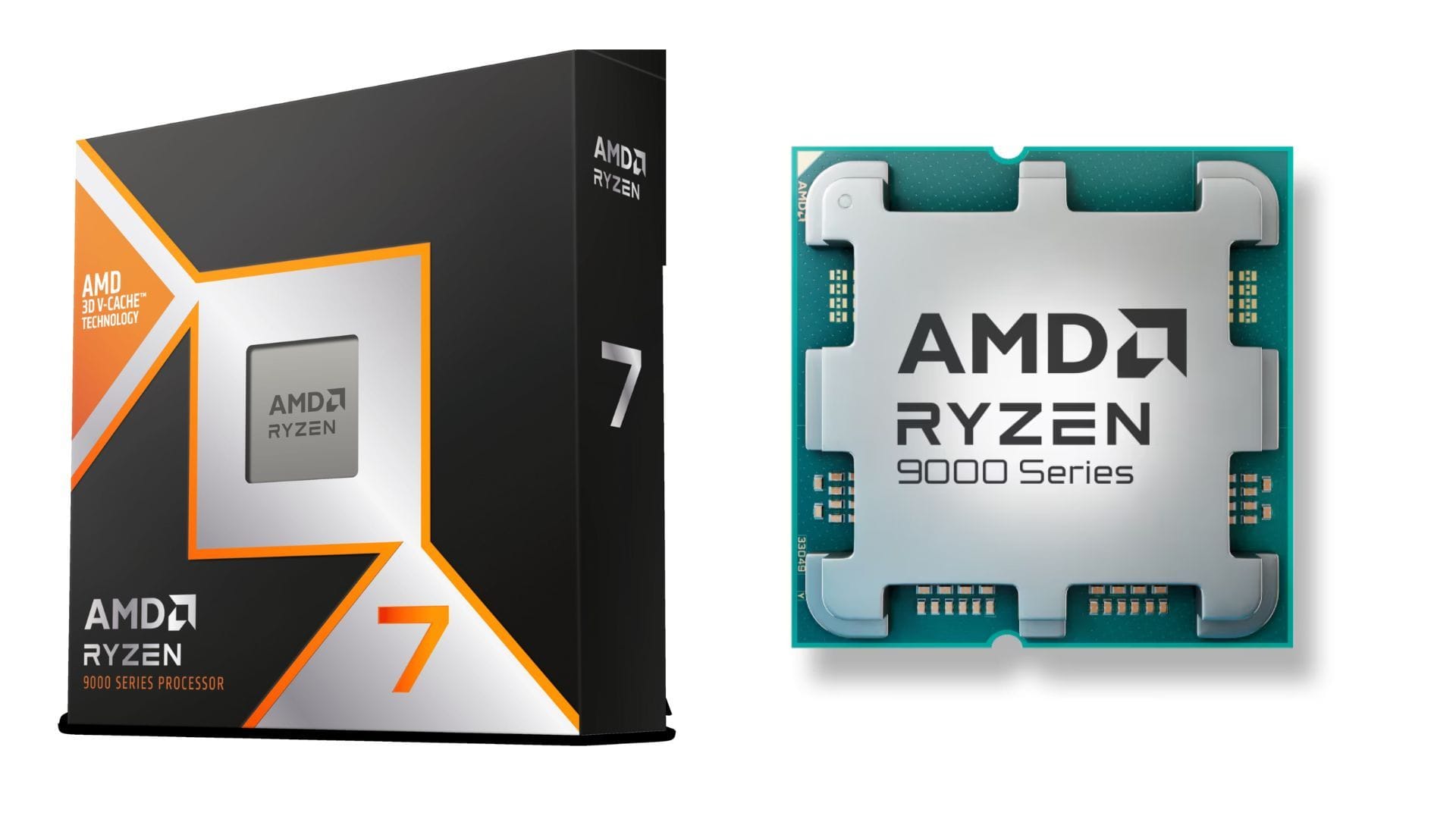

AMD is launching the Ryzen 7 9850X3D late in January 2026 as a refresh to the original eight-core 3D V-cached 9800X3D. The processor features faster operating clock speeds, improved 3D VC-cache thermal characteristics to sustain higher clocks, and cache stack layout refinements.
However, the microarchitecture stays the same with a similar 8C/16T layout and 120W power. This similar on-paper outlook can confuse gamers: Which is the best mid-premium gaming chip for most? Let’s look at some early gaming performance comparisons to answer this.
The AMD Ryzen 7 9850X3D is a mid-cycle refresh to the 9800X3D
The AMD Ryzen 7 9800X3D is designed for mid-premium gaming PCs (Image via AMD)
Under the hood, both the Ryzen 7 9850X3D and the 9800X3D bundle a similar tech stack: you get eight cores and sixteen threads. The 3D V-cache capacity and tech remain the same as well, at 96 MB L3 (of which 64 MB is V-cache). The biggest improvement is the higher 5.6 GHz maximum boost clock speeds, which are 400 MHz higher than the 9800X3D.
Notably, the base speeds on both devices remain the same at 4.7 GHz. Given the boost behavior of Zen 5 processors, this means only high-end systems that can sustain improved clock speeds benefit from the improved design.
Here’s a side-by-side look at the specs of the two chips:
Spec (row)Ryzen 7 9850X3DRyzen 7 9800X3DProduct nameRyzen 7 9850X3DRyzen 7 9800X3DArchitecture / microarchitectureZen 5 (desktop) with 3D V-CacheZen 5 (desktop) with 3D V-CacheCPU cores8 cores8 coresThreads (SMT)16 threads16 threadsBase clock4.7 GHz4.7 GHzMax boost clockUp to 5.6 GHzUp to 5.2 GHzL2 cache8 MB (total)8 MB (total)L3 cache (incl. 3D V-Cache)96 MB L3 (includes 64 MB 3D V-Cache stacked)96 MB L3 (includes 64 MB 3D V-Cache)Total cache (L1+L2+L3)L1 + L2 + 96 MB L3 (common marketing total)L1 + L2 + 96 MB L3Default TDP / PPT120 W120 WProcess node (cores / I/O)Zen 5 cores (TSMC N4 / AMD packaging with separate I/O die)Zen 5 cores (TSMC N4 + I/O die)Socket / packageAM5AM5Integrated graphicsAMD Radeon Graphics (integrated)AMD Radeon Graphics (integrated)Memory supportDDR5 5600 MT/sDDR5-5600Overclocking / unlockedUnlockedUnlockedLaunch / availabilityAnnounced/official at CES 2026)Launched
Performance comparison
Here’s a look at how gaming FPS differs between the two chips. The Ryzen 7 9850X3D homogenously delivers performance gains across all games; however, gains are slimmer on older titles like Red Dead Redemption 2. The chip was paired with an RTX 5080 at 1080p resolutions to ensure the most CPU-bound scenarios. We have sourced these numbers from the YouTube channel Neo channel.
AMD Ryzen 7 9800X3DAMD Ryzen 7 9850X3DMarvel’s Spider-Man 2178 FPS190 FPSAssassins Creed Origins289 FPS312 FPSCyberpunk 2077139 FPS135 FPSFar Cry 6283 FPS312 FPSTotal War Warhammer III 218 FPS230 FPSKingdom Come: Deliverance 2239 FPS252 FPSShadow of the Tomb Raider477 FPS493 FPSThe Witcher 3: Wild Hunt441 FPS475 FPSThe Last of Us Part 2 Remastered260 FPS273 FPSStarfield109 FPS112 FPSBattlefield 6 288 FPS294 FPSRed Dead Redemption 2 233 FPS233 FPSBaldur’s Gate 3 190 FPS200 FPS
Mostly, CPU-heavy gains show the largest gains. We see titles like Far Cry 6 jump 10.25% in average FPS, while other games like The Witcher 3: Wild Hunt (+7.71%), Marvel’s Spider-Man 2 (+6.74%), and Baldur’s Gate 3 (+5.26%) show considerable gains. These titles mostly use cache and clock-sensitive gains, which directly benefit from the improved vertical V-cache packaging.
On the other hand, titles like Red Dead Redemption 2 show no gains, with identical performance. Battlefield and Starfield also show similar FPS as gains stay within the margin of error. Interestingly, Cyberpunk 2077 shows a decrease in average FPS (-2.88%). This could be a GPU limitation or other boost and engine-scheduling limitations.
Overall, performance increases by 4-5%, with best-case gains in the 8-10% range. While these gains are quite large, the final decision would depend on the price of the new chip. Around $575-600, the processor would command a significant premium over the $450 9800X3D.
Mostly, the Ryzen 7 9850X3D would be a modest clock-driven refinement, not a cache or architectural shift. We don’t recommend those on the 9800X3D to upgrade. If you’re coming from an older or weaker platform, buying the latest eight-core can be advantageous.
Why did you not like this content?
Cancel
Submit
Was this article helpful?

Thank You for feedback
Edited by Arka Mukherjee