
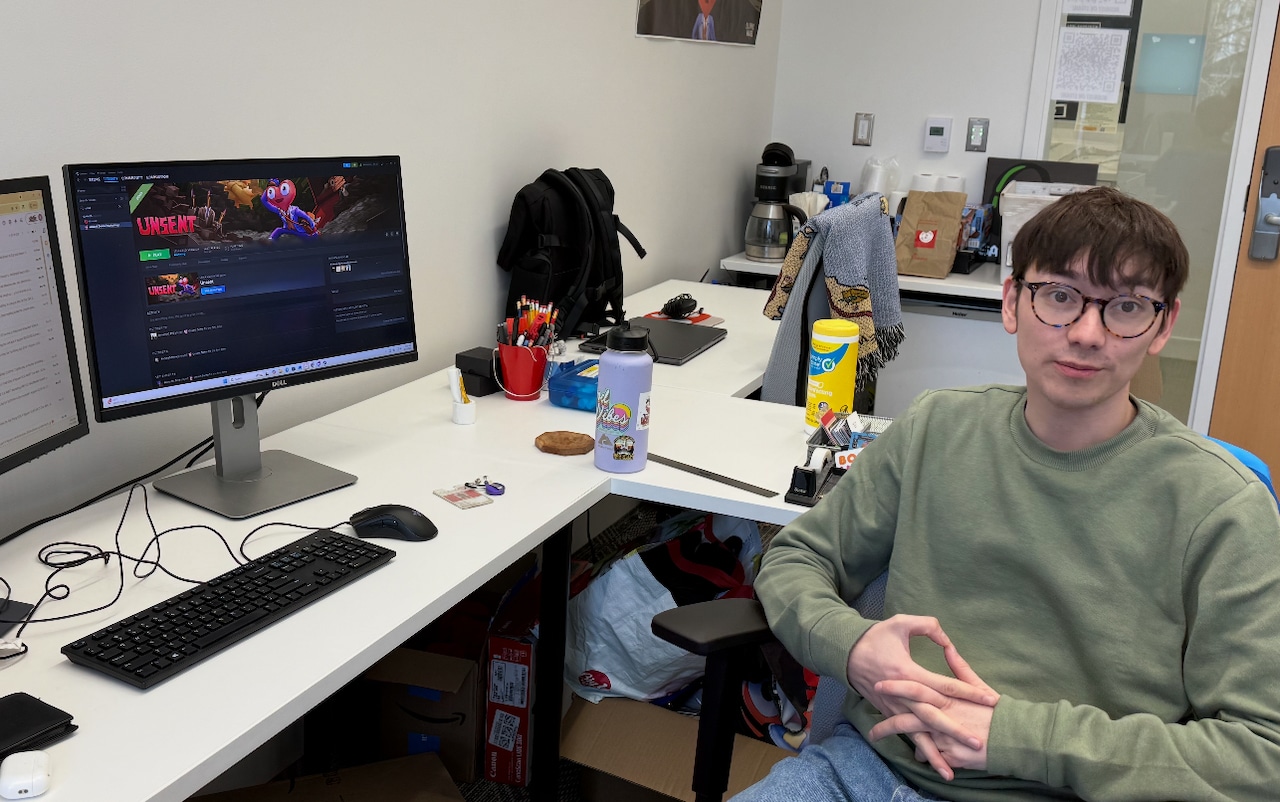
Alex Supron, the producer of Red Rabbit Games, knows his team is small.
Unlike large video game companies like Nintendo, which have more than 8,000 employees, the Worcester-based independent game company consists of eight members.
Supron, 26, believes tiny teams can do mighty things. And in their pint-sized office, his pint-sized crew did just that — launching their very first video game: “Unsent.”
“It takes time and effort, but if you put your mind to it and work as a team with people that you’re close with and work well with, you can create amazing things,” Supron said, spinning side to side on his chair at his desk.
“Unsent,” a 3D platforming game, was released in October.
In the game, players step into the shoes of Valentine, a postman with a heart for a head. His mission is to deliver unsent letters, Supron said. Throughout the game, Valentine will have to collect coins, collect stamps and hop over platforms.
In one level of the game, the postman must traverse an archive room with large books scattered throughout.
So far, Red Rabbit has sold fewer than 1,000 copies of the game, below what the team had hoped for. Nevertheless, Supron is proud of the product and the work his team of eight has accomplished.
Posters and drawings of Valentine hang on the walls of the small studio located on the second floor of Clark University’s Center for Media Arts, Computing and Design on Hawthorne Street. There are also pictures of other game characters, such as ‘Signface,’ a man with a wooden sign for a face and a grumpy demeanor.
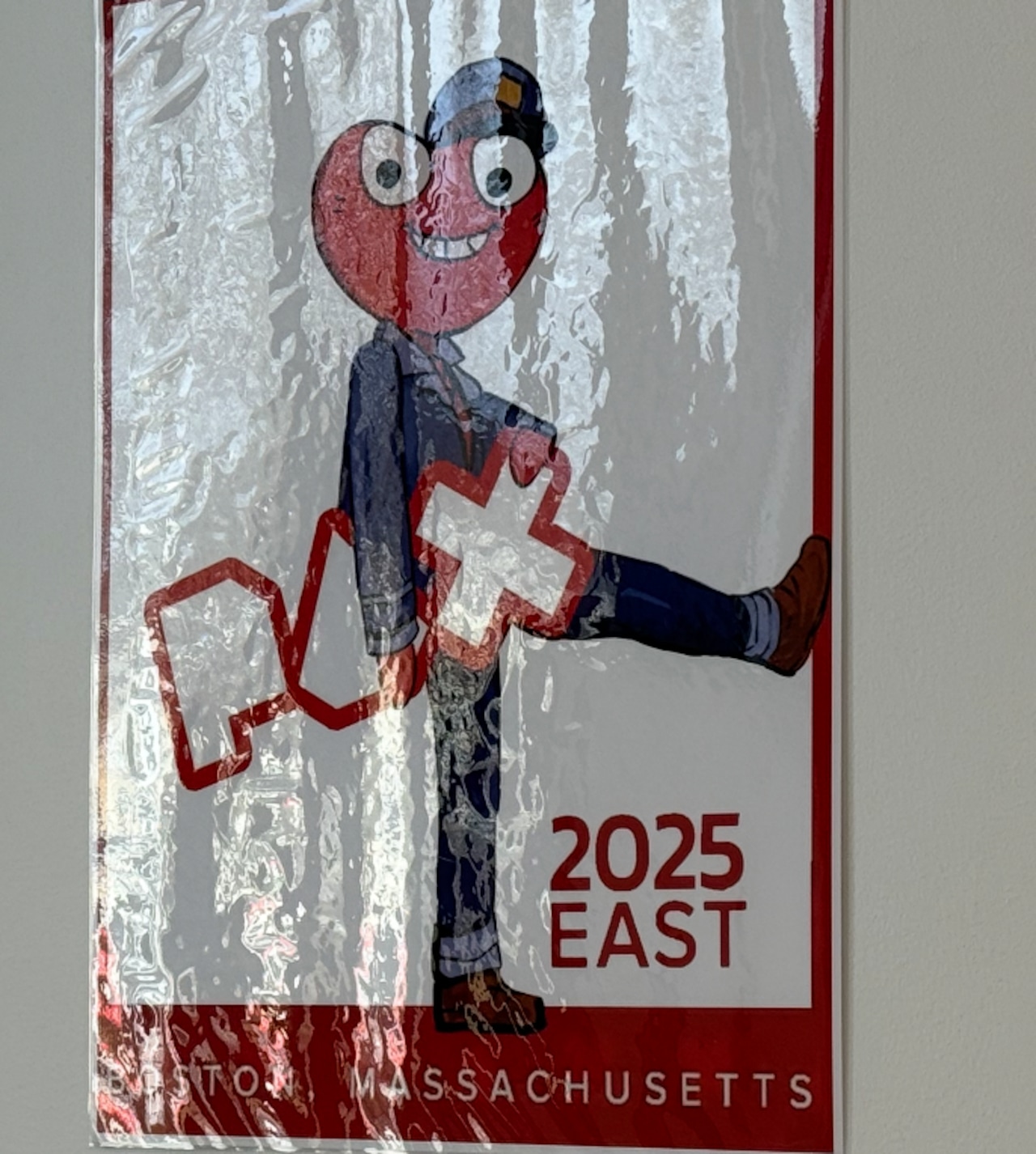 Valentine, the protagonist of the Unsent, the first video game released by Worcester game developer Red Rabbit Games.(Adam Bass/MassLive.com)
The game is available on Steam; however, it is not technically a finished product, Supron said. The version of the game people can play is what is known as an early access version. People can try the game out and provide feedback. The game’s story is also incomplete, but the team intends to release a finished version in the future across multiple platforms.
While not finished, the game has received positive feedback and was shown off at the PAX East and PAX West conventions, Supron said.
“It’s really nice to actually release a product,” he said. “That’s the first step in your game development career. Releasing something and [getting] it put out for the world to see.”
Becoming a gamer
In 2008, Supron received his first video game: “Age of Mythology,” a strategy game where the player summons monsters from Greek mythology. At the time, a fan of mythology, Supron became hooked on the game. As he grew older, he tried out other titles, including “Minecraft,” “Team Fortress 2,” “Counter-Strike” and most recently, the third-person shooter game, “Deadlock.”
For Supron, who has ADHD, video games are an outlet for both fun and to help him focus.
“It is a way that you can kind of focus on something and gain satisfaction,” Supron said. “It’s a good dopamine release tool, you know?”
While video games are an important part of his life, Supron at first didn’t consider working as a game developer. By 2019, he was taking a gap year from Connecticut College before dropping out of school altogether. He also spent time working at a restaurant, an experience he says helped his ADHD.
“You’re always moving,” he said. “You’re always doing something.”
Supron’s life took a turn in 2021, the year Becker College in Worcester closed due to financial and enrollment issues. In the wake of its closure, Clark University launched the Becker School of Design & Technology — continuing the college’s renowned game design program.
Supron, who was previously accepted to Clark University but declined, began considering pursuing a degree in game design.
“I like video games. I like communicating with the type of people that I will be around,” Supron said. “So why not?”
Red Rabbit Games
In 2022, Supron enrolled at Clark, where video games became a huge part of his life. He met Max Miller, who would go on to become Red Rabbit Games’s lead engineer. The two became friends and were commentators for competitive matches in the shooter game “Overwatch.”
He also became friends with Brien Rondeau, and together they ran the student chapter of the International Game Developers Association (IGDA). Under their leadership, the Clark University IGDA’s membership increased from 200 to 600 people, according to Supron.
In 2024, Supron was approached by Rondeau, who asked him to help produce a game he wanted to create: “Unsent.”
“He asked me to come on and act as his producer to help him source the team and get everybody coordinated on the project,” Supron said.
Pre-production of “Unsent” began in January 2024; however, the two students faced one big roadblock: money. Supron said he and Rondeau were considering taking jobs to help pay for the game’s development.
Those plans would change in March of that year, when Supron and Rondeau met with Clark alumnus Matt Rubin. Rubin, a fan of video games, wanted to bring his entrepreneurial skills back to Clark University, Supron said. He proposed creating an independent game company that would also serve as an accelerator to help other developers.
That company was Red Rabbit Games, which was founded in May 2024. Rubin provided funding for “Unsent,” a win for Supron and Rondeau.
Originally, “Unsent” was scheduled for release within a six-month timeframe. Depending on the game company, it can take months to years to create a video game.
Supron said Red Rabbit Games wanted to prove that developers could make profitable games in six months.
Instead of starting a new game, the team continued work on “Unsent.” During development, Supron worked hard to ensure everyone was on the same page and managed time effectively.
“It was just hard to get people to stay on track to create the thing we needed to create,” he said about working as a producer.
Despite the challenges, Supron believes he and his team created one of the best games released at Clark University that year.
Getting ready for the next level
While Red Rabbit Games intends to release a complete version of “Unsent,” Supron said they are also working on a new game: “Reel Tiny.”
Set in the Appalachian Mountains, “Reel Tiny” is a fishing-based game in which the player controls a small shrew that catches miniature fish. Supron intends to release the game in six months and will focus heavily on social media promotion — an area he seeks to improve.
The one thing Supron wishes he had done differently during the development of “Unsent” was market the game better and earlier.
“We really need to improve our social media presence and find ways that we can cheaply market our game to larger audiences,” Supron said.
As for the future, Supron doesn’t mind what kind of game Red Rabbit Games makes next. As long as he is working alongside people to help create the game, he says he is happy.
“I like working with people,” he said. “I like helping facilitate the conversation and helping people get things done.”