
A few months ago, Microsoft hinted that they wants to merge Xbox and PC together. This means that Microsoft must release a PC with support of unified memory to support backward compatibility with existing Xbox games. Backward compatibility will be a deciding factor for the success or total failure of the Xbox-PC initiative.
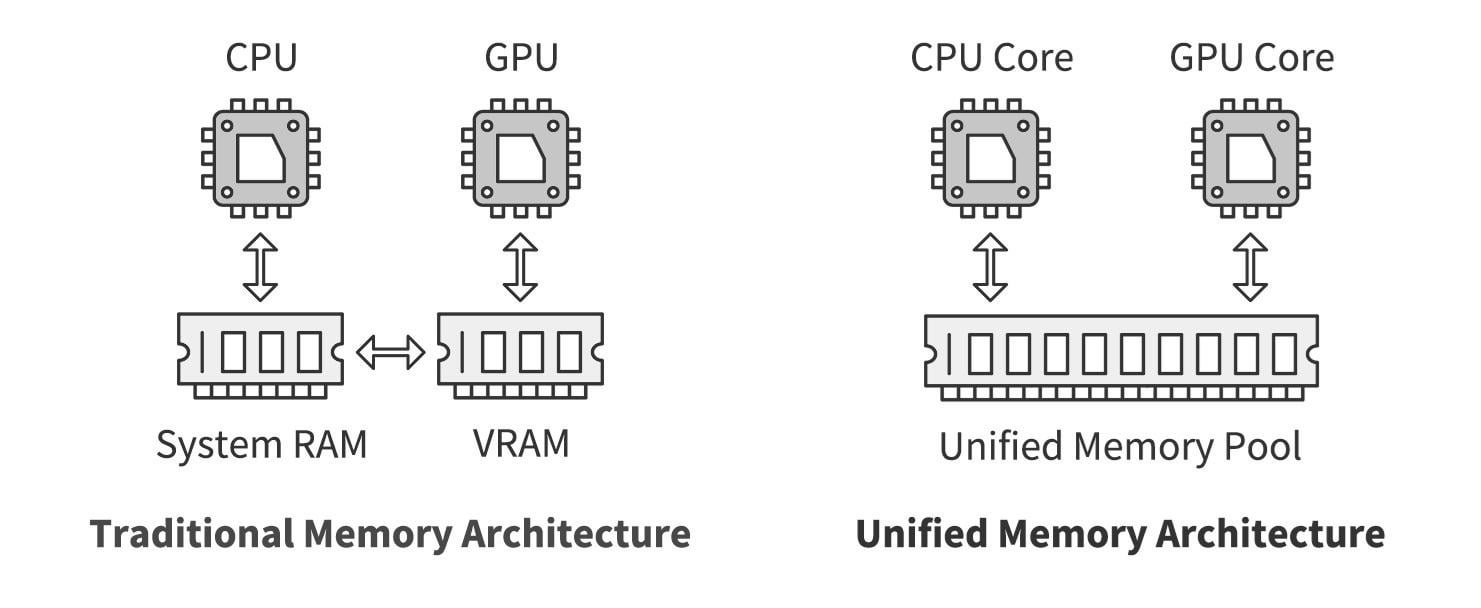
But what exactly is an unified memory and why it is used by game consoles and Apple Mac M-Series computers? Because this kind of memory is much more efficient. Basically in classic PC memory architecture the CPU and GPU can't work together efficiently. Both computation units use separate memory so all objects are duplicated. It is very slow and waste a lot of memory. For example, when the GPU computes something the CPU doesn’t see those results until you copy the changed video memory back to system memory and clear the CPU cache to force CPU to read the new values. This is so slow that basically the CPU and GPU can't work together. All these problems are solved by unified memory where both processing units can access the same shared data. You don’t need duplicate copies of the same objects in different memory pools or later synchronize those copies. Both CPU and GPU can work together at full speed and of course you save a lot of memory
Unified memory architecture is not only simpler but also cheaper because GDDR memory is soldered onto the motherboard. Hardware companies can buy millions of memory chips directly from the factory without any middleman companies. Using classic DDR5 is more complex because you need to work with external partners that build SIMM memory modules. Of course GDDR memory is also faster. For example, an Xbox Series X APU has 560 GB/s of memory bandwidth which is 5x faster than DDR5-6400 on dual-channel configuration (102 GB/s). A PC with GDDR7 memory and a layout identical to the Xbox Series X would have more than 1 TB/s of bandwidth.
How could those next-generation Xbox-PC computers look? We can assume they will be very similar to the current Xbox Series X and still use 320-bit memory layout with 10 memory chips. This means MS will be able to use between 20-30 GB GDDR7 because currently only 2 GB and 3 GB chips are manufactured. For Xbox backward compatibility we need only 16 GB but the problem starts when you want to launch PC games. Existing PC games require two memory partitions: system and video. So Microsoft would need to divide the available memory into two partitions to simulate a classic PC memory layout every time when someone want to launch legacy PC game. So we need at least 28 GB to create those partitions as 16 GB system and 12 GB video which is necessary for 4K games on PC. So the best option will be a PC with 30 GB GDDR7. Hardware like this will be able to play both PC and Xbox games without any problem.
Adding unified memory to Windows PCs this will have a much bigger impact than a single device. It would be possible to create console-like optimizations on PC. Every APU will be able to use memory more efficiently than is possible today. We will see a lot of notebooks and mini-PCs with really fast APUs using unified GDDR memory. We can assume that Asus, MSI, Lenovo and others will flood the market with multiple Windows based Steam Machine clones just like they did with a handhelds. If the Xbox-PC initiative will be successful we could even classic PCs adopting this pattern. How? Graphics cards already use processing unit using GDDR memory so all you need to to add CPU chiplet on it to essentially create a GPU with APU. This would convert a standard graphics card into a self-contained fully functional PC with unified memory. Card like this could be installed into any PC as easily as replacing GPU. Your main CPU and memory installed on the motherboard would be used only for system and I/O while games would run on the APU on your GPU card.
Of course, we don’t know if the Xbox–PC initiative is real. There have been many leaks in recent months but Microsoft has never confirmed it officially. So my vision of PC with native support for Xbox games could be wrong. This is just a summary of what should be done to make this happen. Of course, Microsoft may use a different approach and for example release "backward compatibility" only as streaming but I believe that would be a huge mistake. Streaming is not real backward compatibility and never will be because it is not free. So I hope Microsoft understands this and will release real native backward compatibility. It is possible and hardware will be really fast. They could even advertise those new PC 2.0 a an AI-PC or any other buzzword like that
DISCLAIMER: I work as a software engineer but I don't have any insider knowledge about future XDK. This is just technical speculation about what needs to be done to support native backward compatibility. No leaks