
Hey everyone,
I’m looking for some validation or insight regarding the behavior of my Ryzen 9 9800X3D while tuning PBO/CO. The system specs:
CPU: Ryzen 9 9800X3D
Cooling: NZXT Kraken Elite 360mm
Motherboard: ASUS ROG Strix B650E-E (latest BIOS installed)
Memory: 2×16 GB DDR5-6000 (EXPO I)
Software: All drivers and system tools up-to-date
Current OC settings:
Curve Optimizer: -30 all cores
PBO: +200 MHz CPU Boost Override (for Cinebench testing, usually +150 MHz)
PBO Enhancement Level 1 (90°C limit)
SoC voltage manual 1.19 V (Auto pushes to ~1.24 V)
Performance / stability:
Cinebench R23 (Below Normal priority): ~23,950 pts
Cinebench R23 (Realtime priority): ~24,150 pts
→ Practically the same score on +150 and +200 MHz boost
Vcore under load: ~1.265–1.280 V
Stress tests passed: OCCT Linpack 2019, OCCT Memory, CPU Extreme (per-core)
→ Fully stable
Odd voltage behavior:
When I reduce CO from -30 → -10 all cores, I immediately get:
Voltage spikes 1.34–1.37 V during light loads (browser/app launch)
System feels less stable despite being technically “less aggressive” undervolt
This seems counter-intuitive:
✔ More aggressive CO (-30) → lower and well-behaved voltage
✘ Lighter CO (-10) → higher transient voltage and instability
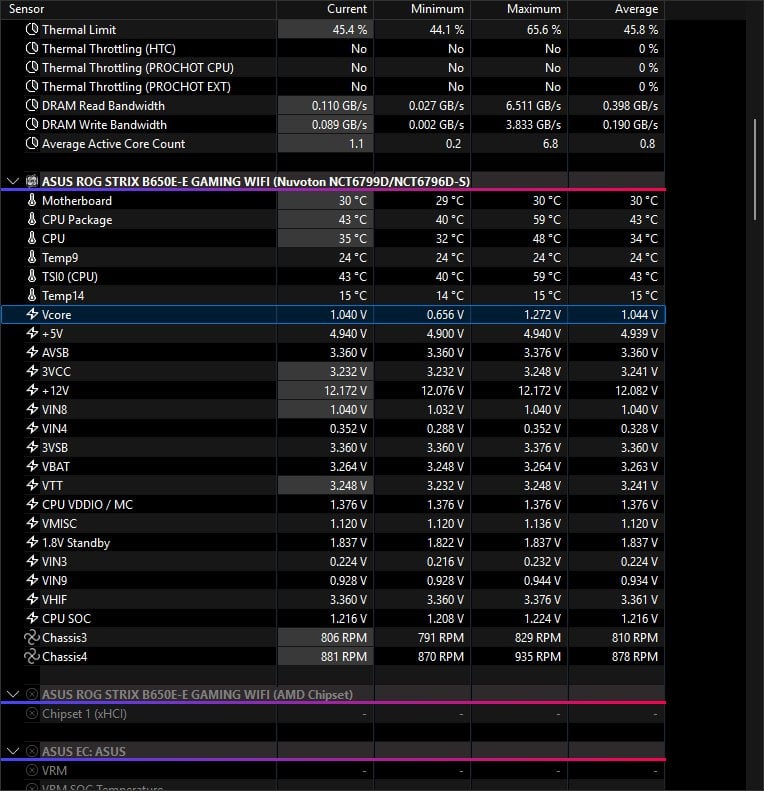
Screenshots:
Idle
https://imgur.com/jAr8Dsf
https://imgur.com/O0WBAq3
Load
https://imgur.com/0xwZ9FR
https://imgur.com/sA4uFU1
My concern:
Is this typical behavior for X3D chips on Zen 5?
Peak voltage at -30 seems perfectly normal, but -10 produces excessive spikes and instability.
Anyone else experiencing this kind of inverted voltage response with CO changes?
Thanks in advance for any insights or suggestions!