

Vice minister for culture, sports, tourism says he will ‘pursue policies that reflect unique nature of gaming industry’
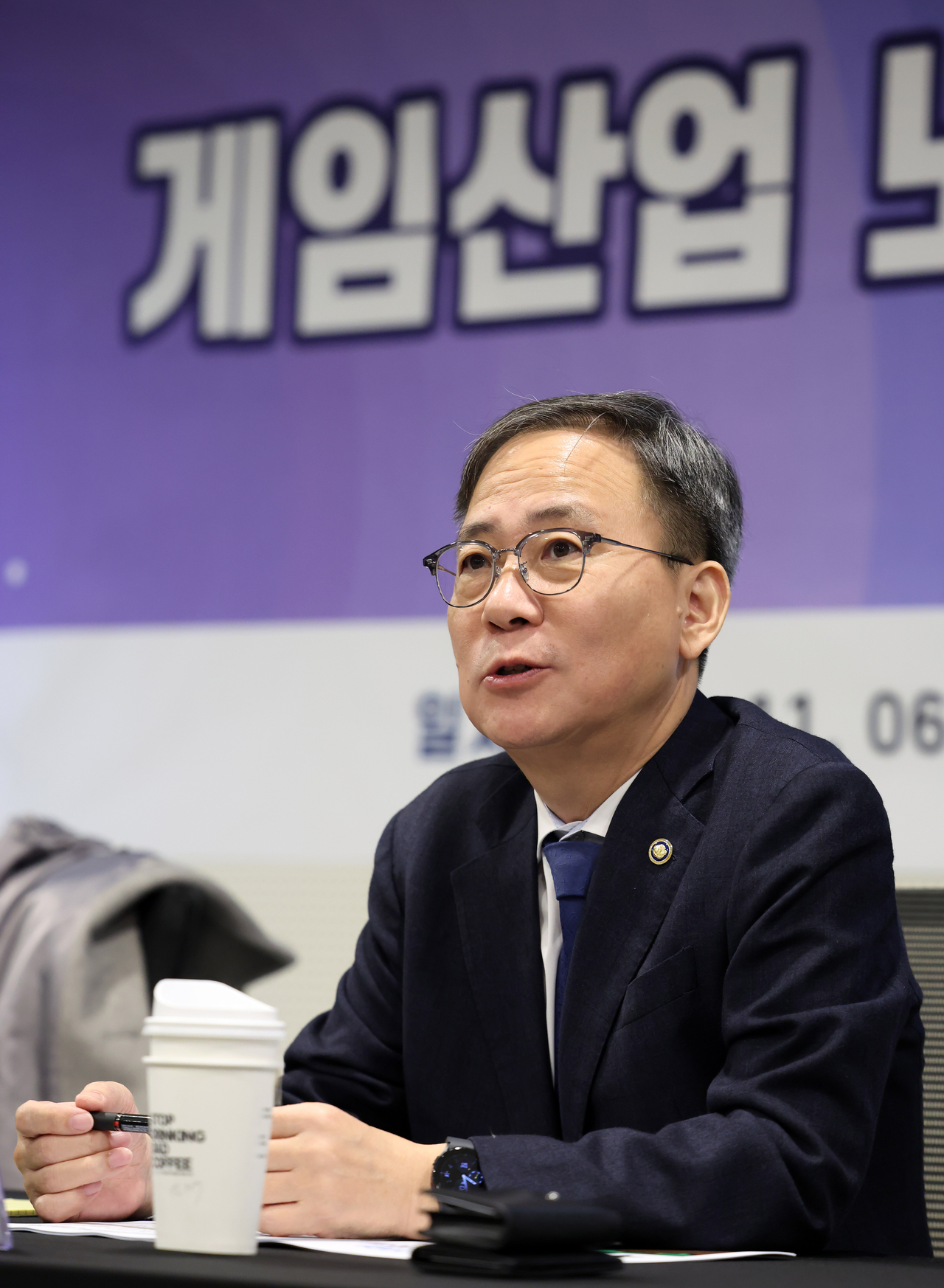 Kim Young-soo, vice minister for culture, sports and tourism, takes part in a roundtable discussion in Jung-gu, Seoul. (Culture Ministry)
The Ministry of Culture, Sports and Tourism on Thursday convened a roundtable with key figures from Korea’s gaming sector, addressing concerns that the nation’s 52-hour workweek policy — initially intended to curb overwork — has instead fueled longer unpaid hours, amid the industry’s demanding production cycles.
Kim Young-soo, vice minister of culture, sports and tourism, met with representatives from gaming company labor unions to discuss the state of working conditions across the sector. The session brought together union leaders from major studios, including Netmarble, Smilegate, NCSoft, NHN and Kakao, alongside members of the IT Committee under the Korean Confederation of Trade Unions’ Chemical, Textile and Food Industry Union, which oversees game industry unions.
According to the Culture Ministry, roundtable participants agreed that enhancing Korea’s global gaming competitiveness requires cultivating an open, collaborative workplace culture and not simply extending working hours. They underscored the need to create an environment where developers can focus on crafting engaging titles rather than chasing short-term, profit-driven releases.
On the subject of the 52-hour workweek, attendees reportedly said better use of existing flexible work models, including discretionary, flexible and selective hour systems, could effectively address the issue without scrapping the current policy.
Vice Minister Kim noted in a press release, “Based on today’s discussions, we will pursue policies that reflect the unique nature of the gaming industry — a fast-evolving, creativity-driven cultural sector — to improve labor conditions while supporting industry development.”
Korea’s game industry has been grappling with ongoing friction over how to balance the nature of game development with the 52-hour cap. Game companies have been arguing that the rigid policy fails to reflect the characteristics of game production, turning unpaid overtime and remote work into a routine practice. Critics say the policy, intended to curb overwork, has paradoxically worsened labor conditions.
“The 52-hour workweek policy has been cited as one of the factors undermining the competitiveness of Korean game companies seeking to expand into global markets. The system needs to be revised to better reflect the unique nature of game development, such as allowing exceptions during intensive production periods,” said an official from a major gaming company on the condition of anonymity.
According to the official, “intensive production periods” refer to the final stage of game development leading up to a new game’s release. He added that the current policy also fails to align with the realities of 24-hour live-service games, as developers often need to work extended hours to troubleshoot real-time issues.
Another official noted that the decline in entry-level hires in gaming companies is further increasing the workload for employees.
“As AI becomes more integrated into game development, entry-level hiring has fallen, increasing the burden on existing staff. During this transition, midlevel employees are often working overtime — and frequently unpaid,” said a developer at a local game company on condition of anonymity.
According to the Korea Creative Content Agency, game industry employees clocked an average of 5.7 hours per week of unofficial labor outside the workplace in 2024 — a 2.3-fold increase from 2.4 hours in 2020. The gaming industry’s official average weekly working hours stood at 44.7 last year, about 15 percent higher than the overall average of 38.7 hours across all industries.
yoonseo.3348@heraldcorp.com