
TORONTO — Orel Hershiser sat down at a Pasadena restaurant on Saturday night, took control of the remote to a television showing Game 2 of the World Series, then watched in awe at a feat no Dodgers pitcher had accomplished since he achieved it 37 years ago.
In 1988, Hershiser had the kind of postseason run that didn’t feel replicable in baseball’s modern era. As the staff ace of that year’s World Series title team, he threw three consecutive complete games in an iconic October tear: One in the National League Championship Series, then two more in the Fall Classic.
In nearly four decades since, no Dodgers pitcher had thrown back-to-back complete games in the playoffs, and only José Lima in 2004 had even thrown one.
In all of the majors, no one had stacked such outings since Curt Schilling with the Arizona Diamondbacks in 2001. The World Series hadn’t featured a complete game since Johnny Cueto of the Kansas City Royals in 2015.
That scarcity was no coincidence. In recent years, the sport has evolved in a way that prevents such heroics. Starters now are instructed to throw as hard as they can for as long as they can, before inevitably passing the baton to bullpens meticulously crafted to maximize late-game matchups.
“I don’t think anybody ever goes into a game thinking, ‘CG,’” Dodgers pitching coach Mark Prior said.
“Not in this day and age,” third baseman Max Muncy echoed.
But then along came Yoshinobu Yamamoto, the undersized but supremely talented right-hander the Dodgers signed out of Japan two offseasons ago. And along came this postseason, in which the 27-year-old superstar has suddenly turned back the clock.
After throwing a one-run complete game in the NLCS against the Milwaukee Brewers last week, Yamamoto did it again Saturday night in the Dodgers’ 5-1 win over the Toronto Blue Jays in Game 2 of the World Series, scattering four hits and striking out eight batters while going the full nine innings for his second straight start.
The performance was masterful, methodical and downright dominant, with Yamamoto navigating early traffic and responding to his lone run in the third inning by retiring the final 20 batters — setting a Dodgers postseason record.
It was also hugely important, evening this Fall Classic at one game apiece as the series shifts to Dodger Stadium for Game 3 on Monday night.
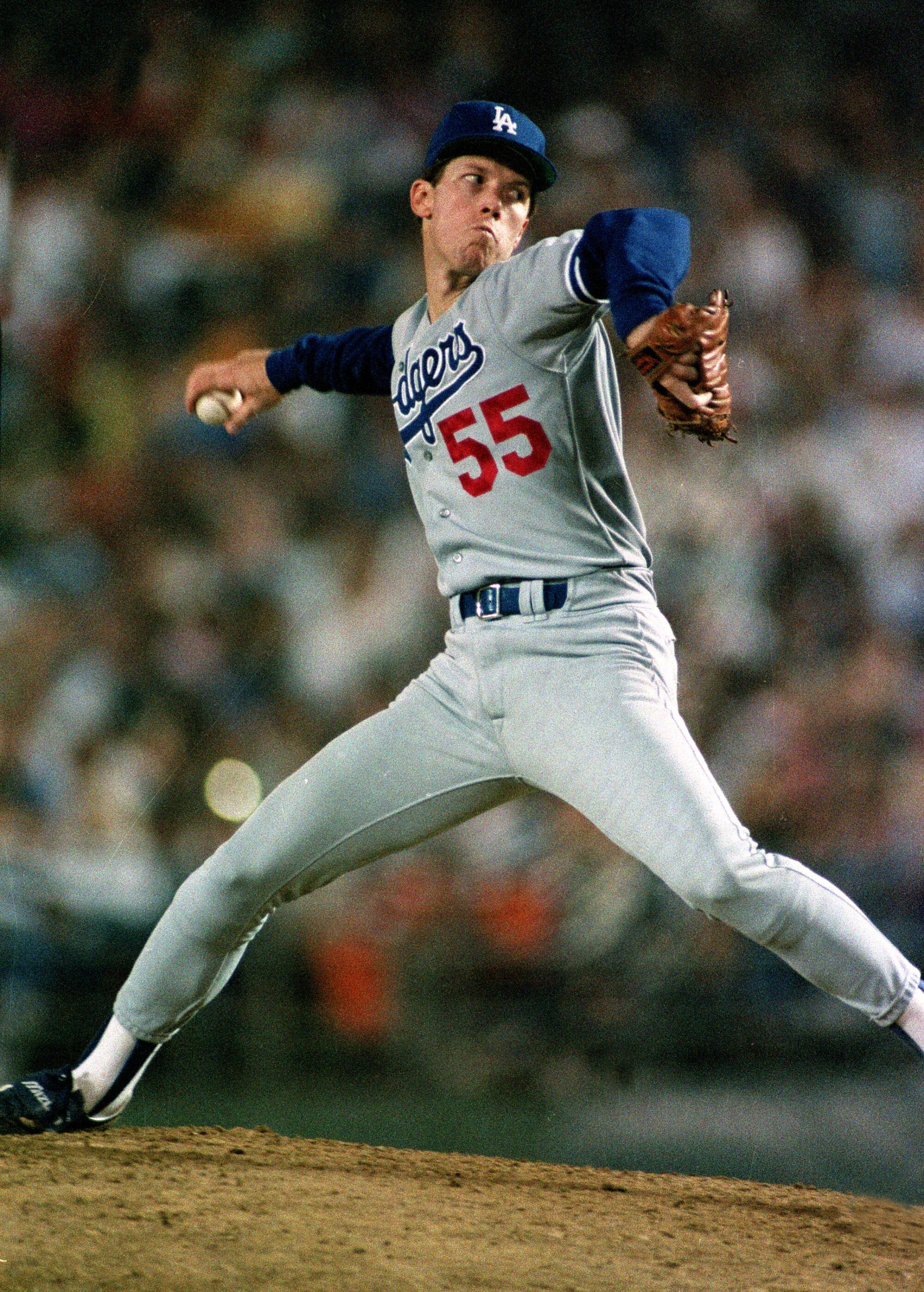
Dodgers pitcher Orel Hershiser delivers against the San Diego Padres in September 1988.
(Associated Press)
Mostly, though, the novelty of the achievement inspired a certain kind of nostalgia. And even from 2,500 miles away, Hershiser felt it as he watched from his restaurant.
“It’s very hard to do in today’s generation, because you have to be more efficient than in mine,” Hershiser said via text late Saturday night, while noting all the added difficulties modern-day starters face. “You’re not only battling the opposing team. You’re battling the pitch count. And the pitch clock.”
Not to mention an analytically driven, new-age culture that discourages managers from leaving starters in too long.
Yamamoto, however, is “a master at his craft,” said Hershiser, who has watched the pitcher closely the last two years as an analyst on the Dodgers’ SportsNet LA broadcasts. “There is no detail that goes unnoticed in his mind or preparation.”
And right now, no lineup that can halt his historic October march.
In Game 1 of this World Series, the Blue Jays had battered the Dodgers’ pitching staff with an 11-run outburst. They chased starter Blake Snell after just 15 outs. They feasted on a bullpen that suffered a long-awaited implosion. And they entered Game 2 with a chance to take full control of the series.
Entering Game 2, they had a chance to take full control of the series.
And early on at a raucous Rogers Centre, they even had Yamamoto on the ropes.
Toronto stranded runners at the corners with no outs in the first inning, but forced the Cy Young candidate to throw 23 pitches. Leadoff runners got aboard again in the second (when Freddie Freeman overran an infield pop-up) and third (when Yamamoto plunked George Springer), before the Blue Jays finally erased a one-run deficit on a sacrifice fly from Alejandro Kirk.
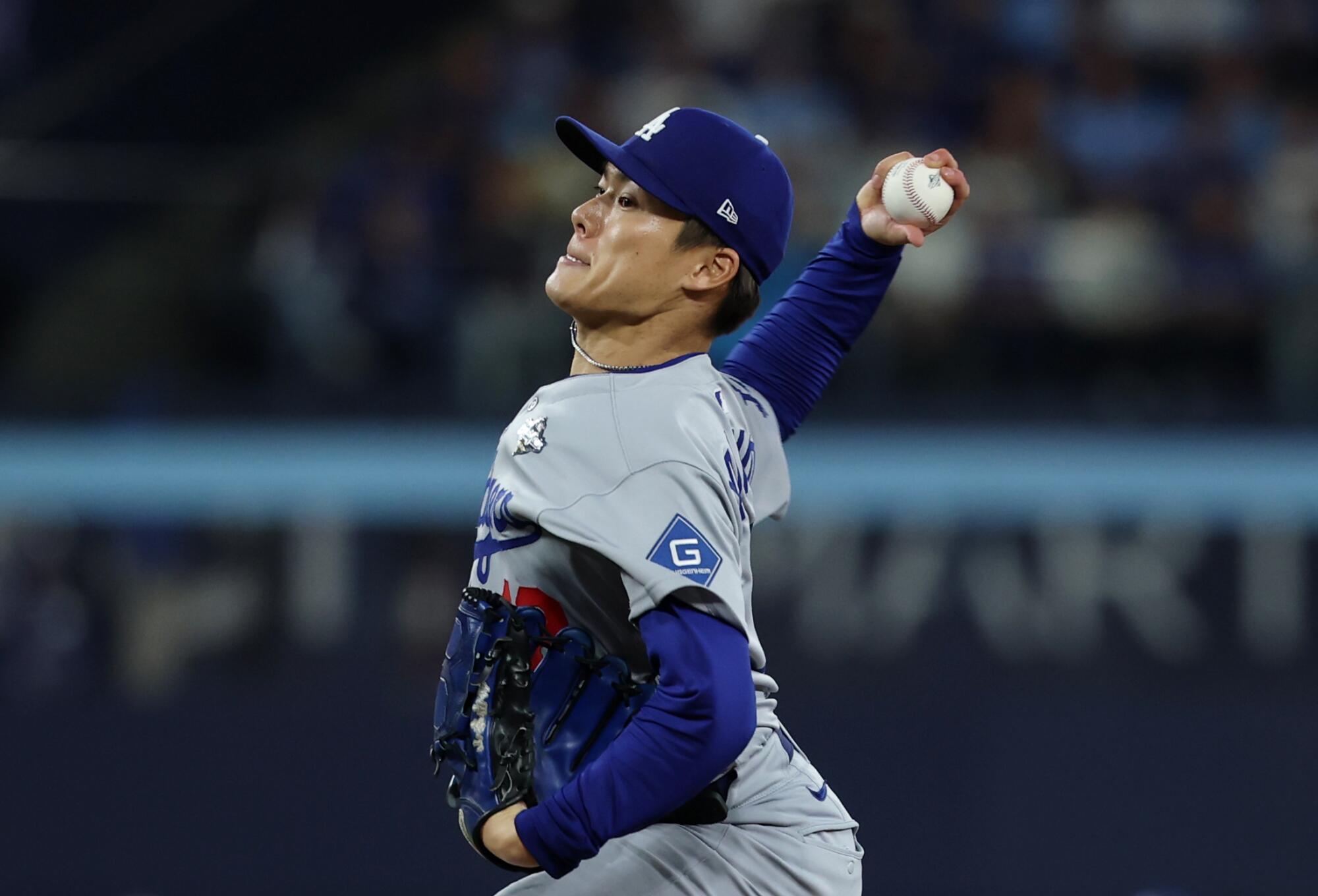
Dodgers pitcher Yoshinobu Yamamoto delivers against the Blue Jays in the eighth inning of Game 2 of the World Series.
(Robert Gauthier / Los Angeles Times)
With that out, however, Yamamoto started to find a rhythm.
The rest of the night, no Blue Jays runner would again reach base.
Yamamoto limited the usage of his fastball, which the Blue Jays seemed to be hunting the first time through the order. He leaned more heavily on his splitter and curveball, and mixed in cutters, sliders and sinkers.
With all of his pitches, he said afterward, his goal was to “just keep attacking the zone.”
The game plan paid off with a flurry of weak contact and quick outs. Though Yamamoto recorded only one strikeout over his next four innings, he retired every hitter he faced without letting one at-bat extend beyond five pitches.
“He was locating the ball well, mixing speeds, keeping them off balance,” said catcher Will Smith, who also led the Dodgers’ lineup with two hits and three RBIs.
“By the third, he just felt really good,” Prior added. “He just felt like he could go with anything.”
Such variance and efficiency allowed Yamamoto to get deep into the game, mixing up looks while turning the Blue Jays’ aggressiveness against them.

It also gave the Dodgers’ offense time to figure out veteran Toronto starter Kevin Gausman, whose fastball-heavy approach helped him retire 17 in a row after a first-inning RBI single from Smith — only to finally be punished on a pair of misplaced heaters that Smith and Muncy hit for solo home runs in the seventh.
“A little bit of insurance for Yama,” Muncy said, “who we just felt like was cruising through the game at that point.”
After the Dodgers stretched their lead again with two more runs in the eighth, Yamamoto mowed through his final two innings with the Dodgers’ bullpen hardly ever beginning to stir.
He struck out the side in the eighth, when he got a chase with his curveball in one at-bat and a called third strike with his heater in another. His return for the ninth required almost no dugout conversation with Prior or manager Dave Roberts, who joked Yamamoto “could have went another 30 or 40 pitches” beyond the 105 he ultimately threw.
“He said before the series, ‘losing is not an option,’ and he had that look tonight,” Roberts said.
“To be honest, I was not thinking I could complete the game because my pitch count racked up kind of quickly [early on],” Yamamoto added through interpreter Yoshihiro Sonoda. “I was trying to take it one inning at a time.”
The last inning was more easy work, starting with a ground ball from Toronto star Vladimir Guerrero Jr. and ending on a pop out Muncy caught at third.
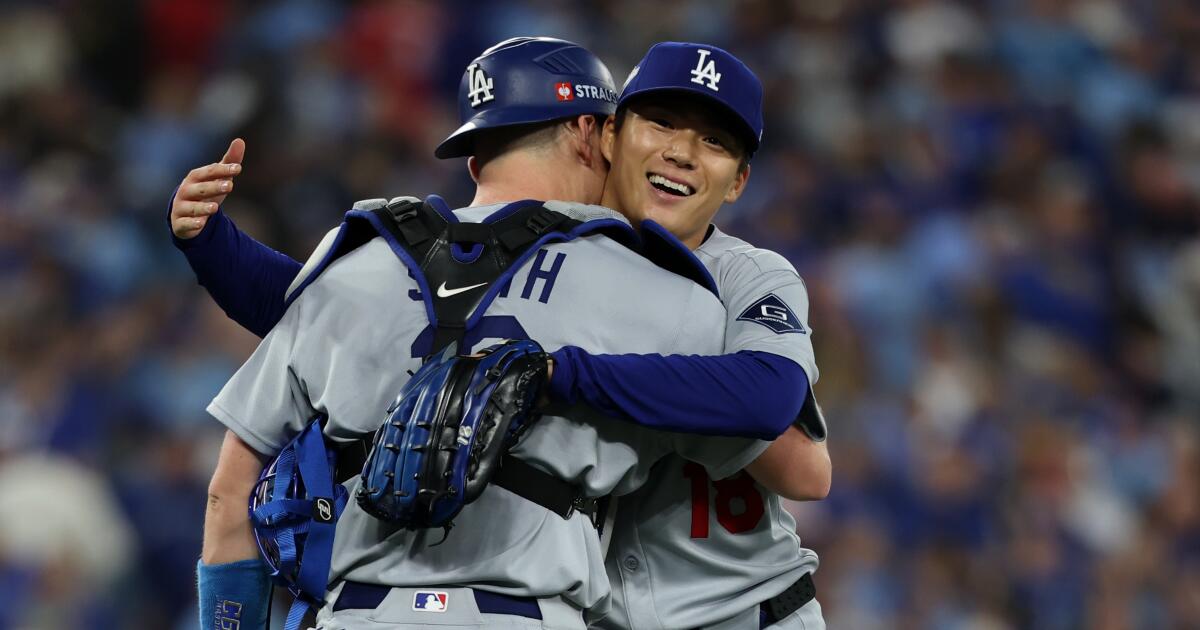
Afterward, Yamamoto’s mild reaction — he simply smiled as he went to embrace Smith in front of the mound — belied the disbelief felt by the rest of the club.
“Outstanding, uber competitive, special,” Roberts described it.
“It’s four or five pitches, and it feels like he could hit a flea with them,” Freeman added. “He can throw it wherever he wants.”
Future Hall of Fame teammate Clayton Kershaw acknowledged he never thought he’d see consecutive complete games in the playoffs — “I don’t think anybody could have predicted that,” he said — and quipped that “maybe it’s a sign of where baseball should and will get back to.”
“It’s always fun to have great starting pitching matchups,” he added. “To see him go deep into games, maybe this will give some people some ideas for the future, hopefully.”
For now, however, the historic nature of the accomplishment was significant enough in its own right.
So much so, Hershiser said he simply felt “humbled” while watching the game back in Pasadena.
In the Dodgers’ franchise history, the only other pitchers with consecutive postseason complete games include Sandy Koufax (who did it twice), Johnny Podres and Whit Wyatt.
“[Modern pitchers] are capable of everything that was done in the past,” he said. “They are just asked and trained at a different expectation.”
That’s what has made Yamamoto’s postseason so singular.
He has transcended such conventions, and ascended to a level none of his recent peers have reached.
Four decades later, it now has him (with a 1.57 ERA this postseason that is best among any pitcher with three starts) rivaling what Hershiser did in 1988.
Three more wins, and this season will reach with the same triumphant, trophy-raising conclusion.
“It’s very special,” Hershiser said, “to watch him pitch.”

Highlights from the Dodgers’ 5-1 win over the Toronto Blue Jays in Game 2 of the World Series.