
An extension to this post about TEC-based subzero cooling and this post.
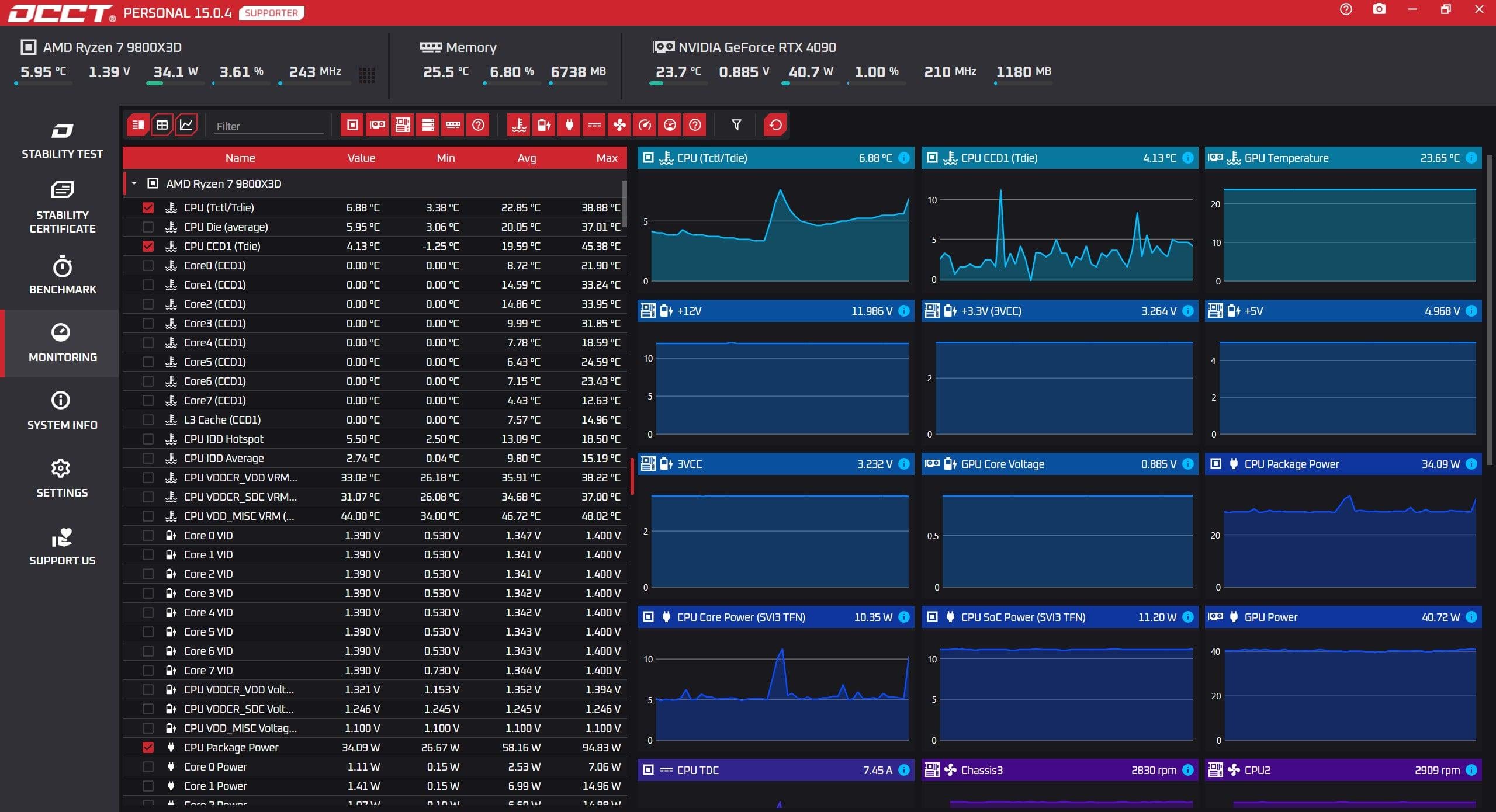
Incident: during system benchmarking/stability test for CPU min temp lows, after CPU hit ~3.38c min, temperature of CPU rose sharply and never recovered.
Setup: TECs – 4x ETX25-12-F1-6262-TA-RT-W6 ( MFG Part Number: 387004948 )
80x160mm Waterblock x3 (see post for setup), TIM Replaced with HY700 + EYG-S series for both coldside/hotside. TEC had been running at 125W per module = ~500W.
Coolant: 40-60 Propylene Glycol – Distilled water.
Fig 1. OCCT system data with temperature monitoring, during incident
CPU core power spiked to ~10W. As expected CPU Tdie temperature increased respectively. however after power spike incident the CPU never stabilized back to ~3c and continued rising. Graph shows no increase in core power /package power.
CPU coolant pump had been monitoring during incident. no current spike was monitored.
Current spike is indicative of blocked flow of lines (esp. pump head). In this context it typically is indicative of freezing coolants. However, this is typically a runaway event of CPU temperature increase since the pump cannot recover from such an event on its own. Therefore, this scenario is not likely.
However, it is interesting that this is not always-reproducible event. Fig 4. Shows Tctl/Tdie dropped to 3.25c (ultimately reached 3.00c) without events that fig 1 & 2 shows. it was maintained for ~5 minutes before system was normalized to usual 8~10c idle (Tctl/Tdie).
Fig 4. Stable temperature at ~3.25c Tctl/Tdie temp.
Since Pump/Coolant can be ruled out, main factor left now is events happening at coldside of TEC and CPU thermal interface. it is unlikely that an event on coldside of TEC would cause sudden temperature increase to CPU due to buffer in coolant. Author also noted no irregularity in TEC power readings (power output of TECs remain more or less uniform +-1W).
That leaves CPU thermal interace to question. Currently, thermal interface uses Thermal Grizzly Conductoanut. Contrary to popular belief, the operating condition of Conductoanut can be below ~7c (Evidenced by core/die temperatures). This is typically attributed to Supercooling effect. It seems plausible that fluctuations in CPU core power/Package power destabilizes supercooled liquid metal, causing local solidification event which then increases CPU. it might be possible to observe this event by monitoring per-core temperature across time domain.