
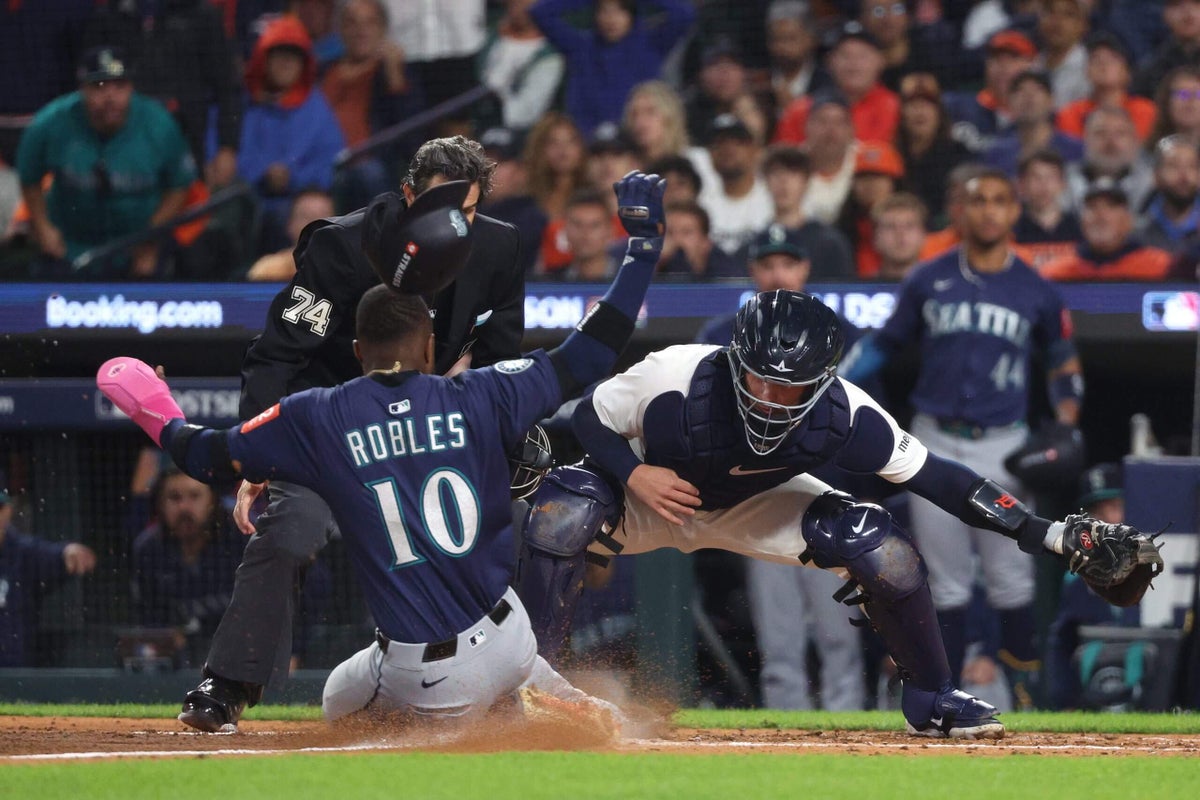
DETROIT — After the Detroit Tigers clubhouse cleared out, Dillon Dingler shuffled over to his locker. He leaned back at the stall, folded his arms and let out a subtle, knowing sigh.
“I blame myself,” he said. “Obviously (the ball) can’t go past me in that situation.”
The play Dingler referred to was the one that tanked the Tigers’ night, the one that set the tone for a dismal and disappointing performance in an 8-4 loss to the Seattle Mariners. This was Game 3 of the American League Division series, one the Tigers now trail two games to one. Their season is on the line, and Tuesday, so much of it was their own doing.
To set the scene: It was the third inning. Victor Robles was on second base. Mariners shortstop J.P. Crawford slapped an inner-third fastball the other way. In left field, Riley Greene fielded the ball and came up throwing. Mariners third-base coach Kristopher Negrón held up a stop sign to keep Robles at third. For a moment, it seemed like a good break for the Tigers.
But Greene’s throw skipped rather than sailed into the infield. The ball bounced past cutoff man Zach McKinstry and hopped again toward the plate. Dingler was lined up with the throw. Just left of the plate, one of the best blocking catchers in the game was in the correct position. But in an instant of inexplicable ruin, the ball bounced off his glove and trickled behind home plate. Jack Flaherty, the pitcher backing up home, scrambled to grab the ball and fired back to Dingler. Robles darted toward the plate and slid in, safe by an inch, confirmed after review.
“A little bit of a breakdown all the way around,” Tigers manager A.J. Hinch said afterward. “I thought Riley stayed under control and made the right throw. It was a little bit off target from McKinstry, so he doesn’t cut it. It skips and gets by Ding, and then just everything that could go wrong in that play did go wrong on that play.”
Crawford advanced to second on the error, which was charged to Greene. Then Crawford scored on a Randy Arozarena single. The Mariners went up 2-0 and never really looked back.
“Obviously, it was just a s—y situation all around,” Dingler said.
In real time, the FS1 broadcast criticized McKinstry, the third baseman and cutoff man, for letting the ball reach the plate.
“Why did McKinstry let the ball go?” former MLB catcher A.J. Pierzynski said on the call. “You know the runner at first isn’t going. That puts the catcher in such a tough spot.”
McKinstry disagreed with that assessment. He said that was not his job on the play. He was moving toward the mound, and the throw veered toward the third-base side. The ball was low and headed toward the plate, so he let it go.
“I’m just a target there,” McKinstry said. “I’ve been chewed out plenty of times for stopping that ball, and I’m never going to do it again. The only way I’m going to stop that ball is if I see the guy (at first) going to second.”
On a night where the Tigers’ bats were again cold against Seattle starter Logan Gilbert, Detroit dug its own grave on the Greene/Dingler play and others. The Tigers, at their best, are supposed to win by doing the little things, by never surrendering an inch. They are supposed to be better than such mistakes. They certainly cannot afford them in the playoffs, facing a team with more high-end talent.
The Tigers’ Game 3 unraveling was multifaceted. The whole third-inning sequence started on the mound, when Flaherty hung an 0-2 curveball to Robles. Letting hitters back in two-strike counts has been a weakness of Flaherty’s this season. Opposing batters had a .603 OPS in the regular season against Flaherty after 0-2. The league average OPS in such counts is .453. Robles doubled on a poorly executed pitch, and then Crawford shot a 1-2 fastball the other way.
“I’d like to have that one back,” Flaherty said of the Robles at-bat. “That whole inning probably shakes out a different way if we execute that 0-2 pitch.”
By the eighth inning, Kerry Carpenter misplayed a Robles fly ball, letting it deflect off his glove in right field. The Tigers’ second error of the night allowed Luke Raley to advance from first to third. He later scored on a Crawford sacrifice fly.
“I kind of misplayed it a little bit, where it carried a little farther than I thought,” Carpenter said. “Once I realized it and the ball got over my head a little bit, the last couple feet, it went in the lights. I thought I had a beat on it. I closed my glove a little too early. … It was just unfortunate, and I’ll be better.”
The Tigers trailed 8-1 entering the ninth inning but staged a small rally. Seattle brought in closer Andrés Muñoz to keep the game from spiraling out of control, something that could work in the Tigers’ favor for Game 4. But Detroit overall still had too many empty at-bats. Balls down the middle, Tigers hitters took or fouled off. Pitches outside the zone they chased, flailed at and missed.
“Their guys are really talented,” Hinch said, “and are exposing a little bit of the zone control that we talk about all the time. … Those who win the strike zone usually win the competition.”
In the first inning, Greene watched a slider down the middle, then chased two splitters outside the zone, striking out on three pitches. In the sixth inning, Spencer Torkelson fouled off a middle-middle fastball, took a low curveball but then chased a slider and a splitter.
After Torkelson was tied up and whiffed for the final strike, the Comerica Park crowd booed.
There were numerous mistakes, breakdowns at the plate and mishaps in the field. Facing a team like the Mariners and on the verge of elimination, that’s a recipe for disaster.
After the game, Dingler was there to own it. His words were matter of fact.
“It can’t happen tomorrow,” he said.
If it does, a team that has lost its past eight games at Comerica Park will be headed home for good.
(Top photo: Junfu Han/USA Today Network)