
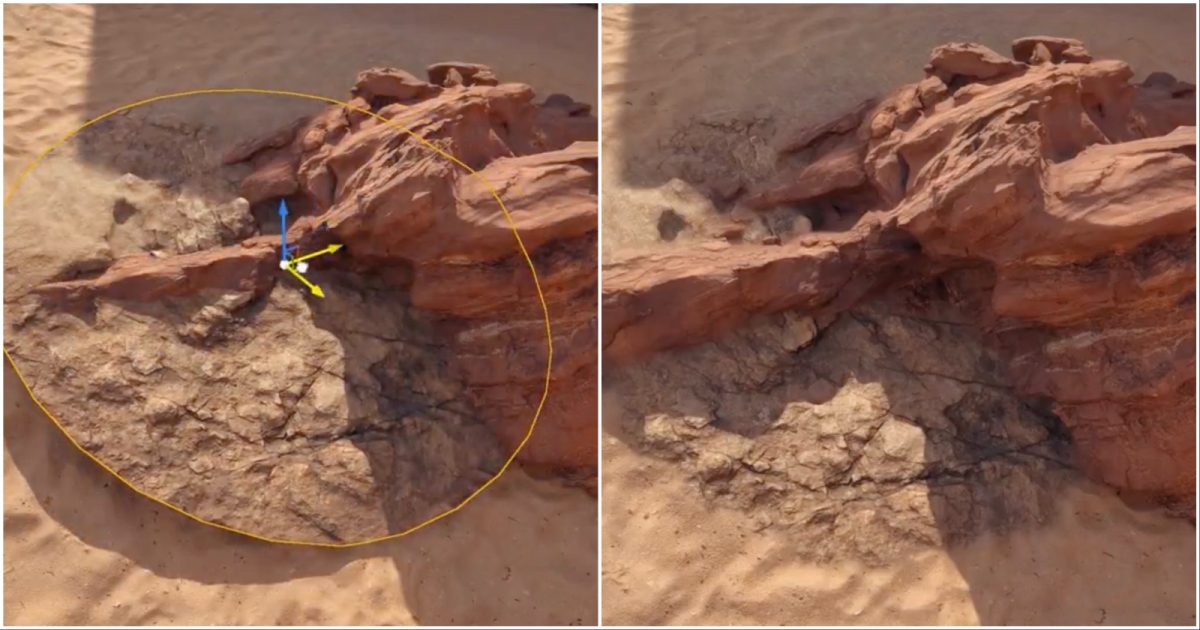
After much wait and anticipation, Tore Lervik’s plug-in for controllable mesh blending is now live. If you missed it, MeshBlend for Unreal Engine 5 allows you to blend any mesh with any other mesh, whether it’s landscapes, static meshes, or even skeletal meshes.
The tool offers four preset blend sizes, each of which can be adjusted individually. There’s an easy editor workflow suitable for projects of all sizes, from small indie efforts to AAA productions. According to Tore, performance is strong, with multiple quality settings available (Low, Medium, and High) to accommodate different hardware. MeshBlend runs as a global post-process shader right after scene rendering, and before effects like upscaling, depth of field, translucency, and other post-processing effects. The effect works in real-time and can be applied to dynamically spawned objects.
MeshBlend also works with opaque materials such as surface, subsurface scattering, and two-sided materials. It supports Nanite and Nanite displacement, as well as decals and mesh decals, with decals blending seamlessly as if they are part of the mesh. It’s compatible with static meshes, landscapes, skeletal meshes, and even particles, provided they are opaque and write depth. It performs well with temporal anti-aliasing solutions like TAA, TSR, DLSS, and FSR, including upsampling and frame generation. When using Sequencer, applying overscan yields the best results.
MeshBlend is used in Subnautica 2 to help build the game’s world: