
Motherboard is a Gigabyte B450 DS3H.
I was working on my brother's computer in the night to enable both boost clocks and Precision Boost Overdrive which worked and allowed the CPU to boost to ~4ghz on all core.
I returned to the computer the next morning and planning to adjust PBO so I ran HWInfo64 and Cinebench R20 to monitor clocks and the effective clocks from HWInfo reported ~3.75ghz and looking at the SVI2 TFN voltage showed ~1.1v.
I don't know if the CPU is boosting normally or if the CPU is at base clock and PBO is giving +150mhz. But after many reboots I decided to manually overclock instead of using PBO. Oddly enough, loading the cores drops the voltage to the afformentioned 1.1v but the voltage goes to 1.45+ when idling.
It didn't seem like the software was wrong so I decided a manual overclock with a 41x multiplier and voltage presumably set to Auto because there's no voltage override or offset. There is Dynamic Vcore but it is only a positive offset.
I ran R20 and although the effective clocks showed 4.1ghz, the voltage remained at 1.1v and of course the PC crashed. I then decided to go on a +0.250 voltage offset and successfully completed an R20 run but the voltage still reported 1.1v.
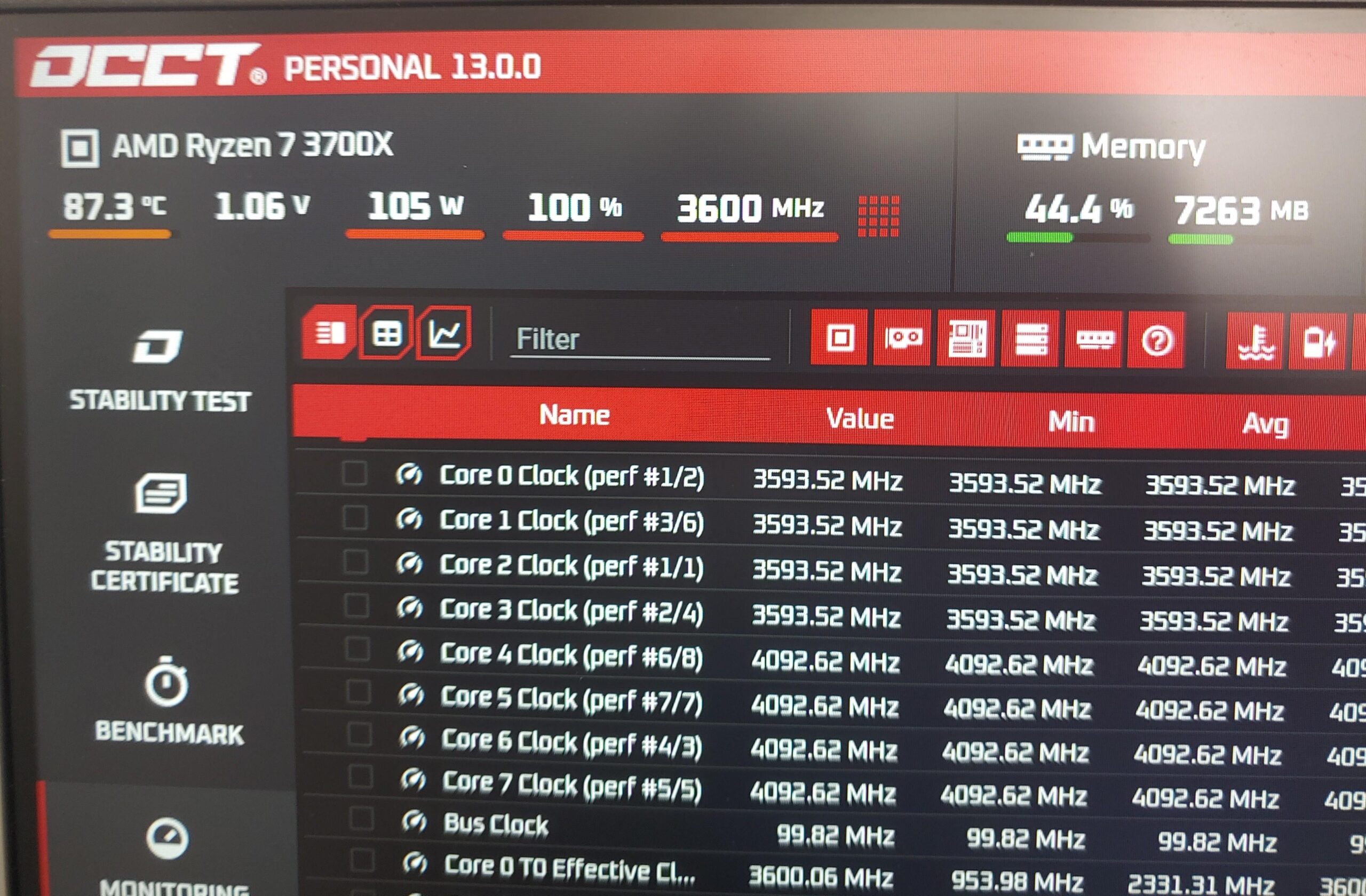
Because I wasn't comfortable with the voltage not seeming correct, I did a per CCX manual oc. Multipliers were 36x on CCX1 and 41x on CCX2 with a voltage offset of +0.200v but the voltage remained as 1.1v as you can see in the on the photo.
Has anyone experienced this and know a solution? I feel like I'm about to throw in the towel because I could just force a manual oc but not being able to monitor and finely control the voltage is not something I'm comfortable with. It hasn't been long since I started messing with over clocking. But even then, I haven't had this kind of issue with a Ryzen 2600 and 3600.
Thanks.