
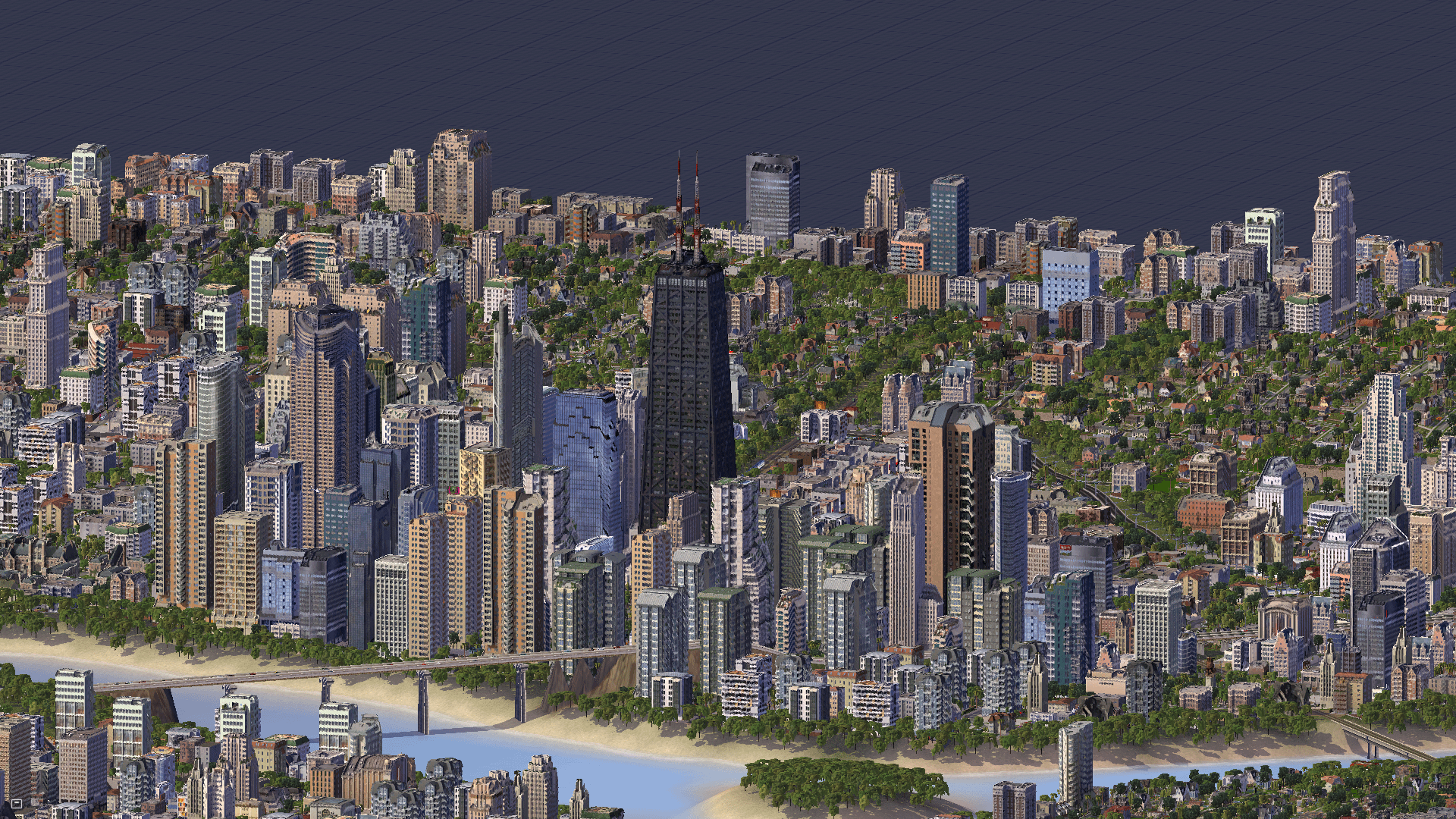
Simcity 4, Already a 21 year old game and new mod just came out that you can utilize cheat codes to adjust the view port to show the true 3D side of SC4 and it is very interesting, the games’s old so some visual bugs are expected but it is very awesome to finally see the “true SC4 3D experience”
12 Comments
Only took 21 years
That’s cool. Crazy it took 21 years to make happen though.
All those buildings will be black in 10 years gametime
I dropped so many hours into this game in the early 2000s. I’m glad to see the mod community is still active.
I’ve tried to play this game a month ago on Steam, and got a lot of crashes. Can you play it on 1920×1080 with the mod?
This game had a tough learning curve, but once you jumped that hurdle, you can watch your city grow. I even had to fix my brother’s horrendous city traffic (large density of high wealth snobs ignoring mass transit)
I loaded up my test city I made last week on a flat world that had 700,000 sims in it and decided to look arround at it with the mod, its very cool
Pardon my ignorance, but I’m confused as to what makes this more 3d than before? Wasn’t it already a 3d game? Also could we get a link to the mod? Thanks!
Man I loved SC4. The fact that you cant play the disk version anymore but you can get a copy for free if you prove you own one is why my EA Origins account name is “SimCity4Plz”
14 yo me knew it was just a matter of time. Well here we are, lol
I made all the roads and bridges for that game and the expansion. Our building pipeline had square boxes for all of the buildings with textures projected on to them, think of it like a 3d sprite. Each model had rendering for 4 directions x 5 zoom levels (IIRC). Larger buildings were built from multiple models all stitched together seamlessly.
Well that wouldn’t work for bridges, because cars would drive through the box in a way that broke the illusion. Not only that, but bridges were constructed from dozens of pieces along their length. The only tool support I had to make them was a .dat tool that would unpack and repack the texture and model files into a folder, and a simple command line tool that could cut a model cleanly with just coordinates and dimensions given.
I planned out each bridge and broke it out into components that would layer correctly in the 3/4 isometric view. One file for a pylon. One file for the deck. One file for each tower with support cables. One file for streetlights. And one any other details that were needed. Etc. Etc. It was a lot of pieces.
So in order to make the bridges work for each one I wrote a script in a windows batch file that would:
1. Unpack each of those model files.
2. Cut all the component 3d meshes from the unpacked file to the size/shape wanted.
3. Combine all the 3d components into a faux-3d model the size of a single road tile (30x30m I think, I can’t remember now).
4. Repeat steps 2 and 3 until all 5 zooms and all 4 rotations were accounted for.
5. Repack all those existing files into a single data file for each piece
6. Those pieces were then placed by the game to dynamically allow almost any length with adjustable heights for elements like the foundations.
That script took about a second per 3d operation and maybe 30 seconds to pack/unpack a model. It took between 45m and 3hrs to generate each piece. I called the script ginsu.bat because it sliced and diced and I thought I was clever. Each bridge type had a completely different script. I spent many nights sleeping in my cube over months to get them all made.
I was maybe 23 and was my second ever game. I had no computer science training or degree, just a passion for 3D modeling and games. The scripts were simple and brute force in each element, but had dozens of subsections to do each part correctly. The only way to test the results was to put them in the game, which also had a very complicated logic and ruleset about how the pieces could be placed. So very often it would run for an hour and error out and I would have to debug and try it again. Or run for 3 hours and get it in game and spot problems. Each bridge went through dozens of iterations this way. Not to mention the initial outlay of modeling and texturing all of the components in a way that this all worked.
The only upside was that I had a great producer/tech artist/engineer who did all of the game side logic.
I wish I could illustrate the exact nature of overall problem. Here is a bridge I made for SC2013 that shows how we solved the problems a few years later in full 3D. It uses system of 3d models and parameterized extrusions, with the big improvement being that it wasn’t all broken down into single tile components.
[https://cdna.artstation.com/p/assets/images/images/035/836/822/4k/michael-long-screenshot0.jpg?1616019517](https://cdna.artstation.com/p/assets/images/images/035/836/822/4k/michael-long-screenshot0.jpg?1616019517)
This has been your daily dose of game development history.
This is awesome and truly warms my heart, nice work!