
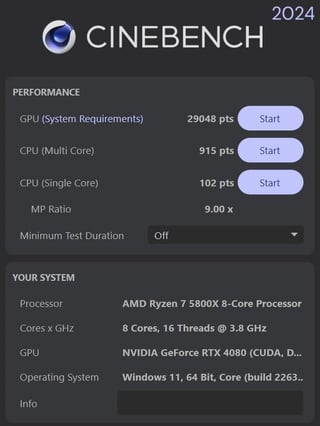
This is a bit of a follow up to my last post where I asked some questions about PBO2 and Curve Optimizer for the Ryzen 7 5800X after spending the weekend experimenting and testing extensively. (Right now I’m allowing Prime95 to run for hours to finalize temperature and stability reliability).
The scores you see here are the result of setting everything, both PBO and Curve Optimizer, to ‘Auto’ within my motherboard bios and setting the core overclock to +200 so my CPU can hit up to 5,050 MHz. This is the best score I’ve gotten with temperatures maxing out around 83°C after 10 minutes of a Cinebench 2024 all core workload.(Although prime95 seems to push it to around 85°c after 15+ minutes.)
If I set PBO to manual and entered values of 142, 85, and 115 for PPT, TDC, and EDC respectively, as well as set the CO to -30 all core, I get slightly worse performance than this on multicore workloads with similar temperatures. Going higher than this on the EDC with the -30 all core offset, with an EDC value of 125 actually would make my CPU go to 90.5°C after a long period of time in prime95 which is obviously just above the throttle threshold.
So, summary for my CPU is that I’ve actually found it best to leave everything on ‘Auto’ and max out the core overclock to hit 5,050 MHz. Maybe the auto settings are just really good at detecting the best values dynamically? Clarity here would be great.
For my GPU, in Afterburner, after lots of testing, I’ve found a max clock of 2,940 MHz (+175 MHz) to be perfectly stable along with a +1,500 MHz boost to the VRAM. Finally, to limit noise and heat, I noticed setting the power limit to 90% gave almost identical performance to 110% power limit, and the score you see here is with that power limit. I find limiting the power is a much easier and more direct way to get the best voltages on the fly without worrying about stability.