
[BD0orG.jpg (353×773)](https://s3.amazonaws.com/i.snag.gy/BD0orG.jpg)
There are multiple limits for PBO to boost CPU cores. CPU temperature, core voltage, currents, PPT power, lastly the undocumented “temperature/voltage/current” combinational limit applied to “CPU power” indicator in the Ryzen Master (which is altered by pbo-scalar setting but details unknown).
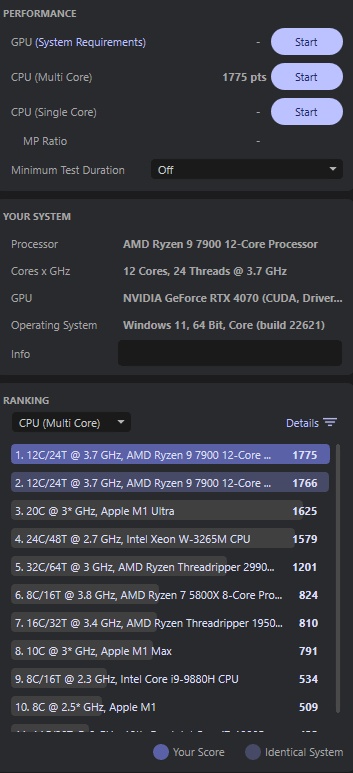
Even when not a single other limit is not reached, this “CPU power” indicator is red when temperature is about 88Celcius (while 95C limit is set inside bios) and the indicator shows \~155Watts while PPT limit is at 230Watts.
After opening pc case in front of balcony (under cold air), the indicator reaches 165 watts and temperature is 83Celcius with slightly higher points in cinebench. Automatically enables 10Watts by just 5Celcius lower load-temperature.
Waiting more and reducing temps down to 80Celcius, the power indicator shows 168Watts. With a little bump of cinebench points.
This is with a cheap 240AIO cooler. Probably all 7950x CPUs are underpowered with 240AIO cooloers, at least under constant work (unlike a single cinebench run).
I guess, if someone delids a 7000 series CPU & decreases delta by 10Celcius, it should add at least 20Watts headroom to the “unlimited” PBO setting.
\—
Another thing to add power headroom to the PBO is to reduce power allocated to infinity fabric / memory controller. When I keep my RAM at JEDEC settings (4800 MT/s, 1.0-1.05V SoC), the SoC power goes down to 7-8 Watts while 6000MT/s optimized version goes 18Watts. 10Watts or more saved from this can directly go towards cores. It’s like 1 extra core can be maxed without changing thermal/power headroom of cores. But ofcourse its not good to lose single-threaded performance.
​