
I have been doing alot of research into Zen 4 and ram, and couldn’t get many clear answers on the latency vs. bandwidth prioritization. I could see lots of recommendations, but not much data. I heard that 6400 was the new 6000 for Zen 4. If 6400 is running at 3:3:2 that may be true, but I could not get that to happen with three different ram kits. I was able to test the latency vs. bandwidth debate, which I hope some people can find helpful.
I used two kits of Hynix A-die 2x32gb kits. They are:
Teamgroup T-Create CTCWD564G6400HC34BDC01 (6400cl34) and G.Skill F5-6000J3040G32GX2-TZ5NR (6000cl30).
Both are in the QVL of my motherboard. The Teamgroup didn’t have EXPO, so I had to manually figure everything out (no idea why it is on QVL). G.Skill did have EXPO, but I still tweaked it. Both had primary, secondaries, and tertiaries tuned, passing 12 hours of y-cruncher N64/VST/C17, 12 hours of Prime95 Large FFT’s, and 8 hours of MemTestPro.
The G.Skill wasn’t very good above 6000, but I could get it down to cl28. The Teamgroup wasn’t very good at 6000, but was very good above that. I wasn’t able to get either to work 3:3:2 at 6200 or 6400 (I could get 6200 on a Mushkin kit, but that is not part of this). I tried for a long time with the G.Skill, and it was very stubborn. With the Teamgroup Kit, I was able to get it running at FCLK 2200, MCLK 6800 (3400) and UCLK=MCLK/2. The G.Skill kit could get tighter primaries at 6000 and run in 3:3:2 compared to the Teamgroup kit which needed looser timings at that speed.
I was curious as to whether my unsynced UCLK was detrimental to my performance, and whether the extra speed was worth it. Generally, with AM5, people suggest synced UCLK/MCLK and tighter timings at 6000 vs. higher bandwidth and UCLK=MCLK/2. This became a pure bandwidth vs. latency test and comparison.
This took a few hours. I used the following tests, each run five times and averaged. (1) Aida 64 latency, (2) Aida 64 Read, (3) Aida 64 Write, (4) Microbenchmark Latency (79872kb), (5) Microbenchmark Read (524288kb), (6) Microbenchmark Write (107511kb), (7) 3dMark Timespy Extreme, (8) 3dMark CPU Benchmark (9) PyPrime 2b, (10) Y-Cruncher Pi1b, (11) Y-Cruncher Pi2.5b, and (12) 7-Zip.
On Microbenchmark I chose a test size that produced results as close to Aida as I could, so I could be consistent between tests and ram kits. Those are identified above. I wanted a size above the CPU cache, and beyond that, it could have really been any number. The important part was that one average was higher/lower than the other.
The 5 test averages are below. The 6800 barely beats the 6000 in everything except Microbenchmark Latency and single core 3dMark CPU Benchmark. I think this shows that the latency vs. bandwidth argument might not be as clear as previously thought, and bandwidth can win sometimes.
​
https://preview.redd.it/vkeyucc27s7c1.png?width=661&format=png&auto=webp&s=bb1af24ae772901f7ed0eb4262441c17758a6770
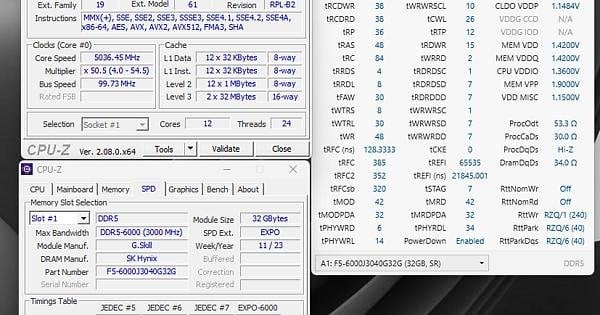
Here are the Zentimings for both:
6000 – [https://imgur.com/2NW8ga4](https://imgur.com/2NW8ga4)
6800 – [https://imgur.com/QglNVvd](https://imgur.com/QglNVvd)
​
Also, if anyone has any ideas on how to lower my tRCD on the 6800 kit, I am all ears.