
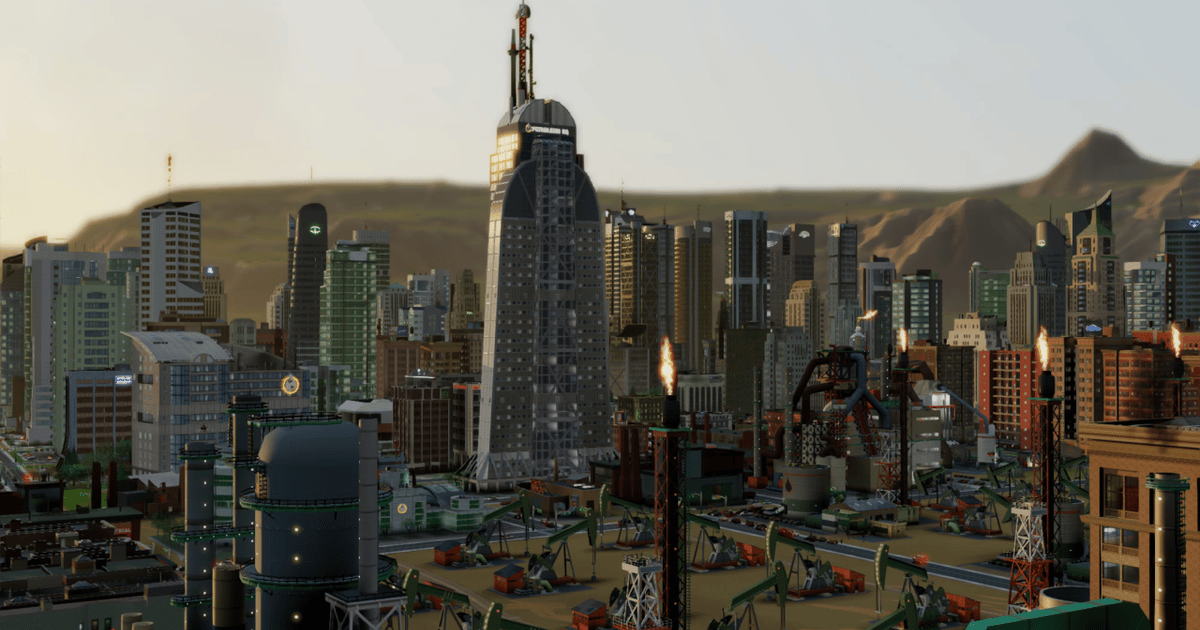
A sequel of sorts to the iconic One Page Designs GDC Talk, Stone Librande brought a world of one-page (and “one-wall”) designs to his 2013 GDC talk, Simulating a City, One Page at a Time. Focused on the design process of SimCity (2013) from the very beginning all the way through the later stages of production. Having had so much success breaking down complex design ideas into one-page documents (meant to communicate information across teams and get immediate buy-in), Librande wanted to see just how far he could push it.
“So, when I started on the SimCity project [speaking about SimCity 2013], three and a half years ago, with five of us as a team, kind of as an experiment, I said ‘what if I only did one-page designs for the entire project, from pre-production all the way up to the day we ship?’ What would happen?” He suspected it wouldn’t work, but really wanted to test the bounds of the one page design process. “What I wanted to do was find out why it wouldn’t work. How far could I push it, and learn from that?”
It turns out, one-page designs can go quite far, and there were plenty of benefits to trying them even when bigger tools needed to come in eventually. Some of his one-page designs—like early maps that were inspired by real-life locales—made it all the way through production, though, Librande was candid about needing to take artistic license with the actual metrics. Indeed, real-life cities in America do have a lot of space dedicated to parking lots.
Librande’s one page design methodology was originally conceived as a way to replace “design bible” style documentation with diagrams and visuals that are one page, printed physically and displayed prominently (to bolster team buy-in), and intended to communicate a core idea clearly, concisely, and thoroughly. It’s not easy, it takes a lot of work to refine and strengthen such a display until it hits those criteria, but once it does, it becomes a very useful tool for finding the best solutions for design problems.
Librande showed this was certainly the case on this project. In charting the multiplayer trading mechanics, the designer found that some early concepts for the system were kind of a mess. That allowed him to cut early, before any more valuable resources were spent on refining something too unwieldily.
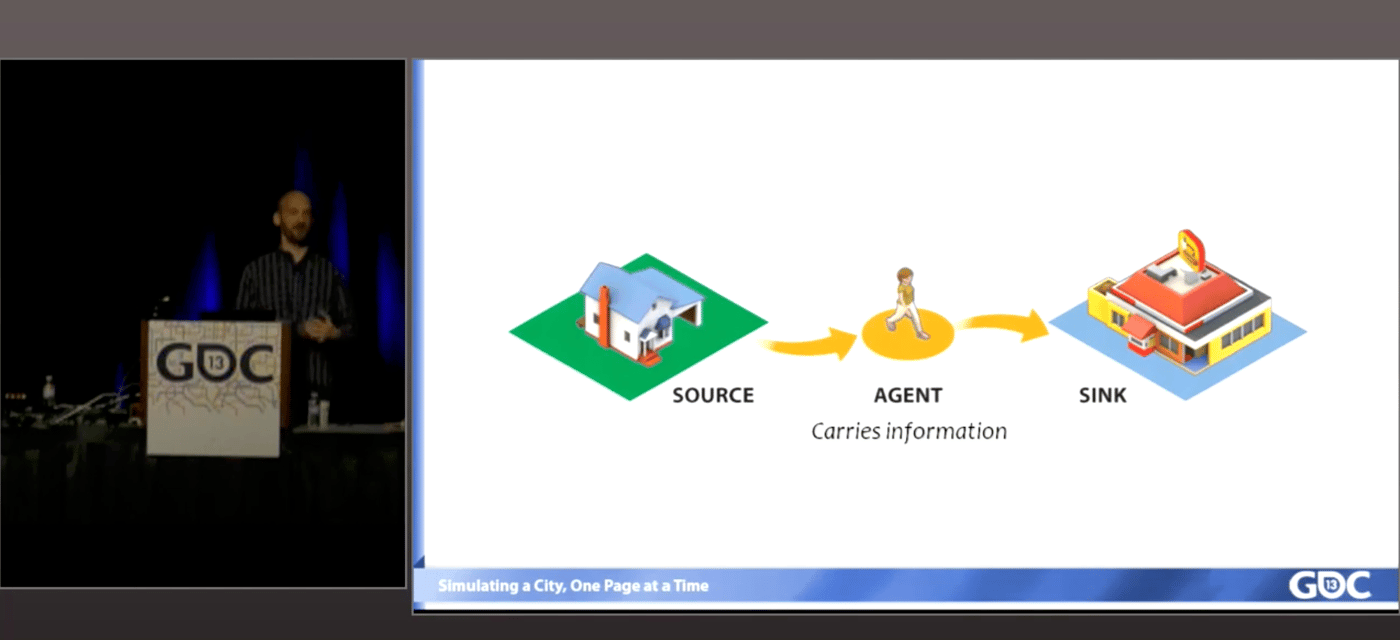
There’s a point in the talk where Librande hilariously shares how his penchant for succinct design diagrams earned him extra assignments. In a slide showing an email from his producer, a visual designer was assigned some visual explorations, a UI artist was tasked with creating mock-ups for the flow into the game, and Librande was handed a rather tall order, for a “Matrix of Coal City, complete with the various levels of the manufacturing plants, the modules, the supporting toys needed to support the city, how it will influence the sim, the rewards, resource chains, in something that’s digestible.” That last bit, Librande had bolded. “He’s saying, ‘do it in a one-page diagram.'”
“At this point, I’m like, ‘what have I done'” Librande laughed, noting he had now essentially trained the team to expect clean, elegant (and succinct!) diagrams no matter how complex the system. But, noting his mission to take one-page designs further, throughout the whole game’s production, the designer suited up for the challenge.
A place for Excel, after all
A game as complex as SimCity did, certainly, need the spreadsheet treatment eventually. So after a number of partial successes (and some failures, like a delightful-but-time intensive run at printing bespoke magnet pieces, and a card game that was “too cute” to really work), Librande turned to the CSV gods.
Even the spreadsheets benefitted from a bit of that one-page magic, however, as Librande consolidated information organized there, added color-coding and a bit of visual flair, and distributed a sort of hybrid chart/one-page design to all who needed them. The consolidated charts lived in colleagues’ offices and workstations, providing a handy, well-organized reference.
“Every time there was a high level update… it was my job to go around the office, take the old ones down, put the new ones up, and do it even when people aren’t at their desks,” he laughed. “It was kind of like the magic design fairy leaves you a present when you are away!”
In all seriousness, Librande makes a strong case for the “design fairy” approach, especially if there isn’t one prominent space where everyone who needs to see your design can see it from their station.
“This is a really important part, if you’re doing this in your own studios: don’t rely on people to come to you… if you really have something important to say to your team, you need to get it to them.”
The veteran designer recommends the one-page process highly, even if he eventually needed to cover entire walls in his one-page designs (he quips that one-wall designs and even one-room designs showed up). There were some failures along the way, and many points where he needed to recalibrate, but the core idea of communicating succinctly and thoroughly still works beautifully, once you properly account for scale. It may have made Librande’s desk a mess (he showed a photo of his paper-strewn desk at one point, surely that would’ve put any design bible to shame), and it may have been a long road, but Librande ends the talk noting it was a huge win for the team.
Talking to members on the team, he noted “we did some postmortems recently, and the diagrams are still valid—even though some of them are three and a half years old. We still refer to them all the time. It was a huge win, the way that the project was organized from the top highest level then drilling down to the smallest details. It’s a really sound foundation to build your game on.”
Indeed, though the talk is from 2013, the methodology is still relevant today. I show parts of this talk to my own game design students at Berklee, who often then create one-page designs for their own work. One-page designs provide a sound foundation indeed, whether you are a new design student, an indie dev whipping up a diagram on Miro, or working on a huge, multidisciplinary team in a central office.
Game Developer and GDC Vault are sibling organizations under Informa.