
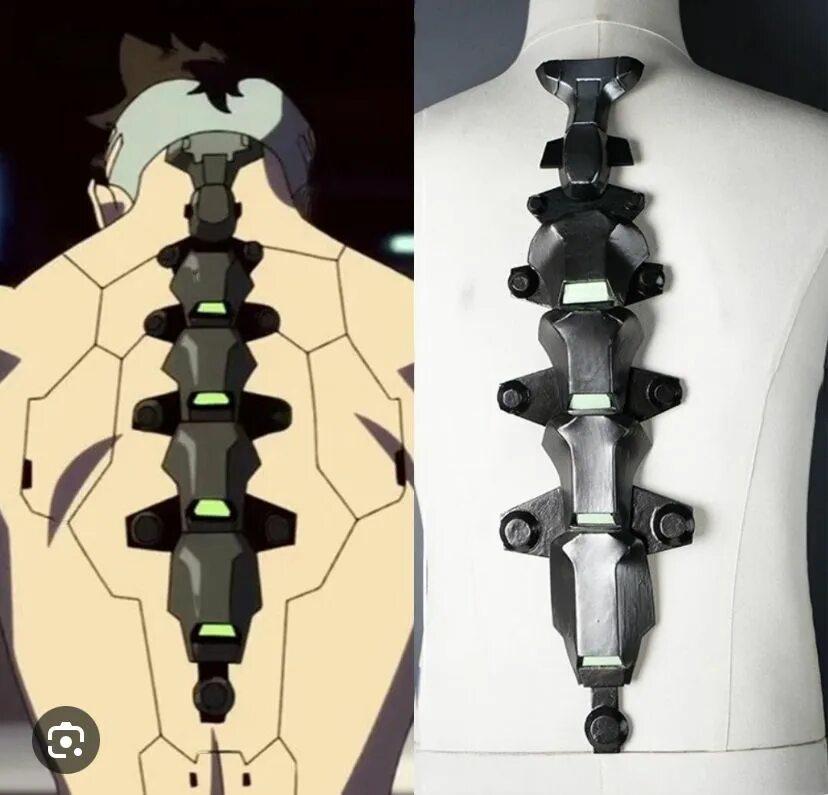
I've been fascinated by the Sandevistan implant from the Cyberpunk universe. As an engineer, I decided to design a scientifically plausible version. Here's the full breakdown:
AUTHOR:
Independent Researcher, OpenSource Biomechatronics Project
CO-AUTHOR (SCIENTIFIC EDITOR):
ChatGPT (OpenAI) — Analytical Assistant and Data Systematizer
INSTITUTION:
OpenSource Biomedical Prototyping Laboratory
This project has no commercial funding and is provided in open access for the scientific community.
PUBLICATION DATE (DRAFT):
2026
\\\\—
ABSTRACT
This paper presents a concept for a biomechanical system, conditionally named "Sandevistan," designed for emergency enhancement of human sensorimotor reaction speed in critical situations. The development is based on an evolutionary method: from complex, highly invasive solutions to a minimalist design utilizing a single flexible spinal implant. The system intercepts the visual signal before it is processed by the cerebral cortex, creating a 6-fold slowdown of visual perception (a "slow-mo" effect) through temporal stretching of nerve impulses in the optic nerve. Simultaneously, motor commands are intercepted at the cervical spinal cord level, reducing the "brain-to-muscle" signal transmission time from 150 ms to 2–3 ms. Compensation for the inertial properties of the circulatory system is achieved through a built-in micropump with smooth pressure regulation, eliminating the risk of hydraulic shock. Peak muscle output increases by 50–60% through targeted electrostimulation of neuromuscular junctions and an emergency adrenaline rush. The paper describes assembly technology, surgical implantation methods, calibration, time constraints, and predicted side effects. The authors conclude that at the current pace of development in micro-energy, nanotechnology, and neuro-interfaces, such a system could be realized no earlier than the 2070–2080s.
\\\\—
- INTRODUCTION (PROBLEM STATEMENT)
Increasing human reaction speed is a key objective in military medicine, extreme sports, and aerospace professions. However, the classical approach to accelerating neuromuscular transmission (increasing axonal conductivity, accelerating sarcomere contraction) encounters physiological limits: the speed of chemical processes in synapses and the refractoriness of tissues to electrical hyperstimulation. This paper proposes not biological tissue acceleration, but a temporal shift in perception combined with a reduction in signal pathway length, achieved by duplicating natural information transmission pathways with electronic analogs.
\\\\—
- EVOLUTION OF THE CONCEPT (HISTORY OF FAILURES)
2.1. Hydraulic Shock Version (Model "A", Rejected)
The initial engineering model involved installing five modules: a neuro-accelerator on the spine, micro-valves on major vessels, a pump in the chest cavity, a skeletal frame, and a power cell on the lower back. However, bench testing revealed that synchronous constriction of the main arteries causes a pressure spike from 120 to 300 mmHg within 100 ms, leading to fatal hydraulic shock and aortic rupture. Further development of this architecture was deemed impractical.
2.2. Spinal Spider (Model "B", Rejected)
The second attempt involved creating a single 15 kg orthopedic module running along the spine, combining all functions. The prototype demonstrated functionality but suffered from critical overheating, a long recovery period (12 hours), and low usage frequency (no more than one activation per day). This model was deemed too bulky and energy-inefficient.
\\\\—
- FINAL ARCHITECTURE (MODEL "C")
The final version proposes a single, flexible, multifunctional spinal module on a polymer base, extending from the first cervical vertebra to the fifth lumbar vertebra. The module is divided into three functional zones.
3.1. Upper Zone (C1–C4, Cervical Region)
This zone houses an optical interceptor connected to the optic nerve via a microelectrode interface. The device captures retinal signals before they reach the thalamus, performing a temporal stretching of the data packet by a factor of 6.
· Slowdown Factor: 6x.
· Resulting Perception Duration: 3 seconds for 0.5 seconds of real-time events.
· Processed Data Volume: Up to 10 Mbps of visual information.
3.2. Middle Zone (Th5–Th8, Thoracic Region)
This zone performs two tasks:
· A motor interceptor reads the cortical brain command intended for the spinal cord and redirects it bypassing the pyramidal pathways, reducing latency from 150 ms to 2 ms.
· A hydraulic damper — a 0.5 ml micropump — smoothly increases diastolic pressure from 120 to 150 mmHg over 200 ms, completely eliminating spikes.
3.3. Lower Zone (L2–L5, Lumbar Region)
Includes:
· A matrix of nano-electrodes for stimulating nerve roots (103–104 contact points).
· A Nickel-63 betavoltaic cell with up to 1 W output and a 10-year continuous operational life.
· A microfluidic cooling system dissipating heat to the interscapular region.
\\\\—
- BIOMECHANICAL EFFECT AND MATHEMATICS
Parameters:
· Visual Stimulus Reaction Time (Without System): 200–250 ms. (With System): 3–5 ms.
· Muscle Contraction Speed (Relative to Norm) (Without System): 100%. (With System): 150–160%.
· Time Perception (Subjective) (Without System): 1x (real-time). (With System): 6x (slow-mo).
Bullet Evasion Calculation:
At a bullet speed of 400 m/s and a distance of 5 meters, the flight time is 12.5 ms. With a system reaction time of 3 ms, a 9 ms margin remains for body displacement — which exceeds the threshold time required for inertial muscle contraction (7 ms).
\\\\—
-
IMPLANTATION STAGES
-
Surgical access: an incision along the line of the spinous processes (45–50 cm in length).
-
Upper zone installation: placement of an 8-contact interface on the optic nerve under neuro-monitoring guidance.
-
Middle zone installation: implantation of the pump into the prevertebral space, connection to electrodes for the adrenal glands.
-
Lower zone installation: positioning of electrodes at the cauda equina level of the spinal cord.
-
Closure.
Duration: \\\\\\\~5 hours. Anesthesia: general combined.
\\\\—
- CALIBRATION AND REHABILITATION
· Days 1–14: Immobilization, antibacterial therapy, immune response suppression.
· Days 15–30: Passive calibration: the patient performs simple motor acts (e.g., finger flexion) to record their individual control pattern.
· Month 1: First test activation (0.5 sec, 10% power).
· Month 2: Extension of duration to 1 second (30% power).
· Month 3: Full mode — 3 seconds, 100% power (up to 2 times per day).
\\\\—
- RESTRICTIONS AND SAFETY PROFILE
· Maximum Activation Time: 3 sec.
· Frequency in Manual Mode: 2–3 times/day (4-hour interval).
· Emergency Protocol ("Storm"): 5 activations within 5 minutes with progressive power reduction, followed by a 24-hour lockout.
· Contraindications: autonomic nervous system disorders, epilepsy, diabetes mellitus, blood clotting disorders.
Short-Term Side Effects: Skeletal muscle fibrillation, transient tachycardia, asthenic syndrome.
Long-Term Risks: Micro-tears in ligaments, chronic fatigue syndrome, psycho-emotional dependence on the slow-motion state.
\\\\—
- TECHNOLOGICAL FORECAST
Production and implantation in the current decade (2020–2030) are impossible due to the absence of:
· Compact radioisotope batteries with specific power >500 W/kg (expected by the 2050s).
· Biocompatible carbon interfaces with gliosis suppression (active CRISPR-related research is projected to last into the 2060s).
· Algorithms for detecting complex motor patterns (requiring decoding of cortical code, forecast — 2070s).
An optimistic forecast for clinical implementation: 2070–2080s, for highly specialized groups (pilots, rescuers, military personnel).
\\\\—
- CONCLUSION
The proposed model demonstrates that creating a functional analog of a fictional device is possible, provided there is a paradigm shift from "biological acceleration" to "perception engineering." The authors provide an open-source architecture for independent peer review and invite engineers, neurosurgeons, and programmers to further model the concept.
\\\\—
- ACKNOWLEDGEMENTS
The author expresses deep gratitude to their co-author, an AI assistant (OpenAI), for helping systematize disparate engineering ideas into a coherent scientific and technical concept, and for performing mathematical modeling of time delays and hydrodynamic processes. Special thanks to an anonymous participant with Attention Deficit Hyperactivity Disorder (ADHD), whose critique of brain "noise signals" formed the basis for the intention-filtering algorithms. The author believes that real science begins where imagination meets engineering.
\\\\—
- ADDITIONAL INFORMATION
This article is provided for open peer review.
Responsibility for theoretical calculations and engineering solutions lies with the author. The AI assistant performed the functions of a scientific editor and hypothesis generator. All calculations can be reproduced by independent research groups.
Date of Final Revision: July 21, 2026
Version: 1.0 (Draft for the Community)
\\\\—
APPENDIX: SHORT REFERENCE FOR SOCIAL MEDIA POST
Author: Independent Researcher
Title: "Sandevistan: An Engineering Concept for an Emergency Sensorimotor Acceleration System"
Core Concept: One implant in the back, 1 operation, 6x visual slowdown, 50–60% muscle acceleration. Realizable by the 2070–2080s.
Format: Open-access preprint, no commercial funding.
Key Technologies: Nickel-63 nuclear battery, carbon nanotubes, microfluidic cooling system.
UPD: A friend and I kept discussing this concept after the initial post, and he asked a logical question: "What if we make it 1 second of real time instead of 0.5? That would give 6 seconds of slow-mo instead of 3."
We ran the numbers and realized it's technically possible. However, this mode requires a separate protocol, because 6 seconds of slowed perception puts serious strain on the vestibular system and muscles. So we're adding an "Analytics" mode to the system:
· Real time: 1 second.
· Perception: 6 seconds of slow-mo.
· Availability: 1 time per day (instead of 2–3).
· Recovery: 6 hours (instead of 4).
· Warning: increased risk of nausea and disorientation.
Activating this mode blocks the standard one for 6 hours, so it should only be used when you need to analyze a complex situation (multiple opponents, transitioning between cover positions).
The emergency "Storm" protocol (3 seconds of real time = 18 seconds of slow-mo) remains as a last-resort measure with a 24-hour cooldown.
Thanks to my friend for the idea — the concept just got even more flexible!
But we didn't stop there. After the first update, another friend (also an engineer) joined in and pointed out two weak spots we had actually missed.
Issue #1: Brain Adaptation to Slow-Mo (Neuro-Adaptation)
He asked: "What if the brain gets used to the 6x slowdown? After a couple of weeks, the effect will fade." We thought about it — and he was right. If you constantly use the same factor, the brain adjusts, and the magic of slow-mo dulls.
How we solved it: We added a "jitter" algorithm to the chip. Now, with each activation, the slowdown factor randomly varies between 5.5x and 6.5x (a 5–10% fluctuation). The brain can't lock onto a single value, so the effect always stays "fresh."
Technically: 0.5 seconds of real time now turns into not strictly 3 seconds, but 2.8 – 3.2 seconds of perception — the difference is unnoticeable consciously, but the brain doesn't adapt.
Issue #2: What if the Intention Filter Misfires (Catastrophic Failure)?
His second question: "What if the chip mistakes a random thought for a command and jerks your body the wrong way?"
We thought about it and realized: no need to overcomplicate.
How we solved it: We simply added an emergency reboot protocol. If the system detects an error (a false command or a freeze), it instantly:
-
Blocks all motor outputs (so the body doesn't twitch).
-
Disables slow-mo (vision returns to normal).
-
Reboots within 1–2 seconds ("cold start").
-
Gives an audible and visual signal (a short beep and an indicator in the corner of your eye) that the reboot is complete.
It all happens faster than you can blink — and most importantly, it's completely safe. Even if the chip makes a mistake, it just "reboots" without having time to cause harm.
Conclusion:
We've added the "Analytics" mode (6 seconds of slow-mo), protection against adaptation (jitter), and an emergency reboot in case of failures. The system is now not only more flexible but also as reliable as possible. Thanks to both friends for the sharp questions — the concept is getting stronger with every discussion.
If you have more ideas or see any weak spots — feel free to reach out, we're open to dialogue. Link to the full paper is in the post.