
Hi everyone,
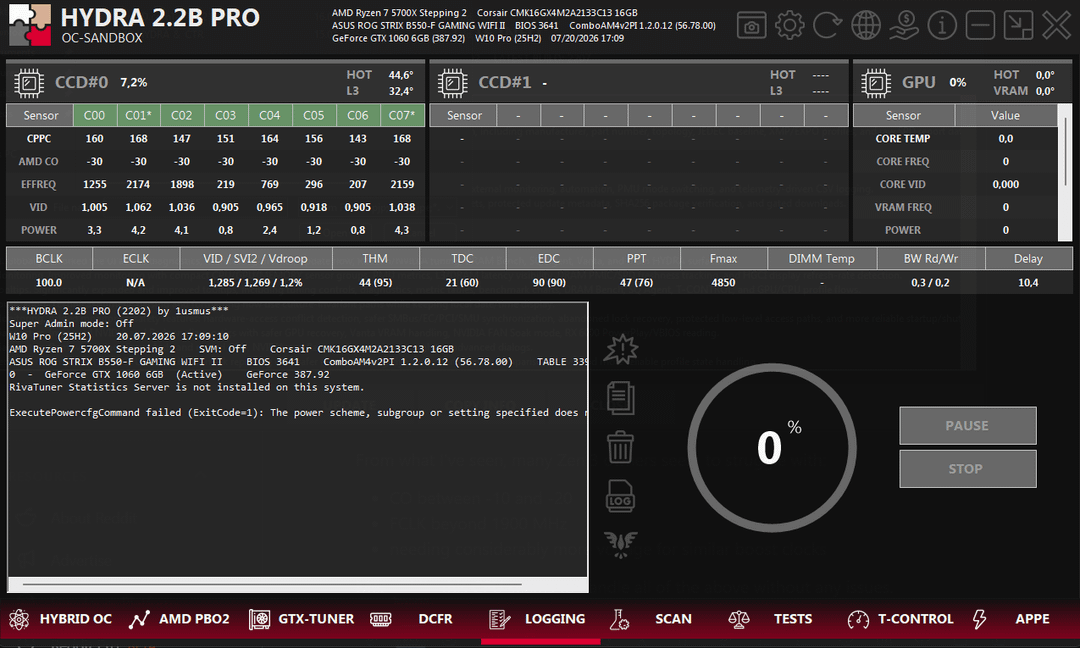
I recently upgraded from an i5-6600K after almost 11 years and bought a brand new Ryzen 7 5700X. After spending the last few weeks testing and understanding Zen 3, I ended up with results that seem significantly better than what I usually read online.
I'm not trying to brag—I'm genuinely curious whether this is considered an unusually good sample or if late-production 5700X CPUs commonly behave like this.
Current setup
- Ryzen 7 5700X
- ASUS ROG Strix B550-F Gaming WiFi II
- Latest BIOS (3641 Beta)
- Arctic Freezer 36
- Sharkoon AK5M
CPU settings
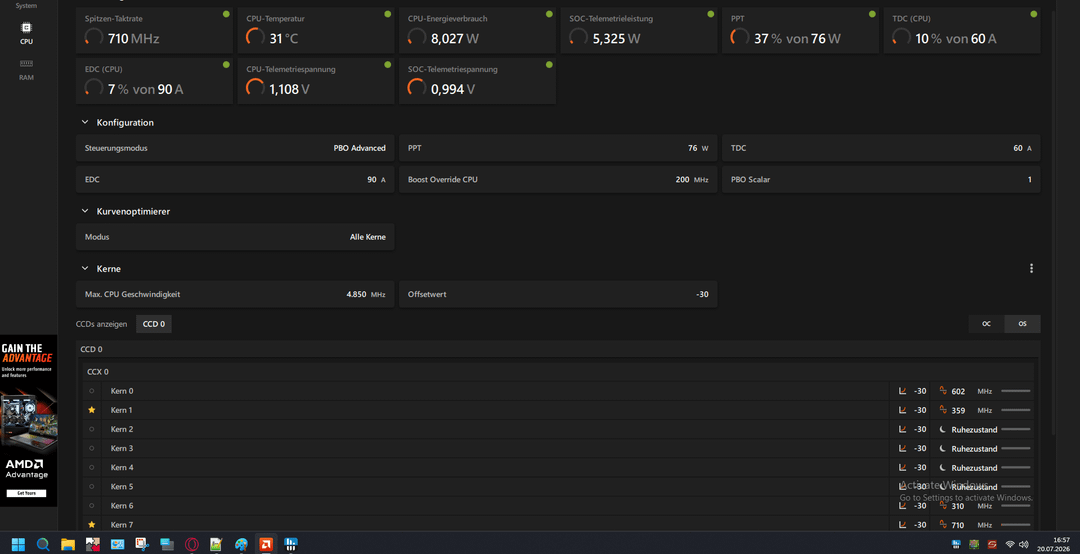
- PBO: 60 / 70 / 90 (Eco)
- +200 MHz Boost Override
- Curve Optimizer: -30 all cores
- Ryzen Master reports 2 preferred ("gold") cores
Stability testing
The settings above have been tested with:
- CoreCycler
- Prime95 (0 errors)
- Daily usage for over a week
- Gaming (mainly CS2)
- No BSODs
- No WHEA errors
Clock behavior
- 4.85 GHz boost is fully stable
- For daily use I normally run around 4.65 GHz, simply because I prefer efficiency over the last 1–2% performance.
Infinity Fabric / Memory Controller
This surprised me the most.
Using a basic G.Skill Aegis DDR4-3200 kit, I managed to boot:
- DDR4-4200
- FCLK 2100
- UCLK 2100 (1:1:1)
It boots and runs, but I get occasional WHEA warnings and some audio crackling.
Completely stable is:
- DDR4-3950
- FCLK 1975
- UCLK 1975
No WHEA errors there.
Temperatures
During Cinebench:
- around 67–71°C
My question
From what I've seen, many Zen 3 owners seem to struggle with:
- CO between -10 and -20
- FCLK beyond 1900 MHz
- needing considerably more voltage for similar boost clocks
Meanwhile this CPU seems to handle all of the above without any issues.
Would you consider this an unusually good Zen 3 sample, or is this fairly common with later production Ryzen 5000 CPUs?
I'd really appreciate opinions from people who have tuned a lot of Vermeer chips.
Thanks!