
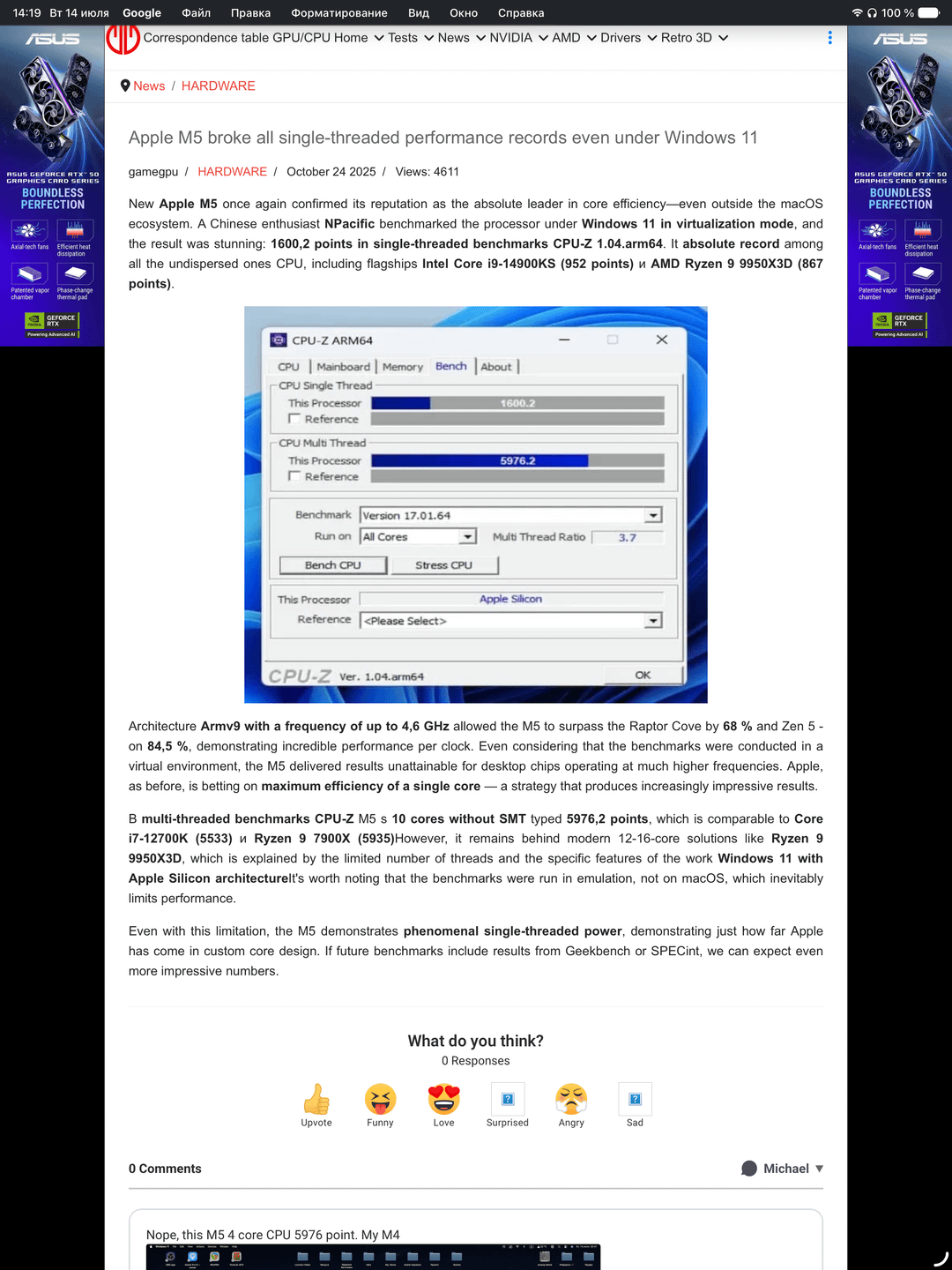

came across an article claiming that an Apple M5 scored 1600.2 points in CPU-Z single-thread and 5976.2 points in multi-thread under Windows 11, allegedly using all 10 CPU cores.
The article then explains the relatively low multi-core score as a limitation of virtualization, Windows 11 on Apple Silicon, and the lack of SMT.
That explanation appears to be complete nonsense.
In CPU-Z, “Run on: All Cores” means all CPU cores visible to the Windows virtual machine, not all physical cores available in the host Mac. Parallels does not normally assign every host core to the VM, because macOS still needs CPU resources.
The original screenshot does not show the CPU tab or the number of cores assigned to the VM. However, it shows a multi-thread ratio of only 3.7, which is a very strong indication that the VM had approximately four vCPUs assigned, not ten.
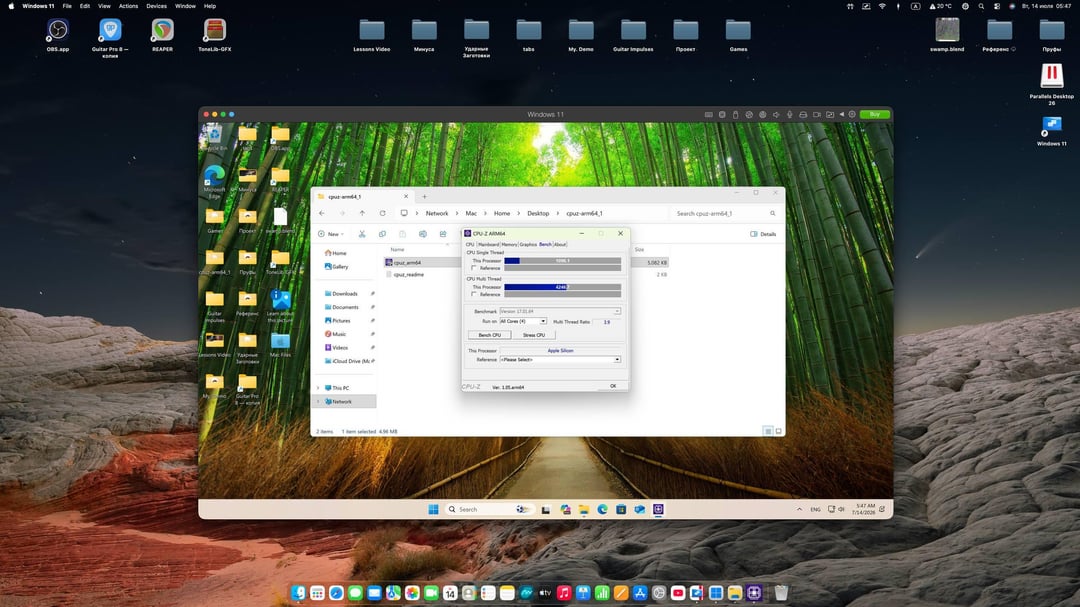
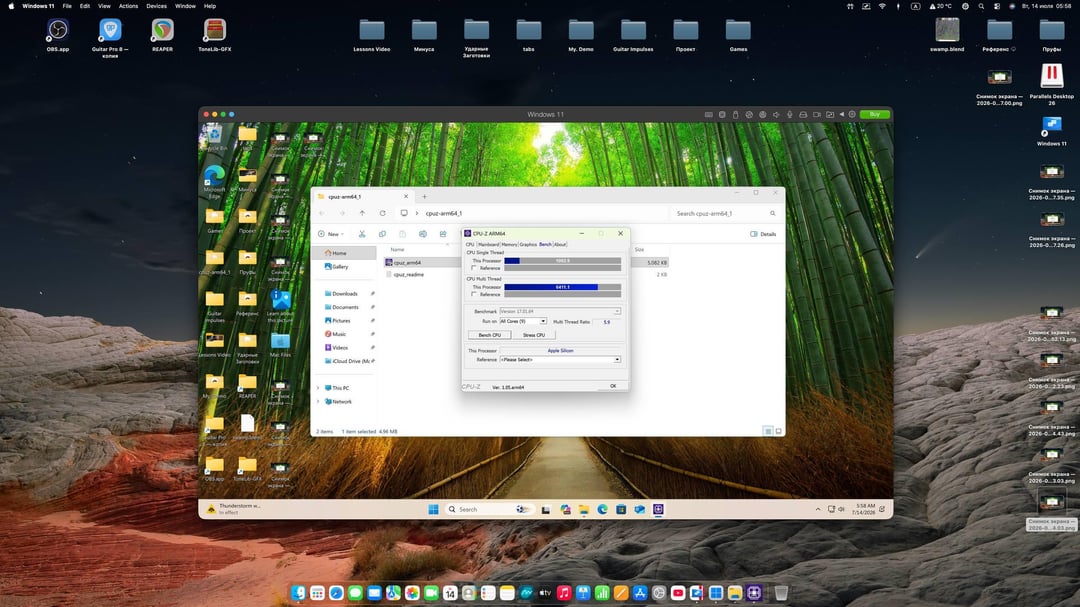
I reproduced the test myself using CPU-Z ARM64 inside Windows 11 running in Parallels on an Apple M4:
- 4 vCPUs: 1096.1 single / 4266.7 multi / ratio 3.9
- 9 vCPUs: 1092.9 single / 6411.1 multi / ratio 5.9
CPU-Z explicitly reported:
- 4 cores / 4 threads in the first configuration
- 9 cores / 9 threads in the second configuration
The scaling is completely logical. Increasing the VM from four to nine assigned cores raised the multi-core result from roughly 4267 to 6411, while the single-core score remained nearly unchanged.
So the published M5 result of 5976.2 multi with a ratio of 3.7 was almost certainly not produced by all ten M5 cores. The benchmark was most likely limited by the number of vCPUs assigned to the virtual machine, and the author mistook CPU-Z’s “All Cores” option for “all physical cores in the Mac.”
There is another error: this is not full CPU emulation. Parallels is virtualizing Windows 11 ARM on Apple Silicon, and the screenshot clearly shows the native CPU-Z ARM64 build. Windows may emulate individual x86 applications, but CPU-Z ARM64 itself is not being CPU-emulated here.
The impressive part of the original result is actually the opposite of what the article claims: an M5 appears to have scored almost 6000 multi-core points while probably using only four assigned cores.
I’m attaching:
- The article and its original CPU-Z screenshot
- My M4 result with 4 assigned vCPUs
- CPU-Z showing 4 cores / 4 threads
- My M4 result with 9 assigned vCPUs
- CPU-Z showing 9 cores / 9 threads
The article’s methodology is not merely unclear. Its interpretation of the benchmark is technically wrong.