
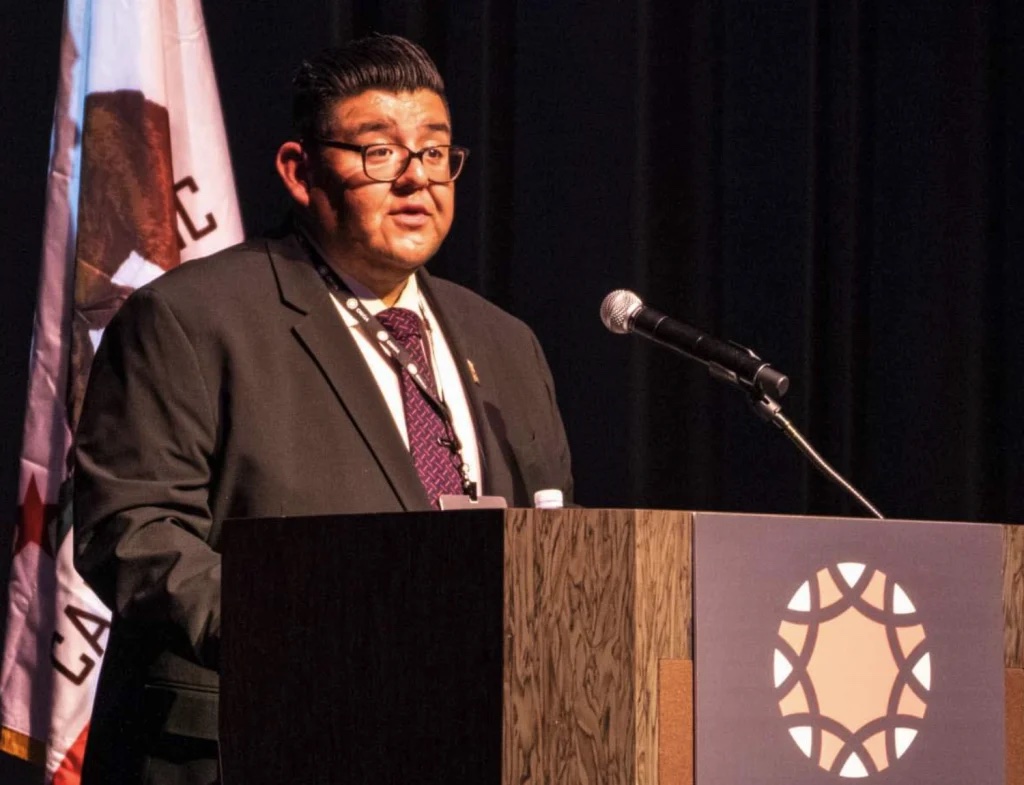
Prediction markets have reduced tribal gaming revenue across the country by an estimated 5%, cutting into funding for tribal government programs, according to the chairman of the California Nations Indian Gaming Association.
Tribal gaming generated more than $43 billion nationally in fiscal year 2023 and helps fund government services including public safety, health care, housing and education. California tribal leaders warn the rapid expansion of prediction markets such as Kalshi and Polymarket could further erode those revenues if the products continue to grow.
Prediction markets sell event contracts that pay out based on the outcome of sporting events, elections and other events. Tribes and several states argue the products function as unregulated sports betting and infringe on state and tribal authority over gaming.
James Siva, chairman of the California Nations Indian Gaming Association, said the organization’s preliminary studies estimate prediction markets have reduced tribal gaming revenue in California by about 5%.
“The rise of the prediction market is, without a doubt, the largest and most impending threat we have to tribal gaming and to tribal government and tribal sovereignty that we have currently,” Siva said. “It may be the biggest threat we’ve seen since the beginning of this industry.”
Siva, who also serves as vice chairman of the Morongo Band of Mission Indians, spoke with Tribal Business News about the industry’s response to prediction markets, the CFTC’s proposed overhaul of event-contract regulation, and why he expects the dispute to end up before the U.S. Supreme Court.
This conversation has been edited for brevity and clarity.
What has California’s tribal gaming community been doing to prepare for online sports betting, and how have prediction markets affected that work?
For us in California, we’ve been looking at online sports betting since before COVID. So this is something that we’ve been working on for a long time – right up through Proposition 26 in 2022, which failed alongside Proposition 27. But even since that time, sports betting has been a matter of importance and focus for tribes from then until now.
With the prediction markets, it definitely forced us to maybe expedite our timeline a little bit faster, just with the speed at which they’ve grown.
Now we’re seeing real, tangible dollar movement in Indian Country. Because of that, it has both become something that we’re trying to react to, but something we’re trying to also be proactive in our approach.
Have prediction markets already affected tribal gaming revenue in California?
We’ve been able to put together a few preliminary studies on that. They’ve grown so quickly that initially it was really hard to put some tangible figures behind it.
The most recent studies we’re conducting are showing preliminarily, with just what they’re offering currently, that we’re looking at up to a 5% reduction in gross gaming revenue. That’s a huge trigger when you look at how big tribal gaming is across the country.
To put it in context, a 10% decline would be the equivalent of the Bureau of Indian Affairs being defunded completely. We’re talking about a huge, massive amount of dollars coming out of Indian Country.
With some of the language being proposed that would potentially allow this industry to expand, some projections show that if they are able to move into what essentially is full casino‑style gaming in these prediction markets, the decrease could be as big as 25%. The equivalent would be the BIA, the BIE, Indian Health Service — just a huge loss for Indian Country.
Those early figures are scary, but knowing that these are just projections based off of current offerings, it’s a really dangerous area we’re in.
Do prediction markets create an uneven playing field for tribes compared to the regulatory requirements they must follow?
Yeah, 100%. There’s a process here in California for what any expansion of gaming looks like, and that’s true with other states as well, with how gaming operates and how tribal-state compacts work.
Here in California, we have a very initiative‑driven process for any kind of changes or amendments for the California Constitution. Tribes have been through a lot of different political fights to help create and establish the market.
We’ve worked to make sure there are protections for consumers, that there are regulations in place and that there is a safe, secure gaming environment. We spent decades doing that.
And the industry essentially being able to do an end-around to access the California market without having to work with tribes, without having to work with the state, without having to establish any kind of regulatory framework, without having any benefits to any other group besides themselves — that’s the issue.
What actions are tribes and the California Nations Indian Gaming Association taking in response, and how are state officials involved?
Lobbying and advocacy work with our attorney general, Rob Bonta, to get him more active, and we’re glad to see him start to be more engaged.
There have been a few bills proposed by members of the legislature here in California around prediction markets. We’ve actually pushed back on any of those bills.
One, for example, was going to prevent any member of the legislature from participating in prediction markets. We had that bill killed early because, in our mind, any piece of legislation short of an outright ban codifies what they’re offering.
If you’re saying only this group of people can’t participate because of insider trading concerns or whatever, you’re saying this is a legal activity that the rest of the general public is allowed to do. For us, that strengthens their argument.
So if it’s anything short of a full ban … we wouldn’t support it.
But we’re continuing to work with the AG’s office on how we can move forward together. We think more proactive stances from AG Bonta are needed. He’s been very good on tribal issues in the past, and we look forward to seeing him continue to be an advocate for tribal sovereignty as well.
Where do you think this fight is ultimately headed, and what avenues for resolution remain?
I feel like the path is leading to the Supreme Court.
I would love to be able to tell you that we believe we can get some action through Congress, but honestly, with the makeup of Congress right now and this administration, that’s simply not going to happen.
Prediction market providers — I mean, the President has connections to these, so unless there’s major changes in the midterm elections, I don’t see a huge amount of help coming from the Congressional path.
We are working on some pieces of Web3 legislation that could potentially help. We’re working on getting some amendments to the CLARITY Act included that will help with the prediction market issues as well as the decentralized finance portion, which is equally concerning.
But ultimately, I think it’s going to take a mass coalition of different advocacy groups — tribes, tribal gaming, state governments, state sovereignty advocates, governors — to really get this issue to move forward. I do think ultimately we end up in court, and I’m hopeful we win because we fundamentally believe we are advocating for the law to be followed.
We’re not advocating for special treatment or special privileges. We’re advocating for current existing law to be followed. Litigation seems to be a very clear path, but there’s so much misinformation out there about what’s happening, and the way information is being shared is very difficult to overcome.
About The Author
Staff Writer
Chez Oxendine (Lumbee-Cheraw) is a staff writer for Tribal Business News. Based in Oklahoma, he focuses on broadband, Indigenous entrepreneurs, and federal policy. His journalism has been featured in Native News Online, Fort Gibson Times, Muskogee Phoenix, Baconian Magazine, and Oklahoma Magazine, among others.
Other Articles by this author