
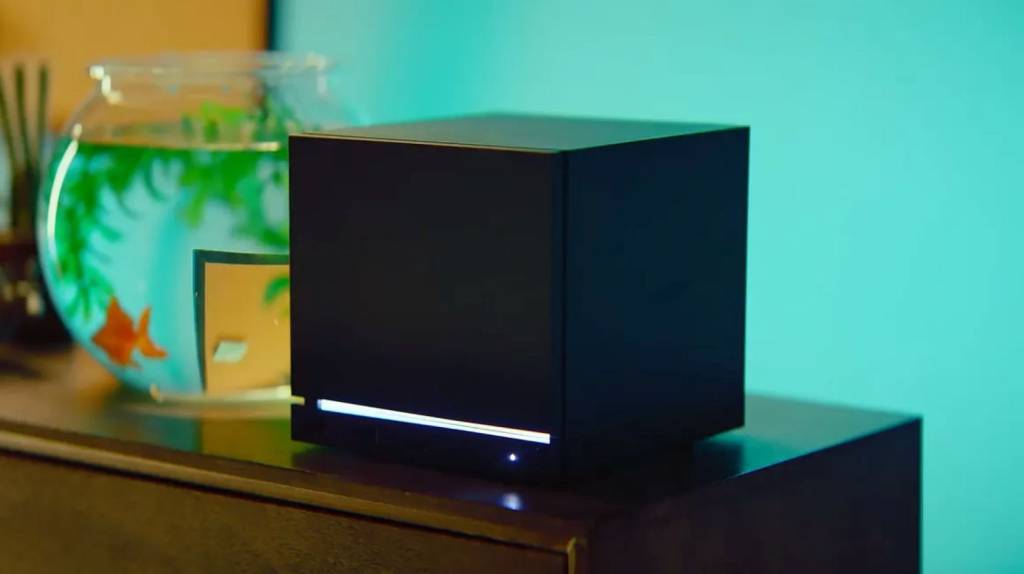
Just over six months ago, it was billed as Valve’s Wii moment. The launch of the Steam Machine would bridge the divide between console and PC gaming.
It would also be a conduit for introducing some of Australia’s best PC native indie games to a living room audience.
Now, with the device’s details revealed, the Steam Machine isn’t closing any gaps. In fact, it’s poised to widen many of them.
It will distinguish those who can afford gaming as a luxury item, and those who can’t. It will reaffirm PC gaming’s relatively higher barrier to entry, despite its extensive access to a library of cheaper indie games. And, crucially, it will galvanise the industry’s and its consumers’ mounting frustration with the rise of data centres and AI.
So what’s going on?
After months of delays and a shifting deadline, and angst emanating from Valve, the Steam Machine has arrived. It’s launching in Australia on June 28, along with the rest of the world, but there’s quite a few, significant, catches.
Get the best of Startup Daily straight to your inbox
Want to know the latest in startup news? Subscribe to our daily news and analysis coverage on what’s happening to ANZ startups, investors and the broader ecosystem. And best of all, it’s FREE!
By continuing, you agree to our Terms & Conditions and Privacy Policy.
First and foremost, it will launch as Australia’s most expensive console to date back a minimum of $1609 ($1115 USD) for the base 512gb model. For contrast: the previous holder of that crown, the PS5 Pro launched with a price tag of $1195.95 ($829 USD) and that caused quite the stir on its debut.
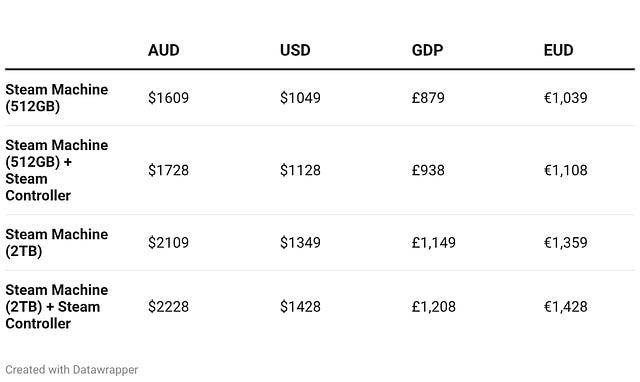
Yet, it somehow gets worse. Due to supply constraints, the Steam Machine can’t simply be purchased at launch. Those interested will have to register for a global lottery, and then win the right to buy one.
We can’t be too surprised by this. Console price hikes have become the norm: Nintendo, Sony and Microsoft have all jacked up their device price tags within the past 12 months. Lotteries are also the norm in other markets, like the US.
But, somehow, this announcement is hitting harder.
“Dared to dream” about the Steam Machine
It certainly has for some in the Australian indie developer community.
“When it was announced, plenty of us–including me–dared to dream it might mark a real shift, if the Steam install base grew here and globally,” said Mike Roberts from The Kids From Yesterday, creator of Dolven and Adventure Calls. He originally dubbed the launch Steam Machine as Valve’ Wii moment.
His take now: “That won’t happen soon, at least not from this product… I think consumers can see better value elsewhere in gaming right now, so the Steam Machine won’t shift the install base, meaning no real change for indies.”
Games industry analysts globally are taking a similar view. Though many told GameIndustry.biz that through keeping a close eye on the parts market, it seemed increasingly unlikely the device would come in under $USD 1000.
Locally, Australian analyst firm Telsyte is a bit more bullish than their global counterparts. They suspects the Australian market could be an outlier for the device.
“According to Telsyte’s Australian Subscription Entertainment Study 2025, 45% of Australian gamers consider video gaming a must-have and gaming commands a relatively high share of Australians’ entertainment budget,” Telsyte senior analyst Alvin Lee said.
“While it is more expensive than other consoles, the Steam Machine unlocks the world’s largest PC gaming library in the living room. It is also competitively priced against a comparable gaming PC build,” Lee said.
“The Steam Machine creates a premium tier between traditional consoles and gaming PCs that could put pressure on both sides of that market if it gains traction.”
Impact on the broader AI debate
Though, arguably, one of the hardest hit by this news isn’t in the gaming industry at all. Proponents of AI and data centres are fighting a global battle to hyperscale their sector.
Valve’s decision and candidness to pin it on the memory shortage hasn’t done them any favours.
Sentiment against AI across online gaming communities and among indie developers is palpable. The initial frustration that games could become AI-slop fuelled experiences and destroy industry jobs is giving way to fresher concerns that it will wipe out any possibility of it remaining an affordable hobby.
Gaming’s new media scene has tapped into this frustration too. One of Aftermath’s recent lines of mech sports a “Destroy AI” motif. Australia’s new CONTINUE? Magazine ran a 30-second ad during Frosty Games Fest featuring its co-editors Mark Serrels and Jackson Ryan chainsawing a computer, blazoned with the text “No AI”.
For the videogame industry itself, it’s a tightrope. Despite hurting their margins and forcing price increases, many major gaming industry players have not condemned or called for a pause to the rapid rollout of data centres.
While Microsoft is a key proponent of the AI trend, others like Sony and Nintendo and major publishers are in an unusual position, snafued by the allure of AI’s promised productivity gains. The mantra: It’s a potentially useful tool to responsibly cut development times and costs, while maintaining margin and quality, as both inputs continue to rise each year.
All of this forms another line in which data centre operators could face a shift in public sentiment from gamers, a group that would be traditionally agnostic towards them, given data centres host and enable some of the world’s largest games. It comes as sites for new data centres emerge as a political issue in both the US and UK, with similar themes emerging in Australia.
In an attempt to hear the other side of the story, Infinite Lives put questions to Data Centres Australia, the peak body representing the organisations surging ahead with Australia’s equally as explosive data centre rollout. They declined to comment, citing that the issue is outside their remit.
For now, what was meant to be an exciting moment for both Valve and the Australian indie gaming scene is now somewhat in tatters. The Steam Machine’s high price and limited availability takes what critics are saying is broadly an excellent device and has turned it into an industry issue.
Much like the Wii’s famous launch, where its unique controller wowed the world, the Steam Machine has all the pundits talking about the future of the industry. But not in the way that anyone hoped or expected.
What do you think about the Steam Machine’s launch? Will you pick one up (if you can)? And does its debut change your view on the rapid rise of new data centres across the globe. Let me know in the comments. (And before you point it out, the figure in the headline is Australian dollars…)
Harrison Polites writes the Infinite Lives newsletter. Follow him here.