
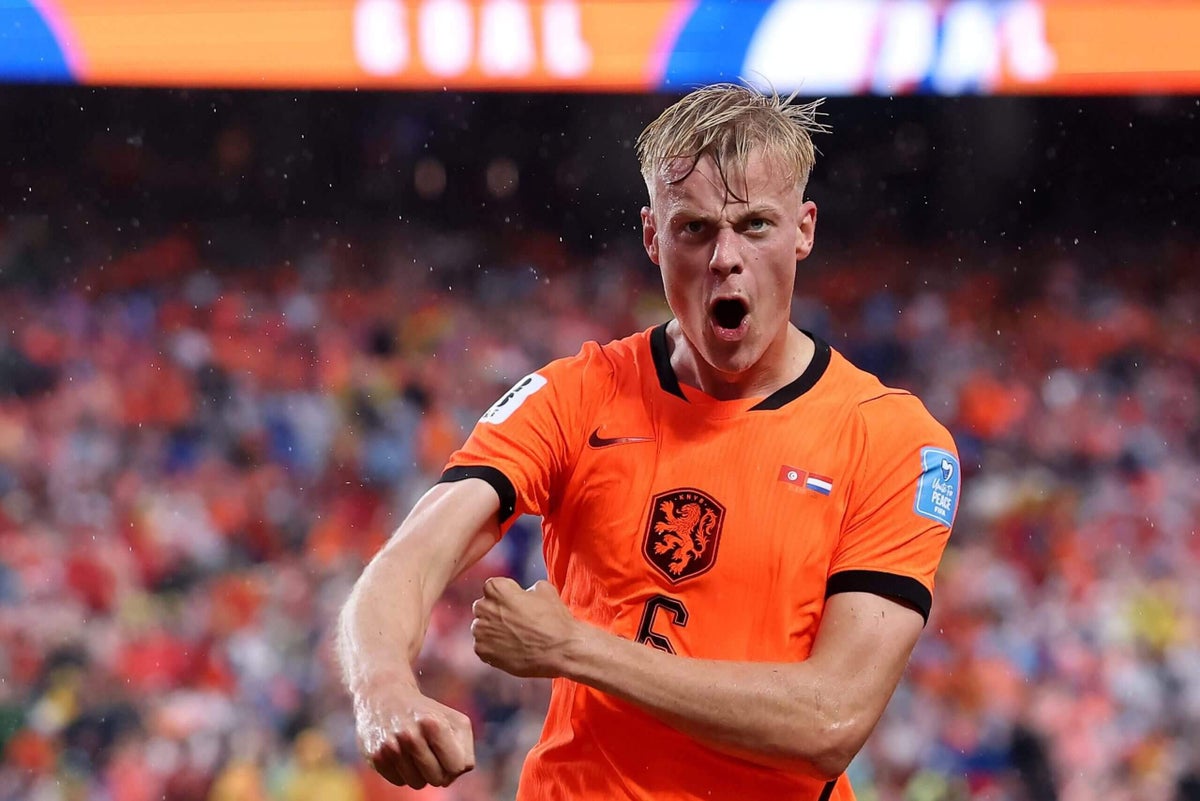
The Netherlands will face Morocco in the first knockout round of the World Cup after topping group F by defeating Tunisia, who lost all three of their games at the tournament in a campaign to forget.
Tunisia were 2-0 down in seven minutes and started the second-half with only 10 men before the game was paused and started properly when Ellyes Skhiri emerged from the tunnel. Skhiri sliced the ball into his own goal for the opener and also lost his shirt numbers during a first-half in which he wrestled with Brian Brobbey.
Hazem Mastouri gave Tunisia hope of a positive final result by scoring early in the second half but Jan Paul van Hecke, newly of Tottenham Hotspur, added a third to make it 3-1.
Thunderstorms had forced spectators out of the stands before the game but while it rained heavily there were no weather delays to the match.
Here The Athletic’s Simon Hughes, Carl Anka, Jacob Whitehead and Oliver Kay break down the key talking points.
Who will the teams in group F face next?
Netherlands are through after topping the group and will play Morocco in Monterrey on Monday June 29 in the round of 32. The winners of that game will play their last 16 game in Houston on July 4 against the winners of South Africa v Canada.
Japan finished second and will play Brazil on June 29 in Houston and should they pull off a surprise and win, then they will face the winners of Ivory Coast against either France or Norway in New York on July 5.
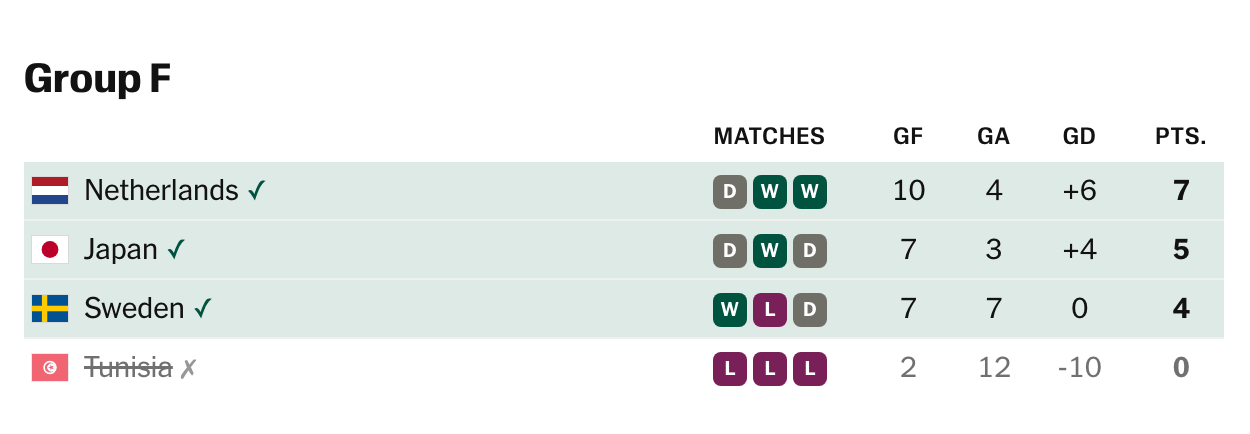
Sweden finished third and The Athletic’s projection tool calculates they will most likely face the winners of Group I (again either France or Norway) in New York on June 30. There is also a possibility (26 per cent) they could play Germany on Boston on June 29. Both paths take them to a round of 16 game in Philadelphia on July 4
Tunisia finished bottom of the group after losing all three of their games.
How strong are the Netherlands?
Are the Netherlands overachievers or underachievers? On the one hand, they are a nation of just 18 million who regularly compete in the final stages of the World Cup. On the other, they perennially boast one of the most talented squads in the competition, yet all they have to show for it are three losses in finals. They are undoubtedly the highest-profile nation to never have won the competition.
That dichotomy is at the heart of Dutch football. It means that, until they win it, the question will remain as to whether they can. Their 2026 squad is the latest to feel that examination. After the group stages, the answer is clear. It is still too early to say whether they are World Cup contenders.
This is why. In recent tournaments, the Netherlands’ issue has not been their defence. Ronald Koeman can boast more resources than ever in North America — the ability to replace Micky van de Ven with Nathan Ake at left-back is just one example, with the side still expertly led by Virgil van Dijk.
The midfield is elite too, made up of Frenkie de Jong (Barcelona), Ryan Gravenberch (Liverpool), and Tijjani Reijnders (Manchester City). That trio have controlled all three games so far.
But the challenge facing the Netherlands is whether their attack is good enough to break down the better teams in the tournament. They have lacked a top quality striker and a top quality winger since the retirements of both Robin van Persie and Arjen Robben almost a decade ago.
Though the five group stage goals shared between Brian Brobbey and Cody Gakpo are a clear positive, the Dutch have not played any side good enough to answer whether they can cause an elite team difficulties.
Against Japan, the best defence they played so far, the Dutch attack was lateral and ponderous for most of the game. A win over Tunisia was no test at all. A knockout tie against Morocco will be the toughest game they have faced so far — it will be the true test of whether they are true contenders.
Jacob Whitehead
Why did Tunisia have only ten players out for the second half?
After a first-half to forget, Tunisia had a slapstick start to the second half when they initially line up with ten men as the countdown started.
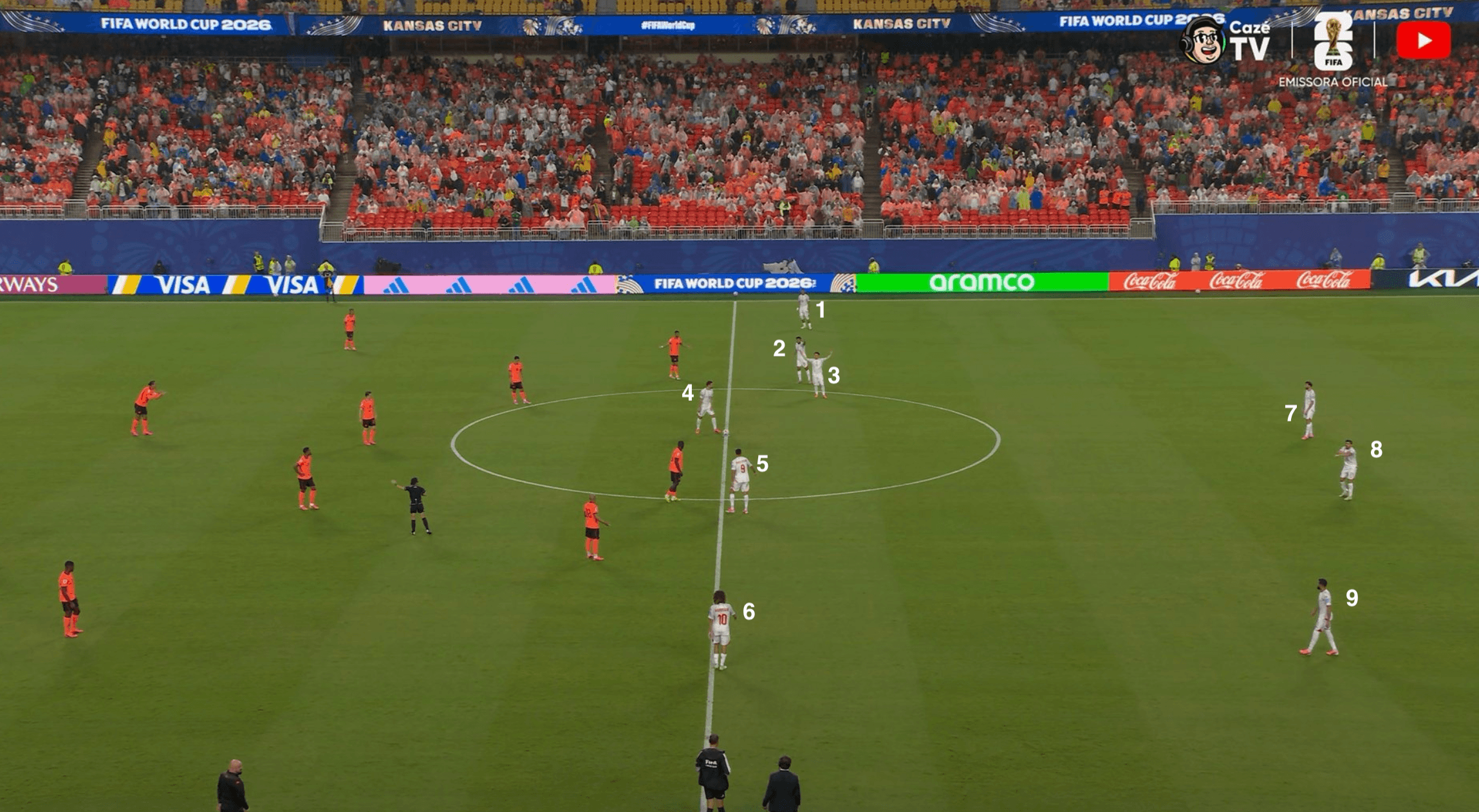
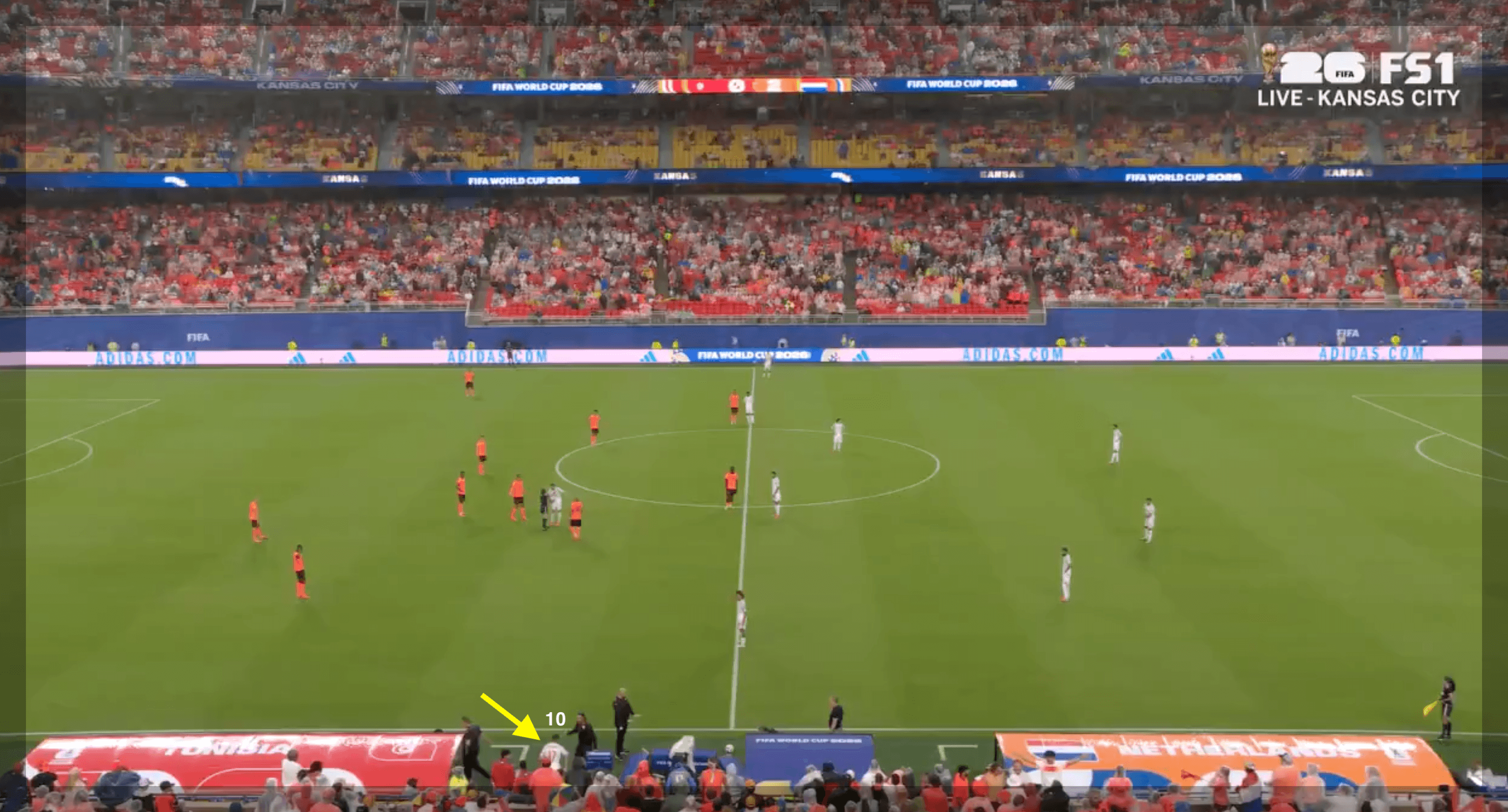
The nine outfield players kicked off before the referee Katia Itzel García stopped the match and Skhiri came running out of the tunnel, below, with the game then kicking off properly.
Are Tunisia this World Cup’s worst team?
At least the 2026 World Cup has been a memorable one for Tunisia, they have really left a mark.
The country’s football federation has, at least, probably proven one thing: sacking a head coach who has barely settled into the job after a thrashing in game one is not a good idea, especially when the solution is parachuting in a manager unfamiliar to most of the players.
At the 2024 Africa Cup of Nations, hosts Ivory Coast won the tournament after changing leadership at the end of the group stages when they were in danger of elimination, but they promoted internally. Tunisia were picked off in their second game and were 2-0 down inside seven minutes in their third.
It was a disasterclass in World Cup campaigning that reduced even Herve Renard, the immaculately dressed Frenchman, who always catches the eye, to the role of chump at a bus stop going home alone after his date did not turn up.
Surely these will be his only two games in charge but none of this can be considered Renard’s fault. Late last year, Tunisians were quietly confident ahead of the 2025 AFCON, held in Morocco, but since losing on penalties in the round of 16 to Mali after conceding an equaliser in the sixth minute of injury time, nearly everything has gone wrong. They have lost five out of seven games and go home from the World Cup with the worst defensive record of any nation as it stands.
Such failings merits more analysis but there is surely some truth in left back Ali Abdi’s comments after a 4-0 filleting by Japan in their second game. “We didn’t have time to work as a team. Instead of fixing the flaws, we started over every time,“ he said, in tears.
In addition to coaching overhauls, Tunisia ultimately made ten changes to squads that were chosen for tournaments, including AFCON, barely six months apart. On that basis, there can be no surprise it unravelled as painfully as it did.
Simon Hughes
Is Brobbey too much to handle?
Lionel Messi, Vinicius Junior, Kylian Mbappe, Erling Haaland … Brian Brobbey? It is three World Cup goals now for the Netherlands, putting him just behind that high-profile quartet in the race for the Golden Boot award, which is all the more impressive when you consider he began the tournament on the substitutes’ bench.
Brobbey is a handful. More than that, he is capable of taking a handful. That much was underlined this evening by the sight of the No 17 peeling off the back of Tunisia defender Ellyes Skhiri’s jersey— the legacy of a struggle with Brobbey in the first half.
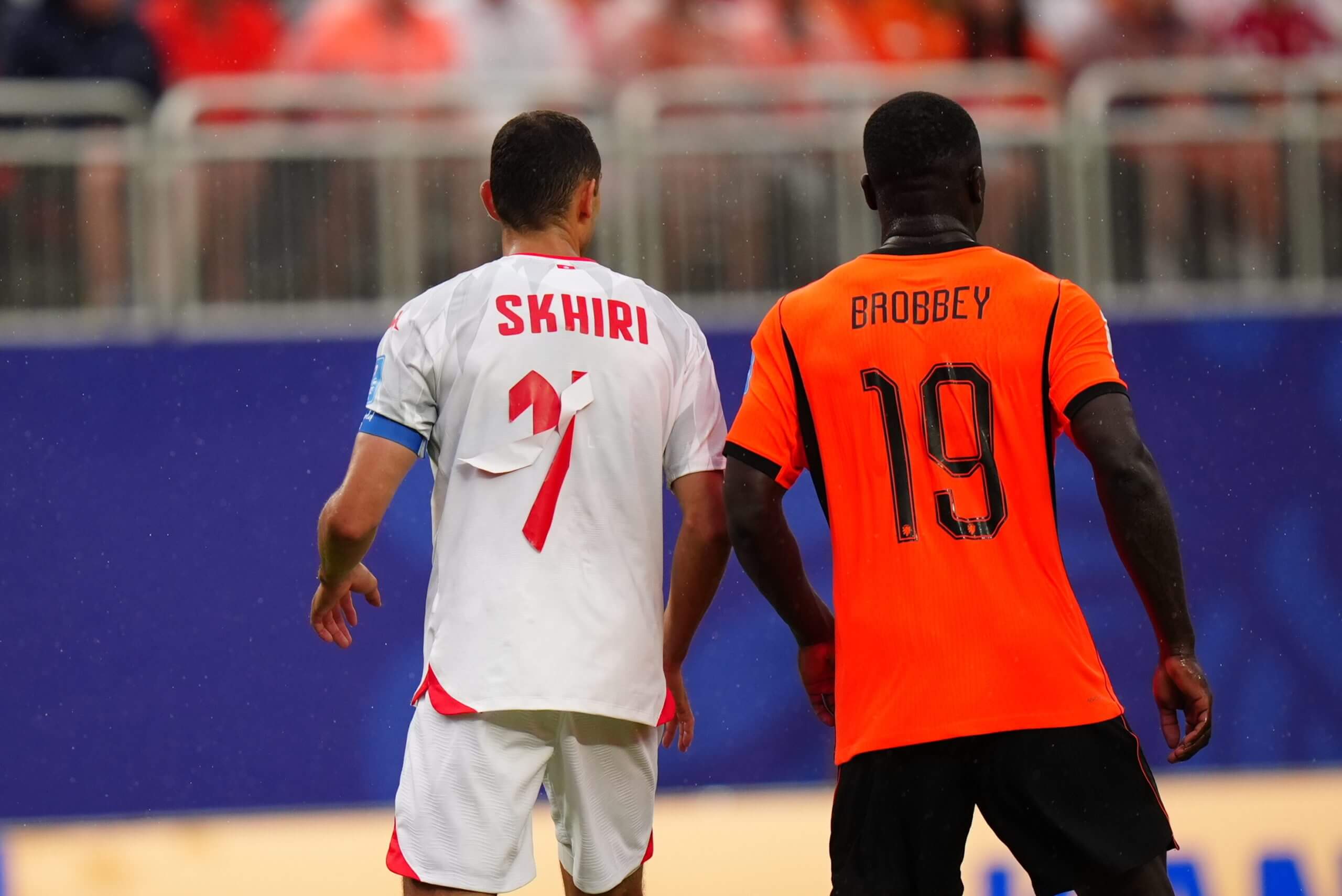
Skhiri loses his numbers (Getty Images)
Sweden defender Isak Hien was heavily criticised for his failure to get to grips with Brobbey in the Netherlands’ 5-1 win last Saturday, but he and Skhiri would no doubt agree it is easier said than done.
Brobbey’s goal to double his team lead was routine — right place, right time, right kind of finish — but it is strength, and his willingness to use it, that makes him such a dangerous opponent.
Oliver Kay
Why is Netherlands v Morocco such a big game?
The Netherlands’ victory over Tunisia sets up a round of 32 game against Morocco in what could be one of the fixtures of the tournament.
The 2025 figures from the Dutch Bureau of Statistics estimate approximately 433,000 people of Moroccan descent live in the Netherlands, with many people travelling from North Africa for work in the 1960s and 70s. Noussair Mazraoui, who will likely play at left-back for Morocco on Tuesday, was born in the Dutch town of Leiderdorp. Sofyan Amrabat, the hardworking utility man who can be deployed in defensive midfield or full-back, was born in Huizen, North Holland.
As explained here, changes in FIFA eligibility rules have made it easier for Moroccan players born in the Netherlands to choose for the country of their parents’ (or grandparents’) if they so wish.
Morocco v Netherlands will kick off at 3am local time in the Netherlands, but expect plenty of noise, colour and atmosphere across Dutch-Moroccan neighbourhoods in Rotterdam, The Hague and Utrecht in particular. Both nations are strong in the full-back positions and will look to accelerate play out wide whenever possible. It could be a fascinating game full of cultural and tactical narrative.
Carl Anka