
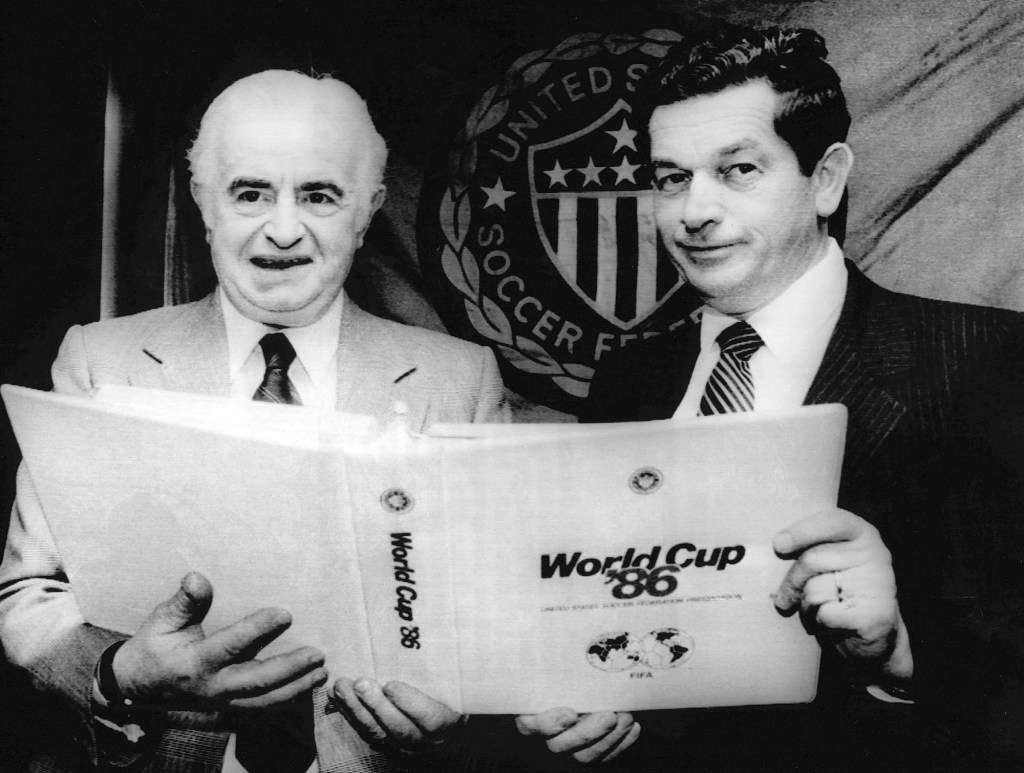
It was a Sunday long ago when father and son pondered what the future of American soccer might look like.
Werner Fricker Jr. was marveling at the hold American football had on Sundays: wall-to-wall coverage, pre-game shows, a day where you could park yourself in front of a screen and endure barely a single football-less minute.
As a soccer fan, Fricker couldn’t help but contrast that to the struggle of the 1990s to find any soccer coverage that wasn’t physically going to a stadium. He wondered to his father if such an available and ubiquitous future might be unlocked for the sport in the U.S. in their lifetimes.
“And he looked at me, and he said, ‘no, we’ll see that,’ ” Fricker Jr. recalled recently. “I’m not sure that that existed yet when my father died way too young in 2001, but now we have that everywhere. There’s soccer on television 24/7 and all year long.
“I think he’d be amazed, but he expected that.”
It’s one of the smaller ways in which Fricker Jr. regards his father, Werner Fricker, as a visionary. The list is long.
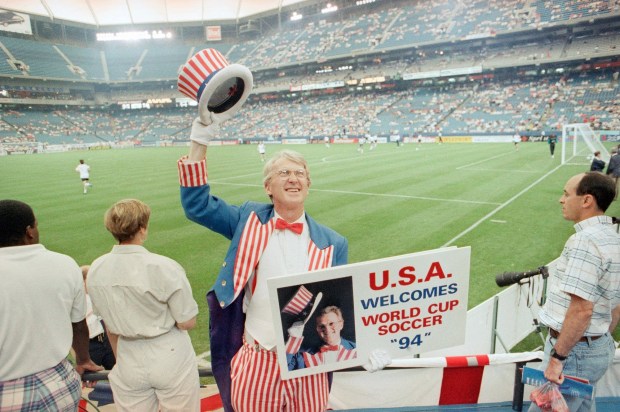 A man calling himself Uncle Sam holds up a sign on June 19, 1993, welcoming the World Cup tournament to the Silverdome in Pontiac, Mich. (AP Photo/Lennox Mclendon)
Fricker, who died at age 65, was the head of the United States Soccer Federation from 1984 to 1990.
He was the central figure in helping the United States land the 1994 World Cup, and thus in everything that followed for the growth of the sport in his adopted country.
From the 1994 World Cup came MLS, a FIFA requirement of the U.S. bid.
From its growth came soccer-specific stadiums, leaps in player development and America as a lucrative market for soccer powers in Europe and South America. And so came the 2026 World Cup, hosted by 11 American cities along with two in Canada and three in Mexico.
But what Fricker didn’t live to see was a World Cup game in his home of Philadelphia.
The longtime Horsham resident was unable, for a variety of reasons, to land games in the 1994 World Cup in Philadelphia. The World Cup coming to Lincoln Financial Field for six games this summer is a culmination of work that Fricker started in the early 1980s, before much of the current American soccer landscape existed.
Though Fricker is no longer with them, the World Cup this month in Philadelphia is a moment to treasure for the Fricker family, a multi-generational unit that remains active in the sport in the Delaware Valley at the grassroots level that their father so adeptly represented.
“My family knows this World Cup is a bit bittersweet for me,” Fricker’s daughter, Janet Malofiy, said. “While I’m super excited, I’m also a bit sad that my dad’s not here to see it through with us. I’m super proud of him and what he has done.”
Long road to the world stage
Werner Fricker’s legacy is such that securing hosting rights to a World Cup is but one note of many.
Fricker was born in Yugoslavia in 1936 to a German and Hungarian family. He fled with his family during World War II to Austria, then to the United States.
He played soccer for nearly two decades with the United German-Hungarian club in Bucks County, including it to a National Amateur Cup in 1965. The midfielder played for the U.S. National Team in its qualification efforts for the 1964 Olympics.
A carpenter by trade, he built a real estate development company based in Horsham, but soccer was his biggest devotion.
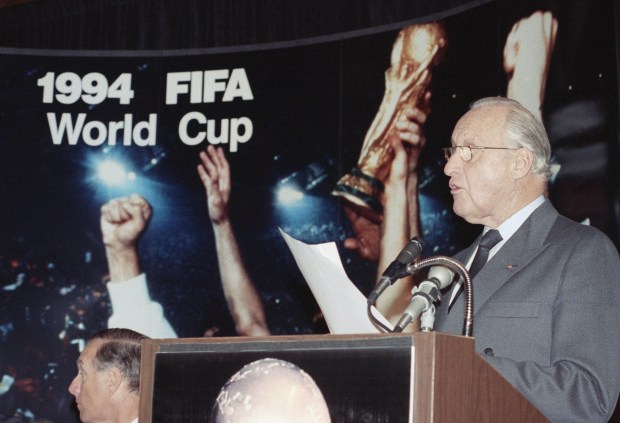 FIFA President Joao Havelange of Brazil speaks at a press conference on the 1994 World Cup in New York on Nov. 28, 1990. (AP Photo/ Marty Lederhandler)
“He was a builder of soccer,” Malofiy said. “And coming here as an immigrant, him along with many other immigrants, they brought the sport here to the United States of America. He really wanted to see the sport thrive.”
Fricker rose through the soccer administration ranks, from leading a club, then a league, to serving as a U.S. Soccer vice president. In 1983, he spearheaded U.S. Soccer’s effort to land the 1986 World Cup when Colombia declared it couldn’t afford to host a tournament it had been awarded in 1974. The bid failed, with Mexico granted hosting rights.
But it was a galvanizing experience for Fricker, his work propelling him to the presidency of U.S. Soccer in 1984.
His first remit was to improve the national teams. The U.S. men hadn’t qualified for a World Cup since 1950. The women’s program didn’t play its first friendly until 1985, then took part in the 1988 FIFA Women’s Invitational Tournament, a precursor to the FIFA Women’s World Cup inaugurated in 1991.
Fricker guaranteed the U.S. World Cup soccer when in 1988 FIFA awarded it the 1994 World Cup, over bids from Brazil and Morocco.
“There were a lot of people, not just people that didn’t know him but even soccer people that were involved deeply in the federation at the time and the soccer family, which was very small in comparison to what it is today, that thought my father was crazy,” Fricker Jr. said. “He was the guy that really thought that we could do this and wanted to do it.”
In the fall of 1989, the United States men qualified for the 1990 World Cup, ending a 40-year drought. Fricker had used his own assets to either keep afloat or secure financing for the national team in those shoestring days, a fact that wasn’t shared publicly until many years later.
“He was determined,” Malofiy said. “He had a vision. I feel often he was ahead of time with his visions, but he wanted to see it through. So we say all the time, if he could see what he has created, he laid the foundation for the sport, for soccer, in this country, and it’s just outright amazing.”
By the time Fricker’s signature achievement came to fruition in 1994, though, neither he nor the city in which he was based was formally involved.
Why not Philly?
Site selection for the 1994 World Cup was a torturous process, originally designed to be completed in 1990 but dragging into 1992. More than 20 stadiums were vetted originally, the goal being 12 host cities. The eligible pool would balloon into the 30s until nine were deemed suitable, a term that those who suffered through games at the Pontiac Silverdome would apply very loosely.
Three buildings in Philadelphia were proposed at various junctures, but none made the cut.
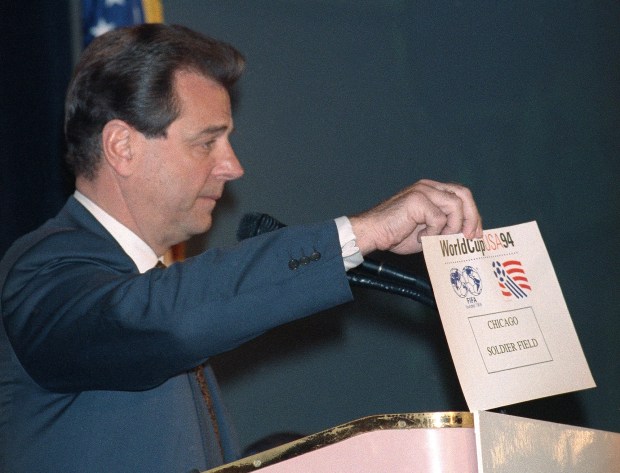 U.S. Soccer president Alan Rothenberg holds up a card reading “Chicago Soldier Field,” at a March 23, 1992, news conference in New York revealing the nine sites for the 1994 FIFA World Cup. (AP Photo/Osamu Honda)
The city had soccer bona fides. In 1989, 43,356 fans filled Franklin Field to watch the U.S. national team beat Soviet club DNEPR (now Ukraine’s FC Dnipro). Veterans Stadium hosted 44,261 fans when the U.S. played English club Sheffield in a 1991 exhibition.
As part of the bid process in 1988, FIFA inspection teams visited 16 stadiums in 13 cities, including Philadelphia’s JFK Stadium and Franklin Field.
The number of candidates would increase to 18 that summer, including such long shots as Oregon State’s Parker Stadium in Corvallis and what was to become the National Sports Center in Blaine, Minn., with temporary stands for 45,000 people. Seven candidates, including Franklin Field, had agreements to replace artificial surfaces with grass. Veterans Stadium, at that point, was not in the conversation.
Philadelphia’s prospects changed greatly in 1989. JFK Stadium, built in 1926, was condemned on July 13. It was demolished in 1992.
FIFA dealt a blow to Franklin Field’s viability by banning World Cup stadiums after 1992 from having “bleacher-type seating.” Individual, assignable seats were mandatory, a response to the Hillsborough disaster that April, when 97 people were killed in a crush at the overcrowded Sheffield stadium in an FA Cup semifinal between Liverpool and Nottingham Forest.
By 1991, Veterans Stadium was the only Philadelphia candidate left, one of 31 stadiums and one racetrack in 27 cities in the running. The racetrack would be a site that “could be created” at Aqueduct Racetrack in Queens if neither Shea Stadium nor Yankee Stadium was suitable as a second New York venue.
The expansion included cities from Knoxville to New Haven, even a proposal to quarantine soccer hooligans in Honolulu after Italy’s success in 1990 hosting England, the Netherlands and Ireland on Sardinia.
The Vet was one of five baseball stadiums considered. None made the cut.
Phillies’ President Bill Giles and Philadelphia Inquirer and Daily News publisher Robert J. Hall raised money to host FIFA and explore modifications. It got a second FIFA site visit in September 1991 and was deemed “very satisfactory” by FIFA’s Guido Tognoni to make a “priority list” of 19.
But FIFA was hedging on trimming its site list from 12 to as low as eight.
That’s when time became a problem. The Phillies were willing to absorb the costs of laying a temporary grass surface over the Astroturf. But it would take three days to install and three to remove. The Phillies committed to a maximum of 17 days for FIFA use of the building. That left 10 days to play games, too narrow a window for FIFA.
It seemed a foregone conclusion when in March 1992, games went to Washington’s RFK Stadium, the Rose Bowl in Pasadena, the Cotton Bowl in Dallas, the Silverdome, Chicago’s Soldier Field, the Citrus Bowl in Orlando, Stanford Stadium in Palo Alto, Giants Stadium and Foxboro Stadium.
“In ’94, it was a little bit disappointing that we didn’t get games in the World Cup in Philadelphia,” Fricker Jr. said. “But at the same time, I think my dad was realistic and understood we really at the time didn’t have an ideal stadium to put games into. And the ’94 World Cup was very successful.”
Fricker’s complex journey
There were many reasons beyond Philadelphia’s absence why Fricker’s relationship to the 1994 World Cup could have been fraught.
The first came in 1990, when his bid for reelection to the U.S. Soccer presidency failed. A blunt talker, he wasn’t FIFA’s preferred man for the job.
“He was tough, but he was fair and he was honest,” Malofiy said. “If you didn’t like him, then you didn’t know him.”
FIFA shifted its support to Alan Rothenberg, who led the organization through 1998.
The consensus from stakeholders at the time was that had Fricker been at the helm, the World Cup would’ve found a way to Philadelphia. But neither found an official place in the festivities.
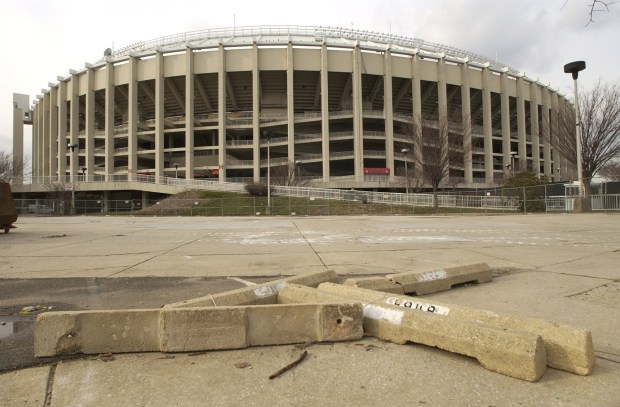 Philadelphia’s Veterans Stadium on Jan. 8, 2004. (AP Photo/Douglas Bovitt)
Fricker Jr., who has taken on the role of family historian, said the World Cup in 1994 wasn’t tarnished in his father’s eyes.
Rothenberg had “accepted him” as a past president. Fricker remained close to many people who spent decades in the organization like the late Hank Steinbrecher. Fricker proteges Kevin Payne and Sunil Gulati went on to prominent roles, Gulati as president.
Malofiy recalls attending matches with her father in 1994 and relishing in the spectacle. They were in Los Angeles for the final and attended events across the country.
“We went to the games. We were very proud of his accomplishments,” she said. “I think he was proud of his accomplishments. He brought the World Cup here, whether he did not see it through all the way to 1994. He laid the groundwork.”
Rothenberg’s appointment put someone with more experience with big events in the president’s chair. Fricker Sr., his son said, came to understand that.
“The people that ran the 1994 World Cup did a fantastic job,” Fricker Jr. said. “I’m not even sure, and my father said so himself, whether he would have been able to put that on as good as they did. He went to every city in the ’94 Cup that he could, because he wanted to see what went on everywhere.”
Fricker’s family has followed in his footsteps.
Malofiy is the president of the United German-Hungarians club. Fricker Jr. sits on the board, as do his sons Werner III and Michael, as well as Alex Blank, the son of Fricker’s third child, Marlene Blank. They’ve been involved in documenting the club’s voluminous history and in carrying forward the legacy that Werner Sr. built.
That will continue during this World Cup. Malofiy’s way of celebrating her dad will be to do what he would’ve done: To leverage UGH’s past and reach out to other ethnic clubs to help them showcase their histories.
The family and club supports events in the city at German restaurant Brauhaus Schmitz, which has World Cup programming. They’ll be in the city soaking in the soccer culture their dad contributed to growing.
Implicit in calling his dad a builder is a focus on the foundation, Fricker Jr. says.
In the days where there was no professional league in the U.S. — or when such leagues quickly blinked in and out of existence — the amateur game kept the flame alive. Fricker Sr. knew, in his time at the helm of U.S. Soccer, that those were his consumers.
That message has gotten muddled as the game has grown more global and commercial. But not to the Fricker family.
“He paid a lot of attention to that, because he needed to,” Fricker Jr. said. “That was our base. That was our membership and it still is today. And sometimes we get a little bit neglected by U.S. Soccer, and they come across sometimes as they don’t need us anymore. … But they do need us, because we’re the grassroots. And my father knew that, because he was one of us.”
The World Cup’s return will be a point of pride for the family, but also a reminder of how much their patriarch is missed. Hence Malofiy calling it as a bittersweet occasion.
“While I’m super excited, I’m also a bit sad that my dad’s not here to see it through with us,” she said. “I’m super proud of him and what he has done, and our family is not very forward about telling everybody who doesn’t know about what my father did for soccer. …
“A tear might roll down my face saying, ‘Oh, I wish my dad was here to see this all.’ ”