
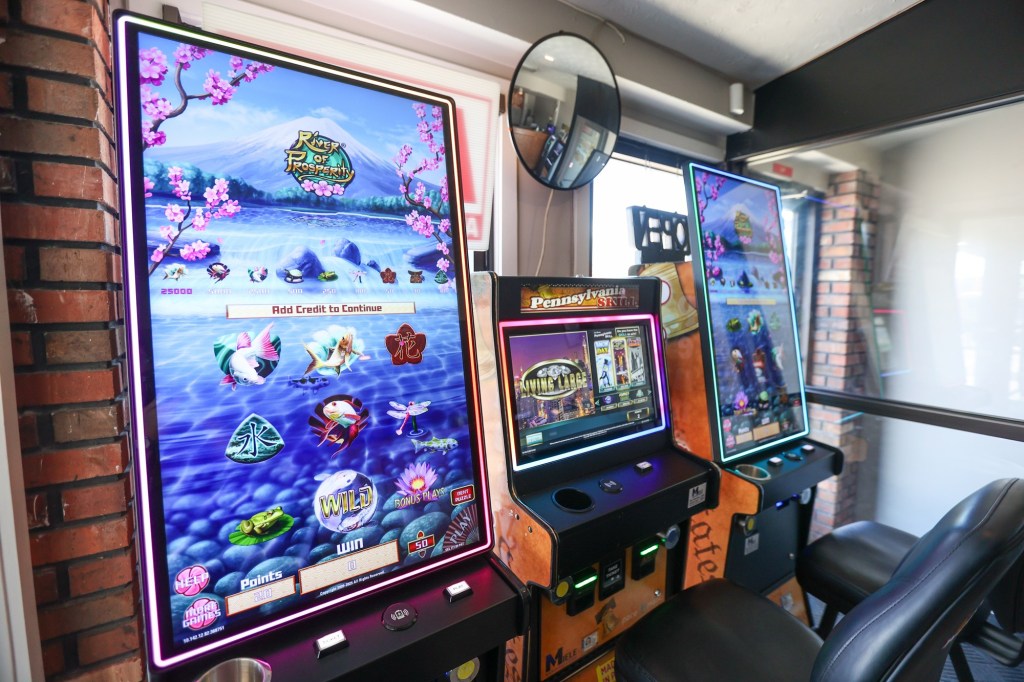
At the Waldorf Park German American Federation in Scranton, several skill games machines remain popular among members of the East Mountain social club where they serve as both entertaining amusements and modest sources of revenue.
More valuable as a social activity than a revenue generator, Waldorf Park Treasurer Joe Wechsler said the financial impact of losing the machines — a potential downstream effect of a recent state Supreme Court ruling — would be “minimal.” But the loss would be more significant in another sense.
“We have a lot of people who enjoy those skill games and that’s why they’re at our club, to enjoy those skill games,” Wechsler said. “We would love to keep them. … It’s an activity that people like.”
It’s also an activity that faces an uncertain future in Pennsylvania after the state’s high court ruled Monday that the skill game terminals ubiquitous in bars, convenience stores, clubs and similar establishments — sometimes even standalone parlors — are slot machines subject to the state’s Gaming Act and Crimes Code. The majority ruling reversed a pair of state Commonwealth Court decisions that were “the central pillars” undergirding a status quo where skill games “have been held to fall into a legal gray area outside of the reach of both,” Justice David Wecht wrote in the majority opinion.
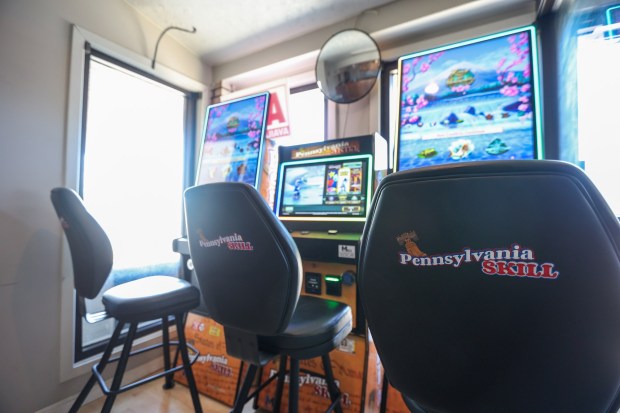 Pennsylvania Skill Games at Wilkes-Barre Gold on Tuesday, June 16, 2026. (JASON ARDAN / STAFF PHOTOGRAPHER)
“However, the Commonwealth Court’s interpretation of the governing statutes, upon which the legal status quo wholly depends, is deeply flawed,” the opinion notes.
Given the impact Monday’s ruling could have on business owners and other “good-faith participants” in the skill games industry, the Supreme Court stayed its own order for 120 days, providing a four-month period of “safe harbor” during which law enforcement cannot take action against skill game operators or owners. But the machines would be subject to seizure thereafter absent legislative action by the General Assembly in the intervening time.
Georgia-based Pace-O-Matic, a major vendor of skill game machines in Pennsylvania, said in a statement that the Supreme Court ruling “will have far-reaching consequences, with more than 10,000 Pennsylvania small businesses and fraternal clubs becoming the real victims.”
“They are now potentially left facing an impossible choice: cease operating these games and lose an important source of revenue, or endure a legislative solution that could bring excessive regulation and crippling taxation, which will force them to cease operating these games and lose an important source of revenue,” the statement continued.
A legislative solution to regulate and tax skill games has proven elusive, with lawmakers struggling to reach agreement on an appropriate tax rate, per reporting by Spotlight PA. Gov. Josh Shapiro’s budget proposal calls for a 52% tax on gross skill game terminal revenues. Spotlight’s recent reporting noted prior GOP proposals of 35% and 16%, respectively.
State Sen. Marty Flynn, D-22, Dunmore, acknowledged Tuesday that Monday’s Supreme Court ruling pushes the issue back to the Legislature.
“Senate Rs will probably have something, House Ds will have something and hopefully we meet in the middle,” he said, arguing lawmakers should strive for a solution that regulates and derives important revenue from skill games while ensuring fraternal clubs and other small operators “don’t get buried.”
At Wilkes-Barre Gold Precious Metals Exchange, home to three skill games machines, owner David Zongaro said the terminals attracted more regular players and generated more business revenue when he put them in a couple years ago, before the market became saturated.
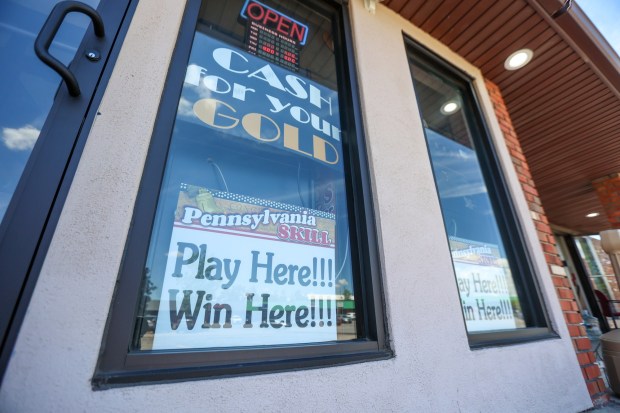 Pennsylvania Skill Games at Wilkes-Barre Gold on Tuesday, June 16, 2026. (JASON ARDAN / STAFF PHOTOGRAPHER)
“It’s kind of like Vegas now, it’s everywhere,” he said. “There was less of (the machines) when I first had them in, so we were getting regulars. … And then they just put them everywhere it seems like, and that thinned out the traffic.”
Potentially losing the skill games wouldn’t amount to a major financial loss for Zongaro’s business, he said, suggesting VFWs and similar organizations would likely be harder hit.
“It would definitely hurt them, but this is just like having an arcade game or something,” Zongaro said. “It’s nothing considerable. I just like to add it because — you know I have a TV also, so some people watch TV while they’re waiting or some people play the games. … I like it here because it just adds to the entertainment and keeps them less bored.”
He expects state lawmakers to reach a solution that saves the machines, given their revenue-generating potential for Pennsylvania.
Wechsler, the Waldorf Park social club’s treasurer, said the club also experienced diminishing financial returns from skill games as they became more widespread, including at skill games parlors he referred to as “mini-casinos.” The revenue they do generate is modest and supports things like benefits and parties at the club, but it doesn’t considerably defray the cost of operations, he said.
“Our competition is those mini-casinos,” Wechsler said. “That’s what’s taking away from our benefit.”
Still, given their popularity with certain club members, Wechsler said the Waldorf would like to keep them. A legislative solution that regulates skill games but distinguishes between VFWs, social clubs and similar venues and larger, casino-esque operations could benefit clubs like his, he said, noting there are administrative costs and licensing requirements to operating the skill games.
“And then depending upon what the tax rate is — I think I’m hearing some numbers of 32, 50 (percent) — crazy numbers like that, if the numbers are that high we’d really have to take a look and see if it’s beneficial for us to maintain those machines,” Wechsler said. “We’d like to keep them. We really would like to keep them. We’ve had them since they debuted. But we’d have to take a look at what the tax rate is going to be … and what restrictions they’re going to put on those other (mini) casinos.”
Efforts to reach larger skill games operators were unsuccessful Tuesday.