
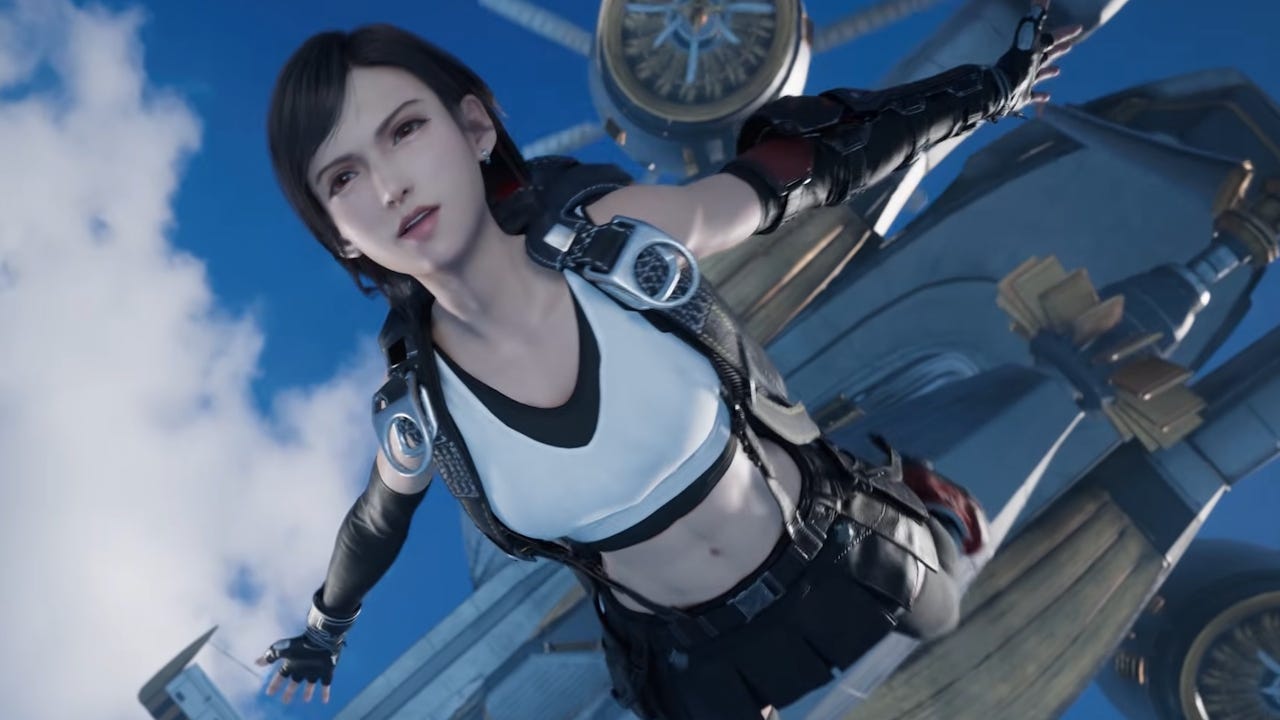
In the opening minutes of Final Fantasy 7 Revelation’s reveal trailer, developer Square Enix reintroduces us to the Highwind. Fans of the original PlayStation game will remember its multi-propeller majesty with fondness; this was the vehicle that unlocked complete go-anywhere freedom across Final Fantasy 7’s world map. Unrestricted by rivers, oceans, or mountain ranges, you could soar at high speed around the globe. And, provided there was a safe space to land, you could explore any location that caught your eye.
That landing caveat doesn’t apply to Revelation’s Highwind. It doesn’t need to touch the ground, because it’s you who will be doing the descent this time. Almost certainly inspired by the original’s late-game airborne insertion into Midgar, you can now dive right off the Highwind’s lower deck and parachute down to the ground. Akin to Zelda: Tears of the Kingdom (and, if we’re honest, Fortnite) Square promises that the dive is completely seamless, taking you from the clouds down to the fully detailed terrain without skipping a beat.
This has no doubt been a challenge to design, not least because it means the developers will have had to completely re-think how we acquire Knights of Round (it can’t be as easy as just dropping onto Round Island, afterall – this is the most powerful summon in the game!) But I’m pleased director Naoki Hamaguchi and his team have made it work, because a fully controllable airship that can navigate through a densely detailed, full-scale open world is something I’ve been waiting for Final Fantasy to do since 2001.
As any long-term fan of the series will know, the structure of Final Fantasy has significantly changed over the past quarter-century. The first nine games, spanning from the pixel art of the NES through to the 3D landscapes of the PlayStation era, all featured an overworld; a big map you explore to discover new locations. These maps were not true-scale in size and were significantly less detailed than the towns and dungeons you accessed from them, but they nonetheless provided the stage for a sprawling, epic adventure. In many ways, these overworlds were one of the seeds from which today’s open world games grew.
Piloting the Highwind is one of Final Fantasy 7’s great joys.
 Piloting the Highwind is one of Final Fantasy 7’s great joys.
When the PlayStation 2 arrived at the dawn of the millennium, it brought with it a whole new generation of graphical fidelity. No longer was Final Fantasy restricted to pre-rendered backgrounds – the entire game could be made up of deeply detailed 3D environments with gorgeous textures. Progress comes at a cost, though. Crafting an overworld that could match the visual advancements of the main locations would have been a development nightmare; hugely expensive, technically demanding, and incredibly punishing when it came to disc space. And so when Final Fantasy 10 arrived in 2001, it did so without the series’ traditional overworld. The entire game took place within its level environments – a linear chain of towns, beaches, temples, and the back of a giant evil whale.
Nowhere is this shift more evident than at the helm of the Fahrenheit, Final Fantasy 10’s airship. In prior games, unlocking the airship was a moment of unparalleled excitement. Each entry’s cloud-surfer grants you complete freedom, permitting you to thunder across the overworld at a pace you could only dream of in the game’s opening act. But in Final Fantasy 10, the Fahrenheit is nothing more than a fancy fast travel menu. A list of destinations dressed for the Met Gala. A diamond-encrusted spreadsheet of co-ordinates.
Final Fantasy 10’s airship was basically Google Maps for Spira.
I cannot begin to explain how deflated 12 year-old me was when I finally took command of the Fahrenheit. I had fixated over the PS1 era’s airships, particularly the militarised space Ferrari that was Final Fantasy 8’s Ragnarok. For me, getting the airship had become the definitive Final Fantasy moment, a gaming experience unlike any other. And in Final Fantasy 10 – the first game I had obsessively followed the development of across multiple issues of Official PlayStation Magazine, dreaming of all the things a next-gen FF could be – this moment had been reduced to a UI element that could teleport me between save points. It may be a looker, with its gilded halo and pearlescant hue, but the Fahrenheit has been a constant reminder of how great progress demands great sacrifice.
The mainline series has never revisited the idea of the overworld, and thus the airship dream faded. While locations became more expansive, such as Final Fantasy 12’s sprawling deserts and 13’s late-game Gran Pulse region, these games followed FF10’s lead. Level environments fed directly into each other, forgoing the need for a world map. The games became more linear, much to Final Fantasy 13’s detriment in particular.
The Type-0 Flightpath
While Final Fantasy 9 marked the final appearance of a player-controlled airship in the mainline series, the idea was revisited a decade later for Final Fantasy Type-0. Originally released for the Japanese market on PSP in 2011 and later launched worldwide as a PS4 HD remaster, Type-0 allows you to unlock and command the Setzer. Similar to the airships of old, the Setzer can be freely flown across an overworld, landing in safe spots from where you can then proceed to enter the level-based environments. Where the Setzer differs from the likes of the Highwind, however, is its armaments: it has cannons that can be fired at airborne enemies, enabling minigame-like combat encounters amidst the clouds. The idea has never been revisited, and so remains a series oddity rather than the genesis point for a whole new breed of airship.
But as gaming technology advanced, the worlds of Final Fantasy did finally begin to resemble the overworlds of its past. The power of the PlayStation 4 unlocked Final Fantasy 15’s Eos, an open world of rolling verdant hills that seemingly stretched on without end. But protagonist Noctis navigated through it in a brand new way: via car, along pre-determined roads. If you wanted to trek off the beaten path, you’d need to hoof it on-foot or hop on a Chocobo (at least until a free update added an off-road version of the Regalia car, six months later.) Noctics’ wheels could be upgraded to fly, but this was a post-game bonus, rather than a transformative moment in the main story.
But even the flying Regalia Type-F was better than Final Fantasy 16’s bait-and-switch. Built for the PS5, the world of Valisthea may have technically been a series of interconnected zones rather than FF15’s more genuine attempt at an open world, but its scope was finally approaching the scale depicted by those old-fashioned overworlds – a series of kingdoms with fields, forests, deserts, towns, and hideaways. And when engineer Mid Telamon tasks you with aiding her rebuild an airship in the story’s final act, it really does seem that Final Fantasy is about to revisit its glory days of airborne freedom. Alas, the quest goes absolutely nowhere near that direction. If anything, your options in FF16 are more limited than those of its predecessor – all you have here are your own legs or those of a Chocobo.
Where we droppin’, team?
That could never be the case for Final Fantasy 7’s remake trilogy, though. The overworld is too important a part of the fabric of its campaign. And so while the linear, Midgar-set first act granted Square Enix some extra time to work it out, Hamaguchi and his team ultimately had to find a solution to the Highwind problem in the trilogy’s final chapter.
The groundwork was laid in the second game, 2024’s Rebirth, which pushed Final Fantasy the furthest it’s ever been into the modern day understanding of an open world game. While technically made up of hubs bridged by linear environments, each hub has the classic hallmarks of a post-Assassin’s Creed open world; towers that reveal the many icons dotted across the map, a multitude of different activity types, and a long list of side quests and bounties to complete in the pursuit of 100%-ing each area.
Revelation looks set to take the next step: turning that structure of hubs into a true open world. Quite how it will do this remains to be seen, as presumably it needs to unify the existing regions we explored through Rebirth – the likes of Junon, Corel, and Cosmo Canyon – with the many new areas its story will take us to, such as Wutai and the Mideel Archipelago. Any gaps between the existing hubs will need patching up, and then there’s the question of Midgar itself. Square needs to find a place for the Mako-powered city in all of this. But there’s no question that, when all brought together, it will create Final Fantasy’s “most expansive open world yet,” as the trailer proclaims.
And high above that world will be the Highwind – no doubt sailing through the skies to an updated version of Nobuo Uematsu’s immortal theme. And down below will be not an overworld, but a genuine open world. And for the first time in a quarter century, we’ll finally be able to fly a Final Fantasy airship wherever we want.
Compilation of Final Fantasy VII: The Complete Playlist
In anticipation of Final Fantasy VII: Rebirth, here’s every game about Cloud, Sephiroth, and the Planet Gaia.
See All
Matt Purslow is IGN’s Executive Editor of Features.