
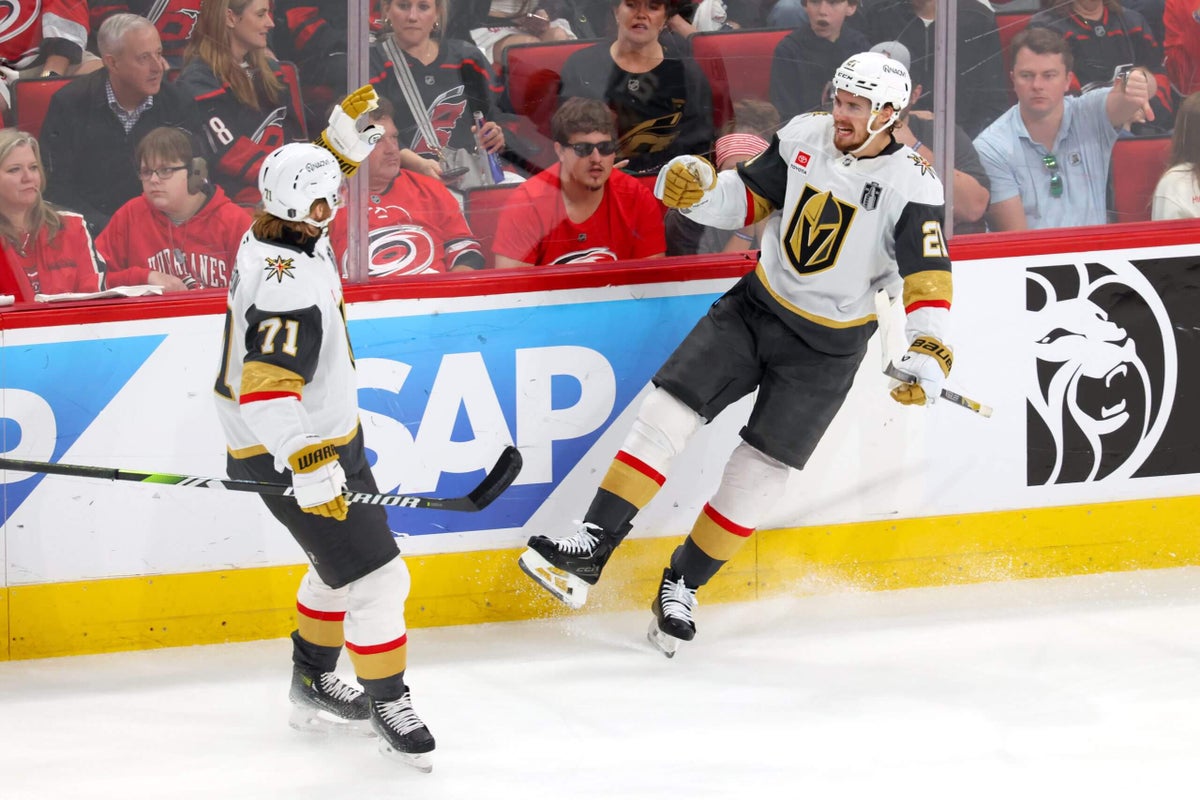
LAS VEGAS — Many entered this Stanley Cup Final with a bit of reservation. It pitted two small, non-traditional hockey markets against each other, without a single major trophy finalist between the teams.
Through two games, the Vegas Golden Knights and Carolina Hurricanes are essentially Russell Crowe, standing defiantly in the middle of the Roman Colosseum shouting, “Are you not entertained?”
We couldn’t have asked for a more thrilling start to the series. First, Vegas became the first team in history to win Game 1 on the road after facing a multi-goal deficit in the Cup Final. Then, Carolina became the first team in 82 years to win a Cup Final game after trailing by multiple goals in the final 10 minutes of regulation.
It has been a wild ride for the Golden Knights, with plenty of ups and downs. Today, we’ll look at what has gone right for Vegas and what has gone wrong.
The goodTop defensive pair
Shea Theodore and Brayden McNabb have been at their best in this series. At least, they were until McNabb exited Game 2 after taking a slap shot to the face in the first period. It was a scary play, and coach John Tortorella has yet to provide an update beyond the fact that McNabb traveled home with the club on Friday.
As gruesome as the injury looked, it wouldn’t be surprising in the least to see McNabb in the lineup for Game 3 with some sort of face shield. If he can’t go, it will be a massive blow to the Golden Knights because he and Theodore have been superb.
In the 20 minutes that the two have played together at even strength, the Golden Knights have a decisive edge in shots (10-3), scoring chances (11-5), expected goals (1.29-0.56) and, most importantly, goals (4-1). On their own, those numbers are impressive. When you consider how lopsided the shots have been in the other direction when those two aren’t on the ice, they’re miraculous.
Theodore and McNabb factored into four of Vegas’ five goals in Game 1, and were off to a great start in Game 2 prior to McNabb’s injury. The combination of Theodore’s smooth skating and McNabb’s stout defending has made them one of the most consistent pairs in the NHL for nearly a decade, and they’ve been that early in this series.
In-zone defending
For several seasons, the Golden Knights have played a tight zone defense that is content allowing the opposition to possess the puck around the edges of the zone in order to protect the slot, and it has worked well through two games of this series.
The Hurricanes have dominated possession, but Vegas has held them out of the dangerous areas for the most part at even strength. The raw shot attempt numbers are staggering, 119-69 in favor of Carolina. They suggest the Hurricanes are caving Vegas’ defense in, but a look at the underlying metrics shows that’s far from the case.
Despite that massive advantage in attempts, Carolina has only one more high-danger chance at five-on-five (18-17). The expected goals are relatively close, 4.47-4.16 in Carolina’s favor, and the Golden Knights have actually outscored the Hurricanes 7-6 at even strength. This shot heat map by Natural Stat Trick is a good visual representation of why. Carolina has had plenty of shots, but they’re not concentrated in front of the net nearly to the extent that Vegas’ are.
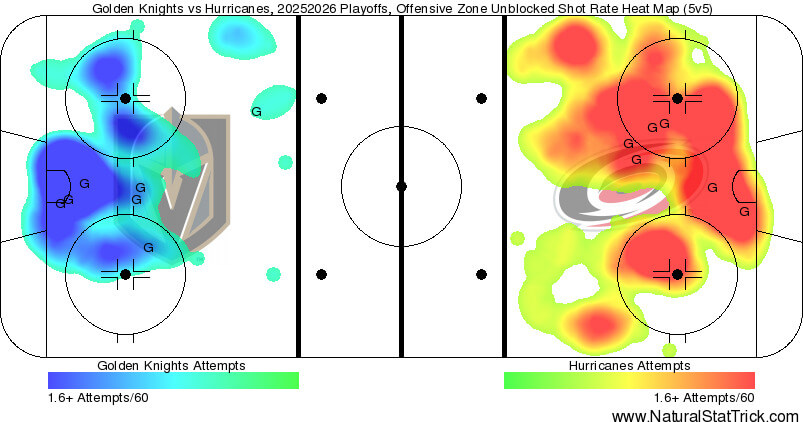
The Hurricanes may be spending a lot of the game in Vegas’ end, which is nothing new for them, but the Golden Knights have defended well and held the chances to the outside. If they continue that moving forward, they have to like their chances.
Karlsson line
Vegas’ best line through two games has undoubtedly been the second line of William Karlsson, Mitch Marner and Brett Howden. They’ve matched up mostly with Carolina’s second line of Logan Stankoven, Taylor Hall and Jackson Blake, and so far they’re winning it.
Howden leads all skaters in the series with three goals and four points. He scored two goals on Thursday with sensational individual efforts to fight through contact and beat Carolina netminder Frederik Andersen. Marner has yet to score, but has three primary assists — all three of which were beauties. Karlsson scored in Game 1 and continues to be exceptional defensively.
The trio blanked Carolina’s most productive line in Game 1, holding them to a single shot on goal in nine minutes of shared ice time. In Game 2, Stankoven broke through with a massive goal that sparked the Hurricanes’ comeback, but it’s hard to fault any of the forwards on that play. Karlsson won the defensive zone draw cleanly back to Andersson, who was stripped behind the net by Stankoven.
It will be interesting to see if Tortorella seeks that matchup out now that he has last change at home for Games 3 and 4.
The badTerritorial battle
As mentioned earlier, the Hurricanes have won the territorial battle by a wide margin. That’s not particularly surprising, considering it’s what they’ve done for years and have done against every opponent in these playoffs. However, the Golden Knights do need to close the gap, if only slightly, moving forward.
Carolina’s 2-1-2 forecheck has been more effective than Vegas would like through the first two games, which has led to extended offensive zone time for the Hurricanes. At even strength, only two Golden Knights players (Theodore and McNabb) have been on the ice for more shot attempts for than against.
While Vegas has limited the quality of those shot attempts, this is hockey and eventually pucks will find their way into the net if a team takes enough of them. The players are saying all of the right things, preaching a simpler, more direct style of hockey coming out of their own end. That will allow them to spend a little more time forechecking themselves, but executing it won’t be easy against a Hurricanes defense that breaks pucks out as efficiently as any.
Bottom defensive pair
Through the first three rounds of the playoffs, the bottom defensive pair had been a major matchup advantage for the Golden Knights. They’ve cycled through four different defenders: Dylan Coghlan, Jeremy Lauzon, Ben Hutton and Kaedan Korczak, but all outplayed their counterparts.
Through two games of this series, the pairing of Lauzon and Coghlan has been an issue. It’s Lauzon’s first action since he was knocked out of the first round with an upper-body injury, and he hasn’t looked up to speed. In Thursday’s Game 2, he was on the ice for all four of Carolina’s goals.
When you break them all down individually, Lauzon isn’t fully to blame. On Stankoven’s opening goal in the third period, it was Lauzon who stick-checked him as he attempted the wraparound, but the puck unfortunately ramped off Lauzon’s stick and into the Vegas net. He was the victim of an incredible play by Carolina’s William Carrier on the second goal, and was a penalty killer on the final two.
Still, this is a concern for the Golden Knights. If McNabb isn’t able to play, it becomes an even bigger issue because one of these two will play an elevated role with harder matchups.
Top line
Vegas’ top forward line of Jack Eichel, Pavel Dorofeyev and Ivan Barbashev hasn’t been terrible through two games. They’ve generated the most shots, chances and expected goals of any line on the team, and they’ve done it without the majority of their shifts starting in the offensive zone.
That being said, the Golden Knights need a lot more from them if they’re going to win this series. Eichel is a game-breaking player, arguably the most talented on the ice, but has only a single assist and three shots on goal thus far.
Carolina coach Rod Brind’Amour targeted Eichel’s line in the two home games in which he controlled the matchups. The line saw a heavy dose of Carolina’s shutdown trio of Jordan Staal, Nikolaj Ehlers and Jordan Martinook, combined with the top defensive pair of Jaccob Slavin and Jalen Chatfield. It has worked, as Eichel has been neutralized — as much as you can with a player of his caliber — and Dorofeyev has had almost no impact.
Tortorella hasn’t put a heavy emphasis on line matching in these playoffs, but you have to imagine he will do what he can to get Eichel’s line out there against different opposition at home.
All on-ice metrics via Natural Stat Trick