
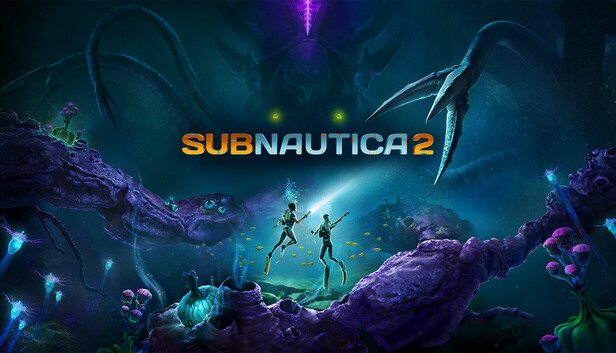
After over five years of rocky development, the long-awaited sequel to the legendary game “Subnautica” by Unknown Worlds, “Subnautica 2,” was released to major success, instantly reaching an all-time high of 467,582 concurrent players on its early access release. “Subnautica 2” is a survival exploration game, where your spaceship has crash-landed deep into the ocean of an alien planet, leaving you, the player, as the sole survivor by the time you reach the surface of the ocean. To survive, the player explores several jaw-dropping environments and collects resources to create tools, food and settlements. They also use advanced AI and scattered documents to solve the mystery of a mysterious plague that took down the rest of the crew and threatens the planet as a whole.
“Subnautica 2” preserved the aspects of the original that made it enjoyable, including exploration and survival on an aquatic alien planet, while adding new mechanics like the ability to scare predators, along with an entirely new storyline. The largest change from past “Subnautica” games is the ability to play co-op multiplayer, which allows players to team up with friends while also offering a solo option. The addition of co-op fits surprisingly well with the theme of aquatic building and exploration, adding a social element to the game. This elevates the experience immensely, allowing players to explore, build and progress together. As this game is still in the early release stage, more features are expected to come after the full release is set.
The developers also brought significant changes to the established mechanics of the game, heavily improving the visual details, as “Subnautica 2” shifts from the Unity Engine to Unreal Engine 5, making use of newer ray-tracing technologies and creating more detailed 3D textures. This was previously unrealistic due to PC demands. The environments in the game are well-built, with each biome having its own defining features and distinct scenery. Despite this, the environment in the game does not surpass that of the original “Subnautica,” lacking the verticality and grand scale of the original biomes, and feels lackluster even considering the game is in early release. Still, the settlement element has improved in “Subnautica 2,” foregoing the modular base-building of “Subnautica 1” for linear construction that allows more freedom to create and fine-tune it to players’ liking. This is an improvement over the first game and offers convenient additions, such as a power dial that indicates how much power a building needs, streamlining the building experience.
Being mainly an exploration game, “Subnautica 2” also excels at world-building through its environmental storytelling. Much of the story is not given to the player voluntarily; it requires them to scan or find information about the world around them, encouraging exploration and making it enjoyable to collect notes and information through PDA (Personal Digital Assistant) entries, the game’s primary means of navigation. This makes exploration feel meaningful because scanning new information for progress doesn’t just give you background information; it also opens up the door to future progression throughout the game.
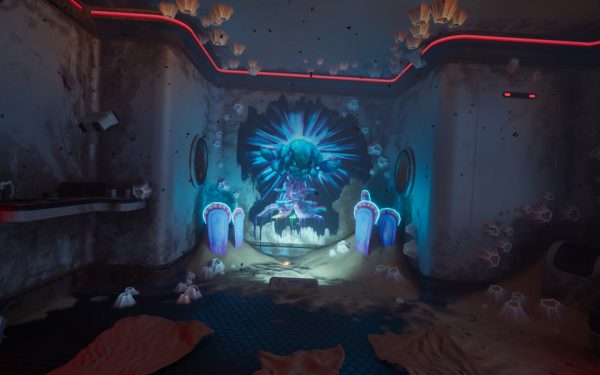 Graffiti of “the tree” | Photo courtesy of Unknown Worlds Entertainment
A controversial change in “Subnautica 2” includes the removal of killing fish, instead relying on methods of distraction and dispersion to get around. But the implementation feels very clunky and unresponsive, making the experience non-immersive. In many scenarios, the player can feel helpless due to the required use of distractions, such as burning flares, to survive violent encounters. The removal of immersive gameplay, which can feel lacking due to the limited number of counters for threats in the game, results in haphazard movement while wandering endlessly to fetch a resource or go on long hunts for certain items. This means that if the player isn’t interested in the environments, aquatic life and lore, the game could get boring quickly without action.
The early released version of “Subnautica 2” also has a healthy amount of content, with over 15 hours of pure in-game story, excluding exploration, basebuilding and collecting story documents. This means a completionist searching to explore the game inside and out could potentially see up to 40 hours of gameplay. The story at the moment, which is unfinished, is also compelling, telling of an alien virus taking over people’s minds. Though at times throughout the game, it feels as if it has no direction, simply waiting until another objective is given. It is important to note that, as an early access game, “Subnautica 2” is unfinished and lacks an ending. This also means that the player can expect more content on the way.
For players wondering about the game’s performance on different platforms and computers, the game will require a decent PC to run, a minimum of a GTX 1060-level graphics card, and an Intel Core i5-8400-level processor to run well. At a minimum, the game is still capable of running smoothly at a high resolution with low graphics.
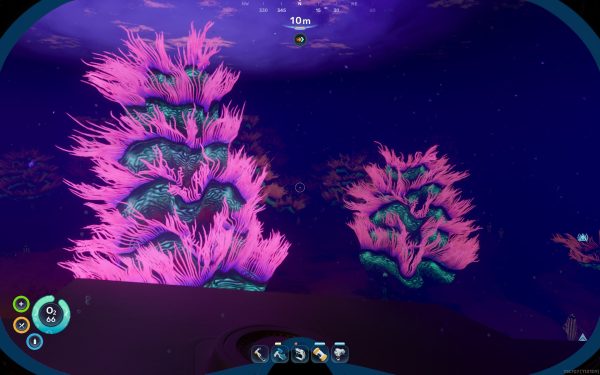 Example of the game running at low graphics on a GTX 1080 Photo Courtesy of Unknown Worlds Entertainment
While the game brought incredible improvements in graphical fidelity and gameplay, especially with the addition of multiplayer, “Subnautica 2” feels lacking in the design of the biomes and gameplay, missing the awe-inspiring landscapes and terrifying looming beasts of the first game. While it can be expected that more will be added, at the moment, the game feels quite lukewarm, and “Subnautica 2” cannot be given anything more than a suboptimal ⅗.
RATING: 3/5