
RALEIGH, N.C. — Disaster loomed for the Carolina Hurricanes on Saturday night. Already down 1-0 in the Eastern Conference final to the Montreal Canadiens, Carolina blew a third-period lead in a game they largely controlled, putting themselves a bad bounce or a blown assignment away from leaving for the Bell Centre down two games to none.
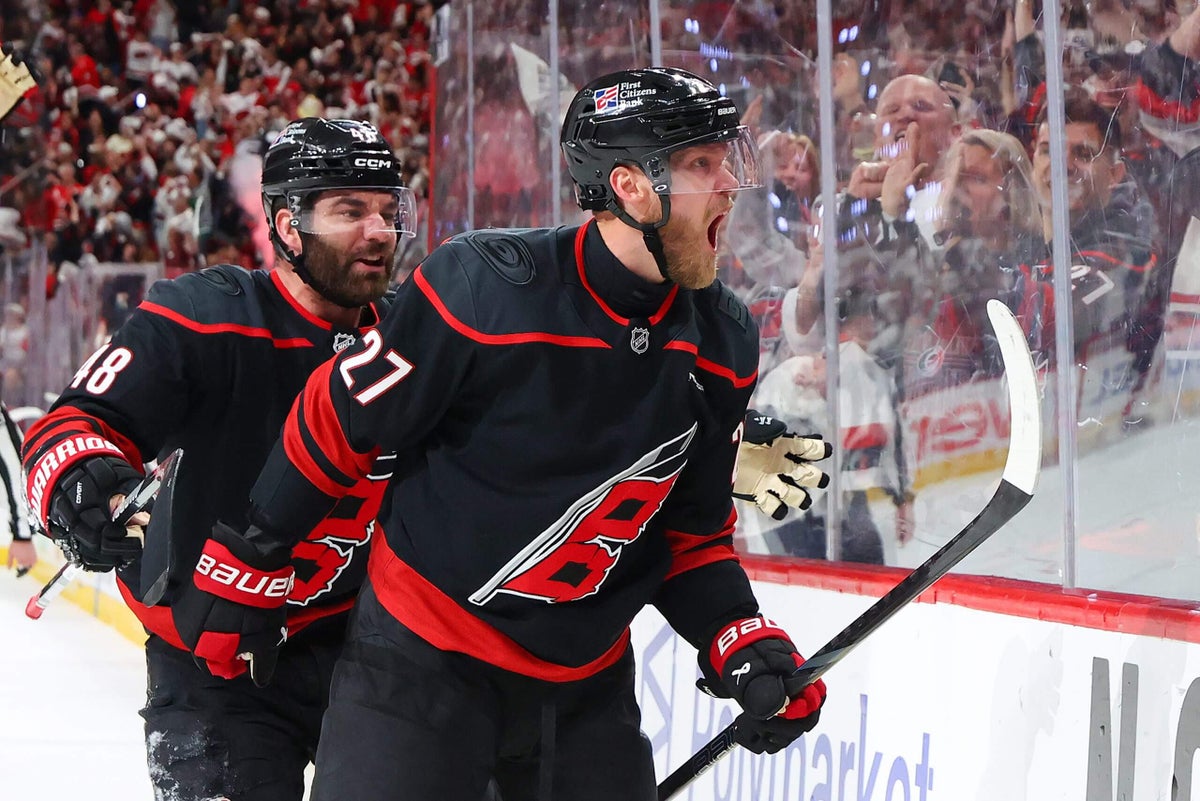
Enter Nikolaj Ehlers, who scored in overtime to lift Carolina to a 3-2 win over Montreal and tie the series 1-1. Game 3 is in Montreal on Monday night.
Ehlers scored 3:29 into overtime off the rush off a pass from Mark Jankowski, a fourth-liner for Carolina who was headed to the bench for a line change and scooped a puck that defenseman Jalen Chatfield had banked off the boards just beyond Carolina’s blue line.
“Easiest assist of my life on that one,” Jankowski said. “Just poke it to (Ehlers) in the neutral zone and let him do the rest.”
Canadiens forward Josh Anderson tied the game 2-2 with 7:09 remaining in the third period, gathering the puck in a net-front scramble and beating Carolina goalie Frederik Andersen. The shot was just Montreal’s ninth of the game. Andersen finished with 10 saves.
“For the entire game there’s not much room out there to create,” Anderson said. “We expected that they were going to bring their best. That’s the way they play; there’s not a lot of space out there. Obviously at the end, we had a tough time getting it past their (defense), a couple of breakdowns and a rush goes the other way, and it only takes one opportunity.”
The Hurricanes, before losing the lead down the stretch, were fueled by highlight-reel goals from Eric Robinson and Ehlers’ first of the night and the sort of puck-possession dominance they show at their best — and, at times, their worst. Carolina finished the game with a 26-12 edge in shots.
Robinson opened the scoring 2:33 into the game on a full-extension redirection of a shot by linemate William Carrier that beat Montreal goaltender Jakub Dobeš. Montreal tied it with 8:49 remaining in the first on a low-slot goal by Anderson that came after two failed clearing attempts by Carolina. The goal came on Montreal’s first shot of the game.
Halfway through the second period, Carolina mounted a push that culminated with Ehlers’ goal, a remarkable, twisting shot from the slot that beat Dobeš, who finished with 23 saves on 26 shots.
Andersen’s evening is the most obvious pivot point from Game 1, when his teammates’ mistakes and Montreal’s skill led to a five-breakaway first period that put the Hurricanes in a hole they couldn’t escape.
“I expect us to play well every night. And when we don’t, it’s a bit of a shock to the system, to be quite honest, because it doesn’t look like it did (in Game 1) very often,” Hurricanes coach Rod Brind’Amour said after Saturday’s pregame skate. “So we give ourselves a chance. If everyone plays well, we give ourselves a chance. That’s what we need tonight.”
That, largely, was what they got.
Ehlers breaks through for Canes
Carolina spent much of the middle frame heavily controlling play — outshooting Montreal 8-3 — but without many big chances, as the deadlock stretched deep into the period. With the Canadiens again forcing a lot of shots wide or into shinpads, it took a brilliant individual effort from Ehlers to make it 2-1 with three minutes left in the second.
Ehlers cut through the slot with his back to the net, then spun past Cole Caufield and found a hole in Dobeš, slipping in his third goal of the playoffs with a deceptive release. Ehlers, the Hurricanes’ big offseason free-agent signing, was their second-leading scorer during the regular season, but did a lot of his damage on the power play.
In addition to the big goals, however, he and his line brought some stout defensive work in Game 2. Brind’Amour altered his game plan so he could hard match that trio — centered by captain Jordan Staal — against Montreal’s top unit after Nick Suzuki, Caufield and Juraj Slafkovský were so dangerous in the Habs’ 6-2 series-opening win. That No. 1 line was far quieter on Saturday, with only one scoring chance and four shots on goal in regulation. — James Mirtle, senior NHL writer
Canadiens’ third period in Game 1 did not carry over
While the Hurricanes were focused on how they played in the second period in Game 1, dominating with an 11-3 edge in shots on goal, the Canadiens were hoping their stifling effort protecting a lead in the third period of that game would carry over to Game 2.
“I think we played with the puck more in the third,” Canadiens defenseman Lane Hutson said the morning of Game 2. “We had the lead, and we didn’t try to change our game too much, but we played with the puck, played on our terms.”
Through 40 minutes of Game 2, the Canadiens did not play on their terms. They had five shots on goal at the second intermission, passing up shooting opportunities and more generally not playing a whole lot with the puck. Even a Suzuki breakaway at the second-period buzzer did not result in a shot on goal, with Andrei Svechnikov getting his stick in there to disrupt the opportunity.
The Canadiens did a good job at limiting the Hurricanes’ opportunities, keeping a high-volume-shooting team at 15 shots on goal through 40 minutes, but they did not do nearly enough to create possession time and force the Hurricanes to defend until they had to chase the game in the third.
“It’s going to be hard. I thought they had really good sticks, our execution was not as good, but it wasn’t terrible,” Canadiens coach Martin St. Louis said. “Overall I thought it was a battle out there, I thought we competed. It’s a close game, it’s a fine line between winning and losing.” — Arpon Basu, senior Canadiens writer
Carolina’s fourth line steps up
Consistently rolling four groups of forwards is a major part of Carolina’s identity, and the trio of Robinson, Jankowski and William Carrier came up big on Saturday. Robinson scored for his second consecutive game after narrowly missing on several prime chances earlier in the postseason. Jankowski set up Ehlers’ game-winner and Carrier added an assist on Robinson’s goal alongside several other noticeable moments.
That group provided nearly six quality minutes at five-on-five in which Carolina outscored the Canadiens 1-0, out-attempted them 10-5 and controlled nearly 60 percent of the expected goal share. They also took shifts in overtime — a rarity for plenty of teams, but not the Hurricanes, which speaks to the way the line is controlling zone time.
“When you get called upon in any situation, you want to make sure you’re taking advantage,” Robinson said. “Not necessarily always offensively, but being responsible, playing the right way, playing hard.” — Sean Gentille, senior NHL writer
A costly turnover
We covered the mental and physical first-period mistakes that turned Game 1 into a mess for Carolina. There were far fewer in Game 2, and that was reflected in the all-situations shot count (7-2) and expected goal share (1-0.3) after the first period.
Still, the score was tied 1-1, largely due to a failed clear by Hurricanes winger Taylor Hall that led to a goal by the Canadiens on their first shot. With 8:55 remaining in the period, Hall, in one motion, gathered a loose puck along the near boards in the defensive zone and tried to send it toward center ice, rather than rim it along the glass. Canadiens defenseman Kaiden Guhle appeared to anticipate the decision, intercepted the pass and started a sequence that ended with an Anderson goal from the low slot.
If the puck squeaked through, Hall may have connected with Jackson Blake for a breakaway attempt, so some credit to Guhle is due. A bit of blame probably goes to Hurricanes defenseman Alexander Nikishin, too, who was late to the crease. Still, the bulk of the blame falls on Hall, and the (temporary) result was a tie score in a game that Carolina had largely dominated. — Gentille
Danault continues to deliver at both ends
The Canadiens did not acquire Phillip Danault for his offense, and that showed in the regular season when he put up 12 points in 45 games for Montreal following the trade before the Holiday freeze with the Los Angeles Kings.
After scoring a goal and setting up another in Game 1 on Thursday, Danault set up Montreal’s first goal on Saturday with a pass to Anderson in front. That gave Danault nine points in 16 playoff games, or just three shy of what he produced in 45 regular-season games. On top of that, he helped generate the zone entry that led directly to Anderson’s tying goal in the third period.
But again, that’s not why Danault is here. He was acquired to provide leadership, and Anderson said between Games 1 and 2 that he has become much more vocal in the dressing room during the playoffs. His faceoff prowess helps the Canadiens gain possession; Danault entered Game 2 winning 57.5 percent of his draws this postseason and finished Game 2 at 50 percent.
The Danault trade is the gift that keeps on giving for the Canadiens. — Basu