
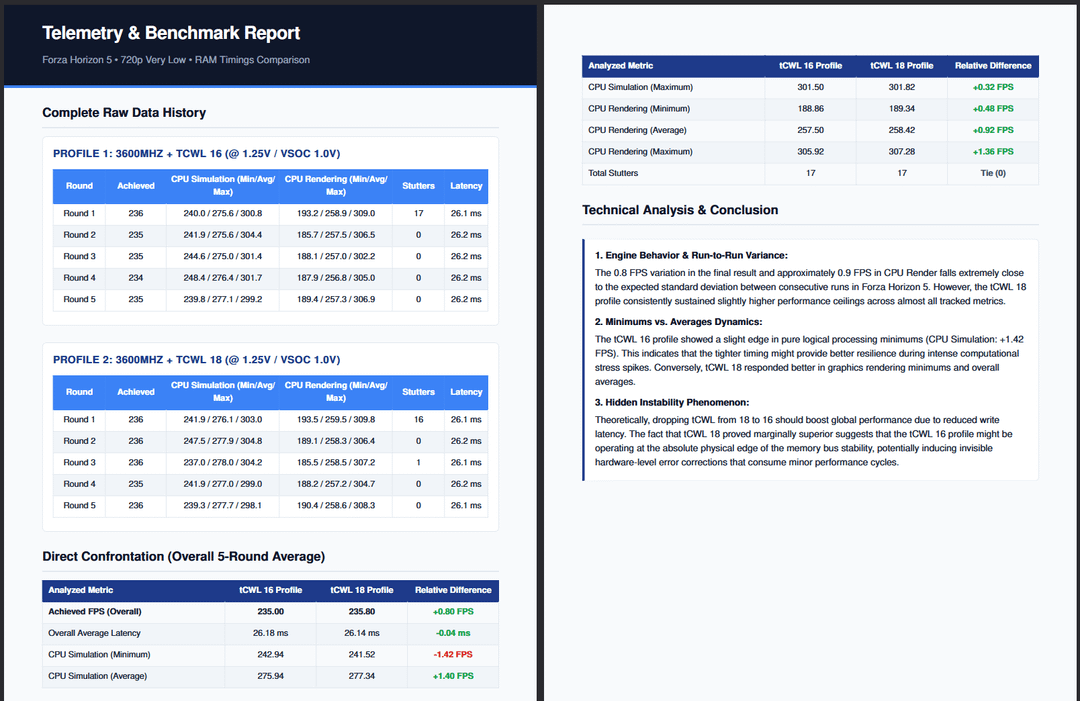
Edit: The images looked blurry here, so I uploaded them to Imgur: Link here.
This post isn't exactly an update to my last two posts, as the focus here is to bring up a discussion about this specific timing, but to check out my last post, click here.
Kit: 2x16GB Kingston Fury Beast RGB (3200MT/s CL16 1.35v – Samsung C-die).
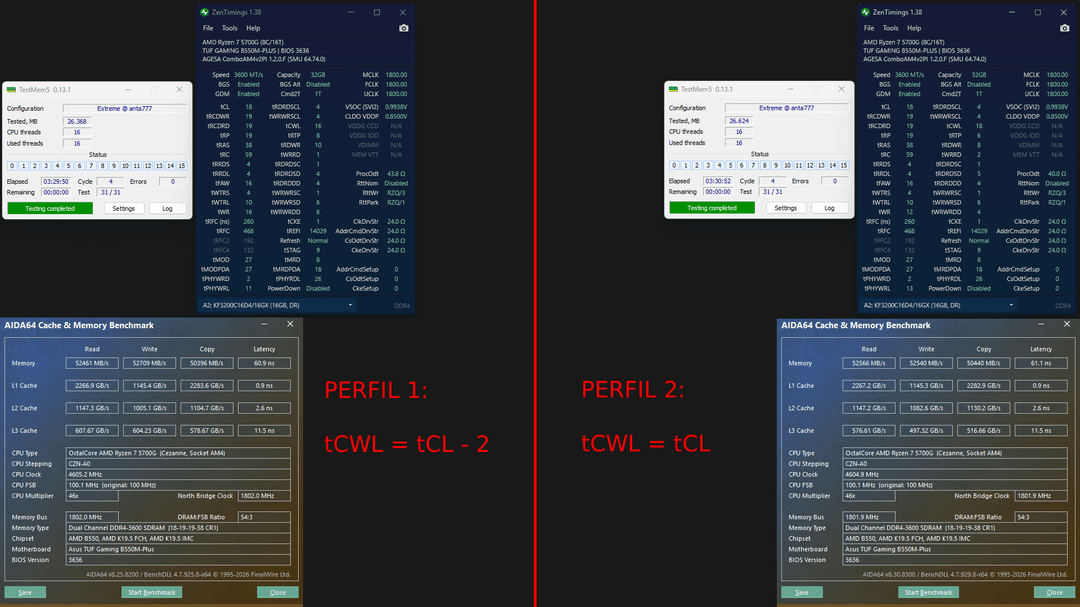
I couldn't find any posts making this direct comparison around here, so I decided to share my results. My goal with this test wasn't to squeeze out more performance, but to test if I would get more stability and performance consistency by leaving tCWL 1:1 with tCL. Despite being 100% stable across 3 TM5 tests (over 3 hours on each: Extreme, Absolut, and 1usmus) + 1 hour of OCCT (which I didn't add in my last post), I was only 99% satisfied with the result because I had more raw performance, but with more micro stutters than the default XMP profile in PUBG, for example.
On the profile with tCWL 16 (as you can compare in the first image with Zentimings), when trying to set tCWL 18, it didn't boot. I realized I would have to tighten the timings all over again starting from tCWL 18, and some timings ended up even tighter than with tCWL 16, which helped compensate for the performance loss. On top of that, I managed to keep procODT at 40 Ohms and 1.25v without running into cold boot issues.
O Resultado: I felt much better stability with tCWL 18 and even had fewer micro stutters in PUBG. I don't quite know how to explain it; looking at the nearly identical numbers it almost feels like a placebo effect, but in general PC usage I can feel a better consistency in performance, as if the data is flowing better internally. You really have to test the PC with both profiles for a while to notice it. I tried adding a bit more RAM voltage (to 1.26v and 1.27v) and VSOC voltage (to 1.1v) using the tCWL 16 profile, but the behavior stayed practically the same.
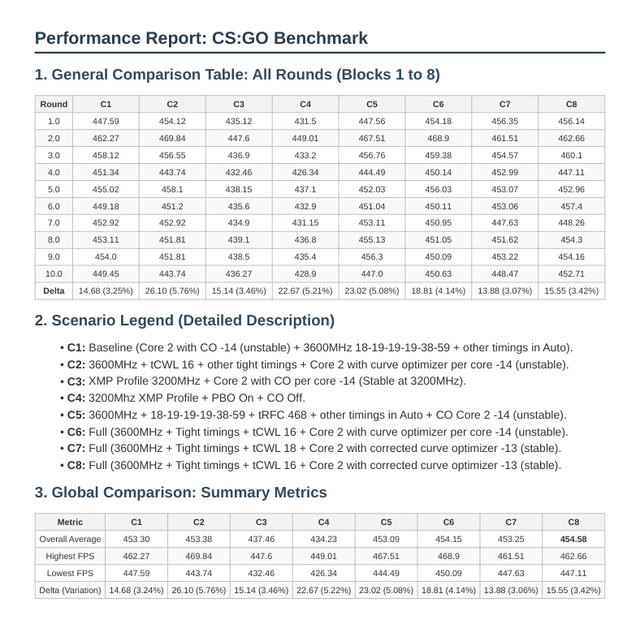
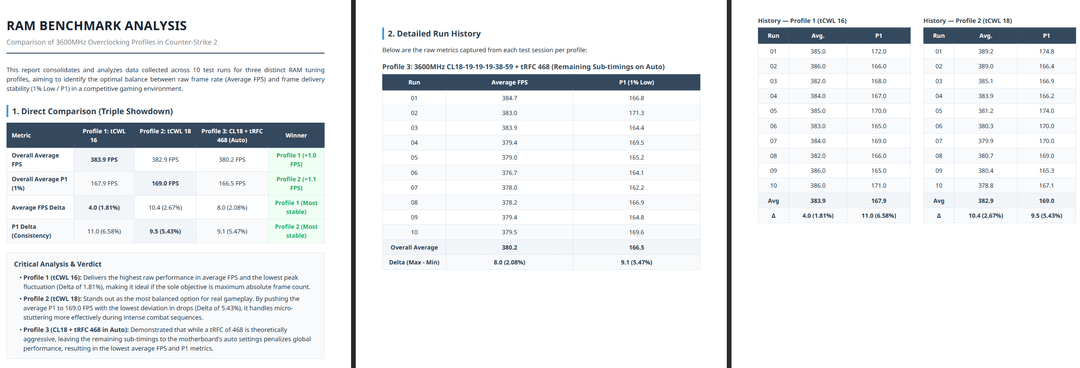
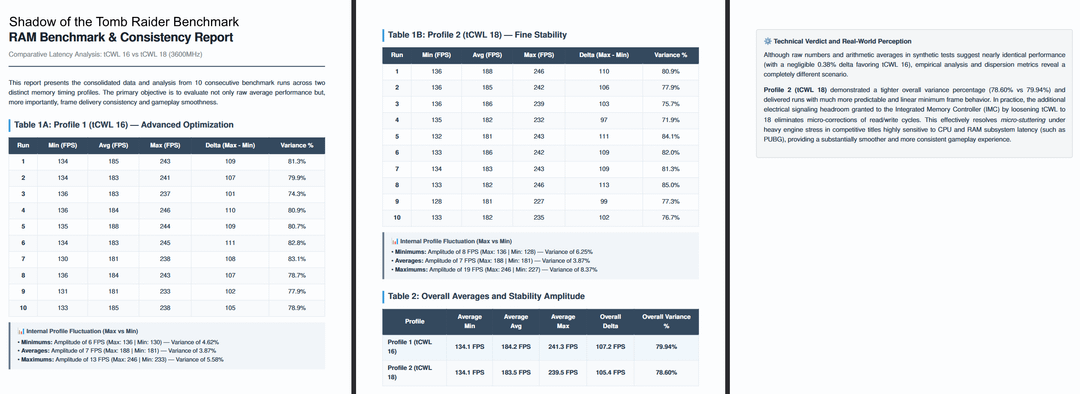
NOTE: All games were tested at 800×600 on the lowest settings (to eliminate GPU bottleneck), except for Forza Horizon 5, where the minimum allowed resolution is 1280×720.
NOTE 2: The CS:GO test was done several days before the others. In the meantime, I ended up discovering that my Core 2 in the Curve Optimizer (per-core) was unstable at 3600MHz. I ran two more tests after fixing it and added them to the table. You can focus on the C3, C7, and C8 results for comparison (topic 2 has the legend for each table). In the other tests, Core 2 was already properly stabilized.
NOTE 3: All tables were generated using Gemini. I only provided the raw numbers, so feel free to ignore its automated comments.
Conclusion: Even though the results in the raw numbers are practically the same, for anyone who hasn't tried it yet, I encourage you to set a tCWL = tCL profile and test it in practice, especially if you are currently running tCWL = tCL – 2 and suspecting that something is off with your performance consistency—like your 1% lows taking some weird dips or experiencing micro stutters, for example. See which profile works best for your setup; every PC will yield a different result, in others it might not make a difference. Every case is unique.
I hope this post helps someone.